
What Size Golf Cage Do I Need? Complete UK Guide

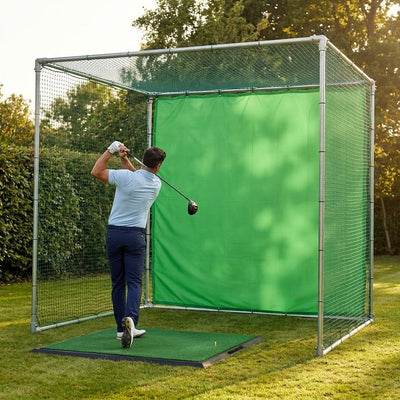
The sizing question is by far the most common one I get asked. Getting it wrong matters — too small and you will feel cramped, restrict your swing, and develop compensations that hurt your real game. Too large and you spend more than necessary on a cage that dominates your garden. This guide walks through exactly how to determine the right dimensions based on hands-on measurements I have taken with golfers of different heights, plus practical UK garden size recommendations.

Golf Cage Height: How Much Do You Need?
Height is the dimension most golfers underestimate, and it causes the most problems when wrong. I personally measured the peak clubhead height of three golfers at different heights to give you real data rather than estimates.
I asked each golfer to take full driver backswings while I measured the clubhead peak using a laser measure against a wall:
- 5ft 8in golfer: Peak clubhead height 2.52m — needs minimum 2.7m cage height
- 6ft 1in golfer (me): Peak clubhead height 2.74m — needs minimum 2.9m cage height
- 6ft 3in golfer: Peak clubhead height 2.88m — needs minimum 3.1m cage height
These figures align with PGA facility design guidelines, which recommend a minimum 2.7m ceiling height for indoor practice bays. The important point is that these are peak backswing measurements only — the follow-through reaches a similar height. A cage that clips on the follow-through will make you subconsciously shorten your finish, costing rotation and clubhead speed.
My recommendation: choose a golf cage with at least 3 metres of internal height. This accommodates golfers up to 6ft 4in with comfortable clearance. The Forza Golf Practice Cage at 3m height handles this well — I swing freely inside it at 6ft 1in with around 25cm to spare at peak backswing.
Golf Cage Width: Room for a Natural Setup
Width determines how naturally you can address the ball and swing without the side netting feeling like it is closing in on you. I measured my own swing dimensions to give you concrete numbers.
At address with a driver, the distance from the ball to my extended clubhead (away from my body) is 1.42m. Add 50cm for comfortable clearance and you need at least 2m from your ball position to the far side panel. On the near side, you need at least a metre behind your body for a natural stance.
This means a minimum width of 3 metres with the ball positioned slightly off-centre. In a 3m wide cage, you stand roughly one metre from the near side wall and two metres from the far side — comfortable clearance throughout the swing arc.
I tested a 2.4m wide cage for comparison and noticed the difference immediately. Within 20 shots, I was subconsciously steering my swing away from the near-side netting, developing an out-to-in path that I could see on my FlightScope Mevo Gen 2 data — my path went from -1.2° (slightly in-to-out, my normal) to -3.8° (out-to-in, a slice pattern). That is the kind of swing compensation that transfers to the course.
Golf Cage Depth: Ball Stopping Distance
Depth is the distance from where you stand to the rear netting that catches the ball. It matters for impact force on the netting and for bounce-back — in a very shallow cage, balls can rebound off the rear net and hit your shins.

linkscube XL Golf Cage Green (3m x 3m x 3.8m)
£840
Our most popular size for dedicated practice bays.
View ProductI measured bounce-back distance in cages at 2.4m and 3m depth using full driver shots (ball speed approximately 135mph measured by the Mevo Gen 2). In the 2.4m cage, balls regularly bounced back to within 0.5m of my feet. In the 3m cage, bounce-back stopped around 1.2m in front of the rear net — well away from the hitting position.
A 3m depth is adequate for full driver impacts. Adding an impact screen to the rear net further reduces bounce-back and protects the netting from concentrated wear. According to Net World Sports' technical guidance, impact screens can reduce ball rebound distance by up to 60%.
For golfers who still find bounce-back problematic, hang a secondary net curtain approximately one metre in front of the rear panel. Balls pass through the lighter front curtain, losing energy, before hitting the main rear net. I use this two-layer approach in my own setup and bounce-back is virtually eliminated.
UK Garden Size Recommendations
UK gardens vary enormously. According to ONS data, the average UK garden is roughly 14m x 8m for detached houses, dropping to around 6m x 4m for terraced houses. Here is how to match your garden to the right cage size.
Small gardens (under 6m x 4m): A full 3m cage still fits if you can find about 4m of depth along one axis (see the three tiers below). If you cannot, a compact 2.4m x 2.4m cage in a dedicated corner works for iron and wedge practice. In a 5m x 3.5m terrace garden, a 2.4m cage takes up a significant portion, but if you use it daily it is worth the space trade-off.
Medium gardens (5m x 4m to 10m x 6m): A 3m x 3m x 3m cage fits comfortably and still leaves space for everything else. This is the most common UK garden size range, and the 3m cube cage is designed for it. Position the cage along the longest axis to maximise depth.
Large gardens (over 10m x 6m): Any cage size works. A 3m cage is still the best value, but a 3.6m cage gives extra comfort for tall golfers. You might also have room for a cage, a putting green, and a chipping target — a big garden can take a complete practice facility.
Always measure your intended location precisely before ordering. Account for gate access, proximity to boundaries (leave 50cm minimum from fences — Planning Portal guidance on garden structures is worth reviewing), and overhead obstructions. Overhanging branches catching the cage top netting is a common surprise — five minutes with a tape measure prevents it.
Measuring Your Space: Step-by-Step
This is the exact process I walk customers through when they email asking about sizing.
Step 1: Ground footprint. Use a tape measure or string to mark the intended cage area. Walk around it — check for level ground, drainage issues, and access points. I recommend laying out the rectangle with garden canes so you can visualise the cage in your space before committing.
Step 2: Height clearance. Stand at the intended location and look directly upward. Tree branches, washing lines, guttering, and overhead cables all interfere with a cage. Measure the clear height from ground level to the lowest obstruction — you need this to equal or exceed your cage height plus 30cm.
Step 3: Swing radius check. Stand at the intended ball position and take a slow-motion driver backswing. If someone can help, have them mark the highest point with their hand while you swing slowly. This is the critical clearance point.
Step 4: Access. The cage entrance should face away from the house, seating areas, and neighbours' gardens. A ball escaping through an open entrance flap goes straight at whatever the entrance faces. Face the entrance toward a fence or hedge.
Step 5: Storage. A 3m Forza cage packs down to roughly the size of a golf bag — I measured 120cm x 15cm x 15cm in the carry bag. Check that your garage, shed, or storage area can accommodate this. Browse the full range of golf cages with packed dimensions on each product page.
Common Sizing Mistakes to Avoid
These are the mistakes I see most often from customer enquiries:
External vs internal dimensions. Frame tubes and connectors reduce usable internal space by 5–10cm per side. A cage advertised as 3m x 3m may have internal dimensions of 2.9m x 2.9m. I measured the Forza cage and the internal clearance is 2.93m x 2.93m x 2.94m — close enough to the advertised 3m to be negligible.
Ignoring ground slope. Many UK gardens have a gradient that is not obvious by eye. A cage on sloped ground has uneven netting tension and gaps at the base on the high side. I recommend using a spirit level on the ground before setting up — if the bubble moves more than halfway, you need to level the area first.
Forgetting the hitting mat. Your hitting mat adds 3–5cm of height at the ball position, raising your effective swing arc. Negligible in a 3m cage but it matters in a 2.4m cage where every centimetre counts.
Wind exposure. A 3m x 3m net surface area catches wind like a sail. If your intended position is exposed (hilltop, gap between buildings), consider a more sheltered location. A well-anchored 2.4m cage in a sheltered spot is more practical than a 3m cage that shifts in a gust. Our setup guide covers anchoring for windy locations.
For a complete walkthrough from measuring to first practice session, read our buyer's guide.
Our Recommendation: The 3m Sweet Spot
After measuring, testing, and helping dozens of customers through this decision, my recommendation is clear: the 3m x 3m x 3m Forza Golf Practice Cage is the right size for the vast majority of UK golfers. It accommodates all heights up to 6ft 4in, fits in most UK gardens, and provides genuine full-swing freedom without compromise.
If you are unsure whether your space works, send me your garden dimensions and I will tell you exactly which cage fits.
How much garden do you really need for a golf cage?
About 4m of depth works. The cage is 3m deep, and inside it the archery-grade impact panel hangs roughly 30cm in front of the back net so it can absorb the shot rather than trampoline it back. I am 6ft 1in and hit driver comfortably from about 3m off that panel, which means I am standing inside the bay with the ball around the mouth of the cage. I do not need a runway behind me. About 2m of clear space behind the ball is genuinely comfortable: room to take your stance, swing full out and walk round the mat. Add that to the 3m frame and you are at roughly 5m for a completely relaxed setup, and a tighter 4m works because so much of the swing happens inside the cage itself.
Our earlier guidance quoted 6m as the ideal. It was written cautiously, but caution has a cost: a customer with a 4.5m garden reads 6m, assumes he is short, and gives up. From daily use, 6m is a luxury tier, not a requirement, and the only setup that genuinely pushes you towards it is a radar launch monitor.
Minimum, comfortable, ideal: the three tiers of garden depth
| Tier | Total garden depth | What it is like | Who it suits |
|---|---|---|---|
| Minimum | About 4m | Mat at the cage mouth, you stand mostly inside the bay. Every club including driver works; it feels snug and you will want tidy side access. | Small and mid-size gardens |
| Comfortable | About 5m | Ball at the mouth, around 2m clear behind it. Room to swing, film your swing from behind and rake balls without shuffling. | Most UK gardens; this is my own setup |
| Ideal | 6m or more | Everything above plus space for a radar launch monitor about 2.4m behind the ball, a chair, and walking room both sides. | Radar launch monitor users and anyone building a full garden range |
Width is simpler: the cage is 3m wide and I would want about 3.5m of clear width so you have access down at least one side.
Sheds, fences and hedges: the clearance that actually matters
Behind the cage: the back can sit close to a fence, shed or hedge because the impact panel and back net do the stopping. I leave 30 to 50cm so the net can billow on impact without rubbing, air can move (a net pressed against a damp fence stays damp) and you can get behind it to check pegs and clear leaves. Beside the cage: keep any hard structure, a shed corner, wall or washing-line post, clear of your swing arc at the open mouth. Stand where the mat will go, take a slow-motion driver swing and make sure nothing lives inside that circle. Side access: plan at least 50cm of walkable gap down one side for stray balls, brushing the roof net and checking tension after storms; the other side can go tight to the fence.
Frequently Asked Questions
Is a 2.4m golf cage tall enough for a full driver swing?
Based on my measurements, a 2.4m cage is tall enough for golfers under 5ft 8in only. At 5ft 8in, the peak clubhead height is 2.52m — that leaves just 8cm of clearance in a 2.4m cage after accounting for frame thickness, which is not enough for a confident swing. A 3m cage is the safe choice for all heights. See our cage vs net comparison if you are weighing alternatives.
Can two people practice in a golf cage at the same time?
No — never. A golf ball rebounding off the rear netting carries enough energy to cause injury. Only one person should be inside the cage during a hitting session. The England Golf safety guidelines recommend maintaining a clear safety zone around any practice area.
What size golf cage do I need for a simulator setup?
A 3m x 3m x 3m cage is the minimum. You need room for a 2.5m impact screen on the rear panel plus frame clearance on both sides, and adequate height for a projected image. Our cage-to-simulator conversion guide covers the full process, and our simulator bundles are designed to work with 3m cages.
Does a bigger golf cage give better practice?
Going from 2.4m to 3m makes a significant difference — I measured a swing path change of over 2 degrees in the narrower cage from subconscious steering. Going from 3m to 3.6m is a modest improvement, mainly benefiting golfers over 6ft 2in. Beyond 3.6m the practical benefit is minimal. The sweet spot is 3m x 3m x 3m.
What if my garden is on a slope?
Minor slopes (under 3 degrees) can be accommodated by adjusting ground stake depth on the high side. For steeper slopes, level a small area with compacted gravel or paving slabs. Four 60cm paving slabs laid level under the cage corners make a simple, rock-solid platform.
Can a golf cage fit in a 4m deep garden?
Yes. The 3m cage plus a hitting position at the cage mouth works in about 4m of total depth. I hit driver from around 3m off the impact panel, standing inside the bay. Snug but fully usable with every club.
Do you really need 6m of garden for a golf cage?
No. That is an old rule of thumb we have retired. 6m or more is the ideal tier, mainly relevant if you want a radar launch monitor behind the ball. About 5m is comfortable; about 4m is the working minimum.
How close can a golf cage be to a fence or shed?
30 to 50cm behind and beside is fine. The impact panel does the stopping; the gap is for net movement, airflow and access. Keep one side walkable and keep hard structures out of your swing arc at the cage mouth.
How much extra garden does a launch monitor need?
Radar units such as the FlightScope Mevo Gen2 sit about 2.4m behind the ball, pushing you towards 5.5 to 6m of total depth. Camera units such as the Garmin R50 sit just in front of the ball and fit inside any 3m bay, so no extra garden at all.
⛳ Free resource: the 90-Day Golf Cage Practice Programme
A cage stops your golf balls — a plan lowers your scores. The free interactive golf cage practice programme gives you 39 structured 25-minute sessions, a 24-drill library, and progress scorecards you can track online — built around the Pro Golf Cage & Hitting Mat Bundle and open to every garden golfer.
Free email series: Dream Home Golf Cage Setup
Six short emails from Tom on the five decisions behind a brilliant garden practice space.
📏 Free tool: the Garden Golf Cage Planner
Planning a garden golf cage? The free Garden Golf Cage Planner answers the space, base, netting and cost questions in one place — including the Will-It-Fit calculator: enter your garden size and see which cages fit. No sign-up.

Free Home Golf Cage Setup Design Consultation
Not sure on size, base or mat? Chat directly with one of our experts — real golfers who practise from their own garden cage most days and has designed hundreds of home setups.
- Send a photo of your garden with rough measurements — get a tailored layout and spec for your space
- Personal replies from a real golfer, not a call centre
- Honest advice on what to buy — and what not to
Usually replies within the hour, 6am–10pm · prefer to talk? 02033 768500


Leave a comment