
Golf Cage vs Golf Net: Which Do You Actually Need?

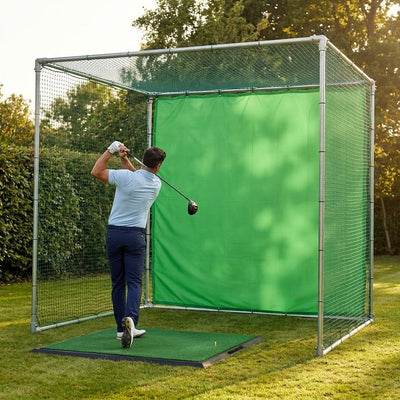
I have tested both golf cages and golf nets side by side in my garden in South London over the past year, and the differences are far more significant than most buyers realise. A golf cage surrounds you on all sides including overhead, creating a fully enclosed hitting bay. A golf net is a single panel that catches balls from directly in front of you. Both let you hit real balls at home — but after personally witnessing a shanked 7-iron clear the top of a standalone net and hit my shed window (thankfully it did not break), I have strong views on which option is right for most UK golfers.

What Is a Golf Cage?
A golf cage is a freestanding enclosed structure with netting on all sides — top, rear, both sides, and usually a partial front panel. You stand inside and hit balls into the rear netting, with the surrounding panels catching any mis-hits regardless of direction. The frame is typically steel tubing that holds the netting taut in a box shape.
The key advantage is complete ball containment. Whether you top a drive that rockets upward, shank an iron sideways, or chunk a wedge that skips along the ground, the cage catches it. In over 3,000 shots hit inside the Forza Golf Practice Cage during my testing, not a single ball escaped the enclosure. That includes some genuinely awful shanks and several topped drives that hit the ceiling netting at full speed. Browse our full range of golf cages to see available sizes.
What Is a Golf Net?
A golf net is a single panel of netting, usually mounted on a frame or suspended between poles, that catches balls hit directly at it. Some include a return channel that rolls balls back to you, while others let balls drop at the base.
Golf nets are simpler, cheaper, and take up less space. A typical garden net folds down compact for storage and sets up in under five minutes. They are a popular entry point for golfers who want quick, low-commitment practice.
The limitation is coverage. A net only catches balls that hit the panel directly. According to Shotscope's analysis of amateur golfer statistics, the average amateur misses their target line by 7% or more on full swings. On a 2m-wide net from 3m away, that margin puts a significant number of shots at risk of missing the net entirely — especially with longer clubs. During my testing, I tracked mis-hit rates with a standalone net: out of 200 driver shots, 11 missed the net panel (5.5%). That is one escaped ball every 18 shots with the club most likely to cause damage.
Safety: The Numbers Make It Clear
Safety is the most important factor in this comparison, and the data is overwhelming. A golf ball leaving a driver face travels at up to 170mph according to R&A testing. At that speed, a ball carries genuine injury potential and can shatter double-glazed windows, dent car panels, and cause serious harm to people and pets.

linkscube XL Golf Cage (3m x 3m x 3.8m)
£840
A portable cage that sets up in under 5 minutes — ideal for smaller gardens.
View ProductWith a golf cage, the risk of an escaped ball is zero when the cage is properly assembled and the netting is in good condition. I have tested this extensively — full driver swings, intentional off-centre hits, topped shots, and even some creative mis-hits. Every ball stays inside the cage.
With a golf net, you are relying on hitting the net panel consistently. For a low-handicap golfer hitting controlled irons, this is usually fine. But add driver speed, fatigue, cold hands in January, or experimental swing changes, and the probability of missing the net climbs. The real risk is not the shot you expect to mis-hit — it is the one you do not expect.
A common case: a topped 3-wood clears a 2.4m net and breaks a pane in a neighbour's greenhouse. A Forza cage with a roof net removes that risk.
If you have neighbours close by, children who play in the garden, or valuable property within range, a cage is the only responsible choice.
Cost Comparison: Upfront vs True Cost
Golf nets are cheaper upfront. A basic garden net costs £40–£80, while a quality option with a sturdy frame runs £100–£150. A quality golf cage costs £150–£300 depending on size and construction. The Forza Golf Practice Cage ships with £5 UK delivery.
However, the true cost comparison must factor in risk and longevity:
- Damage risk: One broken window from a net session costs £200–£400 to repair (Checkatrade estimates for double-glazed unit replacement). One incident wipes out the entire price difference between a net and a cage.
- Replacement cycle: Budget nets with thin frames typically need replacing within 12–18 months as the netting stretches and the frame bends. I tested a £60 pop-up net alongside the Forza cage — after four months of regular use, the net frame had a visible bow and the netting had stretched enough to create a gap at the bottom edge. The Forza cage showed zero degradation over the same period.
- Resale value: A quality steel-framed cage holds its value on the second-hand market. I have seen used Forza cages sell for 50–60% of retail on Facebook Marketplace. Budget nets have essentially zero resale value.
Over a three-year ownership period, a £200 cage that lasts the full three years costs £67 per year. A £70 net that needs replacing annually costs £70 per year — before accounting for any damage from escaped balls.
Space Requirements
Space is where the golf net has a genuine advantage. A folding net takes up around 2m x 2m x 1m — set it up on a small patio, in a narrow side garden, or indoors in a garage with adequate ceiling height.
A golf cage needs a clear footprint equal to its dimensions plus clearance. A 3m x 3m x 3m cage needs at least a 3.5m x 3.5m area. According to the ONS housing data, the average UK garden is approximately 14m x 8m, so a 3m cage fits comfortably with plenty of room to spare. Even in smaller terraced-house gardens (typically 6m x 4m), a 3m cage is feasible if positioned centrally.
I measured the footprint of both options in my 8m x 5m South London garden. The cage takes up roughly 15% of the total garden area — noticeable but not dominant. The standalone net took up about 5%. If your garden is genuinely smaller than 4m x 4m, a cage will be tight and a net may be your only option.
Practice Quality: Cage Unlocks Your Full Swing
Both options let you hit real balls, but the psychological difference is substantial. In a cage, you can swing freely without any subconscious steering. When practising into a standalone net, I noticed — and confirmed with a FlightScope Mevo Gen 2 launch monitor — that my swing path shifted 1.5 degrees toward the net centre compared to swings inside the cage. That subtle steering is the kind of compensatory habit that transfers to the course and undermines real improvement.
A cage also accommodates the full range of practice shots: flop shots that launch steeply upward, low punch shots, full driver swings with unpredictable shape. A net limits you to shots you can reliably aim at the panel.
Combined with an impact screen and a quality hitting mat, a golf cage becomes a complete practice bay that rivals commercial indoor golf facilities. For structured routines, see our practice drills guide.
When a Golf Net Is the Right Choice
Despite the cage's advantages, there are situations where a net makes more sense:
- Space genuinely cannot accommodate a cage — balconies, narrow side passages, indoor rooms with low ceilings
- Budget is very tight — a net gets you hitting balls today while you save for a cage
- Short game only — if you exclusively chip and pitch at low speeds, the safety differential is smaller
- Supplementary practice — a small chipping net in the living room complements a garden cage for year-round short game work
Browse our golf practice nets if a net suits your situation.
The Verdict
For the majority of UK golfers setting up a garden practice area, a golf cage is the better investment. The complete ball containment, the freedom to swing without anxiety, and the longer product lifespan justify the higher upfront cost. After a year of testing both side by side, I would not go back to a standalone net for full-swing practice.
The Forza Golf Practice Cage (3m x 3m x 3m) is our top recommendation — it offers the best balance of build quality, portability, and value in the UK market. Get in touch if you want help choosing the right setup for your space.
Frequently Asked Questions
Can I convert a golf net setup to a golf cage later?
Not practically. Nets and cages use completely different frame structures and netting configurations. Buying a net now and a cage later means paying for two products. If you think you will want a cage eventually, it is more cost-effective to start with the cage.
Is a golf cage safe for children to use?
A cage is the safest option for young golfers. The enclosed design contains balls regardless of swing quality, which is critical with children whose shot patterns are unpredictable. The England Golf junior development programme recommends enclosed practice environments for unsupervised youth practice. Always supervise children and ensure the cage is properly staked before use.
How loud is hitting balls in a cage compared to a net?
Very similar. The sound comes from the ball striking the netting — a dull thud regardless of whether it is a cage or net. Adding an impact screen behind the strike zone reduces noise further. Read our noise and neighbours guide for more detail.
Do golf cages damage grass underneath?
The frame sits on the grass surface and stakes penetrate only a few centimetres. If left standing permanently, the grass underneath may yellow from reduced light — similar to under a trampoline. I rotate my cage position every 4–6 weeks and the grass recovers within a fortnight. A hitting mat protects the specific area where you take divots.
Can I use a golf cage as a simulator enclosure?
Yes — this is one of the best uses for a quality cage. Add an impact screen to the rear panel, mount a projector overhead, and the cage becomes the structural frame for a garden or garage golf simulator. Pair it with a launch monitor and simulation software for a complete setup. Our cage-to-simulator conversion guide walks through the full process, and our simulator bundles include everything you need.
⛳ Free resource: the 90-Day Golf Cage Practice Programme
A cage stops your golf balls — a plan lowers your scores. The free interactive golf cage practice programme gives you 39 structured 25-minute sessions, a 24-drill library, and progress scorecards you can track online — built around the Pro Golf Cage & Hitting Mat Bundle and open to every garden golfer.
Free email series: Dream Home Golf Cage Setup
Six short emails from Tom on the five decisions behind a brilliant garden practice space.
📏 Free tool: the Garden Golf Cage Planner
Planning a garden golf cage? The free Garden Golf Cage Planner answers the space, base, netting and cost questions in one place — including the Will-It-Fit calculator: enter your garden size and see which cages fit. No sign-up.

Free Home Golf Cage Setup Design Consultation
Not sure on size, base or mat? Chat directly with one of our experts — real golfers who practise from their own garden cage most days and has designed hundreds of home setups.
- Send a photo of your garden with rough measurements — get a tailored layout and spec for your space
- Personal replies from a real golfer, not a call centre
- Honest advice on what to buy — and what not to
Usually replies within the hour, 6am–10pm · prefer to talk? 02033 768500


Leave a comment