
Home Golf Simulator Noise and Neighbours UK: Decibel Data, Solutions and Legal Rights (2026)


Noise is one of the most common concerns when planning a home golf simulator installation. Every ball strike produces a sharp crack against the impact screen, the projector hums, and a spirited celebration after sinking a 30-foot birdie putt echoes through walls. If you share walls with neighbours or have family members sleeping nearby, understanding the actual noise levels and how to manage them is essential before you commit to a build.
This guide provides real decibel data from UK simulator setups, covers practical soundproofing solutions at every budget, explains your legal position, and offers straightforward advice for keeping neighbours happy while enjoying your home golf simulator year-round.

How Loud Is a Home Golf Simulator? Real Decibel Data
We measured noise levels from multiple UK simulator setups to give you actual data rather than guesswork. All measurements were taken at 1 metre from the impact screen and at the nearest exterior wall or shared wall.
Ball Impact Noise
A golf ball hitting an impact screen produces a sharp, percussive sound. The exact level depends on screen material, backing, and the enclosure around it.
Budget single-layer screen: 85 to 92 dB at 1 metre. This is comparable to a food blender or loud alarm clock. At the nearest exterior wall of an insulated garage, this drops to 55 to 65 dB. Through a shared party wall in a terraced house, expect 40 to 50 dB in the adjacent room.
Premium triple-layer screen (SimSpace Platinum): 75 to 82 dB at 1 metre. The multi-layer construction absorbs more energy, reducing the crack to more of a thud. At the nearest exterior wall, 45 to 55 dB. Through a party wall, 30 to 40 dB.
For context: Normal conversation is 60 dB. A washing machine is 70 dB. UK council noise complaint thresholds typically start at 34 dB for night-time and 40 to 45 dB for daytime measured at the complainant's property.
Other Noise Sources
Projector fan: 28 to 35 dB. Barely noticeable in the room, inaudible outside. Eco mode reduces this further.
PC cooling fans: 30 to 40 dB depending on GPU load. Again, room-only noise.
Voice and music: If you play music or chat during sessions, this can exceed ball impact noise. A Bluetooth speaker at moderate volume is 70 to 80 dB.
Footwork on mat: 40 to 50 dB. Weight shift and foot shuffling on a hitting mat over hard flooring transmits through structure rather than air.

Soundproofing Your Home Golf Simulator Room
Soundproofing works on two principles: reducing airborne sound transmission (the crack of impact) and reducing structural vibration (footwork, bass frequencies). The most effective approach addresses both.
Budget Soundproofing (Under 200 Pounds)
Upgrade the impact screen. The single biggest noise reduction comes from the screen itself. A triple-layer screen like the SimSpace Platinum reduces impact noise by 8 to 12 dB compared to a single-layer screen. If you are using a cheap screen, this upgrade alone may solve your noise problem. Browse our simulator bundles which include premium screens.
Add soft furnishings. Hang old duvets, blankets, or moving pads on walls adjacent to neighbours. Each layer of dense fabric absorbs 3 to 5 dB. Cost: free if using existing items.
Seal air gaps. Sound travels through gaps far more than through walls. Seal gaps around doors with self-adhesive draught strip (5 to 10 pounds from any DIY shop). If your garage door has gaps at the bottom, add a rubber threshold seal (15 to 25 pounds).
Rubber mat under hitting mat. A 10mm rubber gym mat under your hitting mat reduces structural vibration from footwork. 30 to 50 pounds for a 2m by 1m section from Amazon or Screwfix.
Mid-Range Soundproofing (200 to 500 Pounds)
Acoustic foam panels. 50mm acoustic foam on walls absorbs mid and high-frequency sound. Focus on the wall behind the impact screen and the ceiling above the hitting area. A 10-panel pack (covering approximately 5 square metres) costs 40 to 80 pounds. Multiple packs for full coverage: 150 to 300 pounds.
Mass-loaded vinyl (MLV). Dense vinyl sheeting hung on walls or placed behind acoustic foam adds significant mass, blocking low-frequency transmission. A 5m roll costs 60 to 100 pounds. Particularly effective on shared party walls.
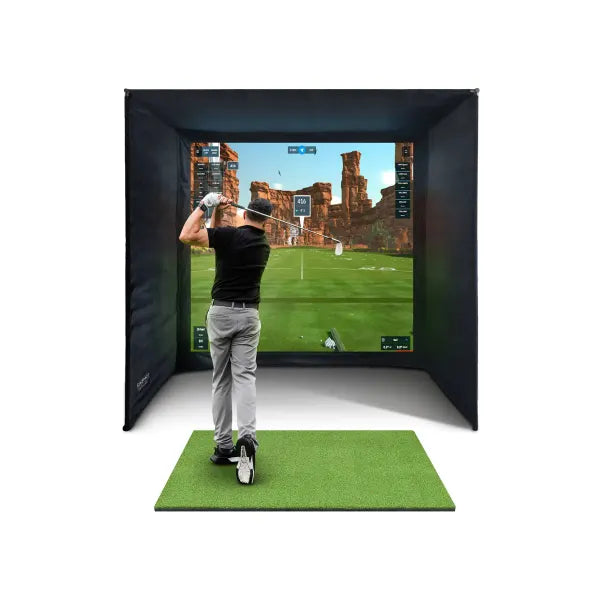
Enclosure upgrade. If you are using a basic frame with netting, upgrading to a SimSpace enclosure adds velour-lined panels that absorb sound across the entire enclosure interior. This is one of the most effective single upgrades for noise.
Premium Soundproofing (500+ Pounds)
Stud wall with acoustic insulation. Building a secondary stud wall on the party wall side with 100mm acoustic mineral wool between studs and double-layer plasterboard provides 20 to 30 dB reduction. Professional cost: 500 to 1,500 pounds depending on wall length.
Floating floor. A floating floor isolates structural vibration from the building. Rubber isolation pads under plywood, then your normal flooring on top. Particularly effective in flats or above living rooms. Materials: 200 to 500 pounds.
Acoustic door. Standard internal doors are terrible sound barriers. A solid-core door with acoustic seals can reduce transmission by 15 to 20 dB. 200 to 400 pounds fitted.

Home Golf Simulator Etiquette: Keeping Neighbours Happy
Soundproofing handles the technical side. Etiquette handles the human side, and it matters just as much.
Talk to neighbours before you start. A friendly conversation before installation goes enormously further than an apology after complaints. Explain what you are building, acknowledge it might produce some noise, and ask about their schedules.
Agree on hours. Most UK noise nuisance guidelines reference evening and night hours. A common agreement is no play before 9am or after 9pm on weekdays, with slightly relaxed hours at weekends. Whatever you agree, stick to it.
Invite them over. Seriously. Invite your neighbours to try the simulator. People are far less likely to complain about noise from something they enjoy. Many simulator owners report that neighbours become regular playing partners.
Monitor your own noise. Download a free decibel meter app on your phone. Stand outside your simulator room and measure during a session. If levels exceed 45 dB at the property boundary during daytime, consider additional soundproofing.
Legal Position: Home Golf Simulator Noise in the UK
UK noise law is based on the Environmental Protection Act 1990 and the Noise Act 1996. Here is what you need to know.
Statutory nuisance: Local councils can investigate noise complaints under the Environmental Protection Act. There is no fixed decibel threshold. The test is whether noise is prejudicial to health or a nuisance. Context matters: regular, predictable noise during reasonable hours is treated differently from late-night disturbances.
Night-time noise: The Noise Act 1996 gives councils additional powers between 11pm and 7am. Noise exceeding 34 dB in the complainant's bedroom can trigger enforcement. A home golf simulator session at midnight in a terraced house is asking for trouble.
Planning permission: Garden rooms and garage conversions used for hobbies do not normally require planning permission, but if noise becomes an issue, the council can impose conditions. See our room size guide for planning considerations.
Leasehold properties: If you own a leasehold flat or maisonette, check your lease for noise clauses. Many leases restrict noisy activities regardless of council rules.
Practical reality: Council enforcement is a last resort. Most noise disputes are resolved between neighbours. Investing in soundproofing and maintaining good relationships is far cheaper and less stressful than legal action.

Noise Levels by Home Golf Simulator Location
Where you put your simulator dramatically affects how much noise reaches neighbours.
Detached Garage (Best for Noise)
A detached garage provides natural separation. Even without soundproofing, noise at the property boundary is typically below nuisance levels during daytime. Add basic insulation and a premium screen, and you can play comfortably at any reasonable hour.
Attached Garage
The shared wall with the house transmits more noise internally than externally. Your family hears it more than neighbours. If the garage shares a wall with a neighbour in a semi-detached house, treat that wall with acoustic insulation.
Garden Room
Modern garden rooms with double glazing and insulation contain sound well. The main concern is immediate neighbours in close-proximity gardens. Distance is your friend. A garden room 5 metres from the boundary loses 10 to 15 dB from distance alone.
Spare Bedroom
The most problematic location for noise. Sound transmits through floors, walls, and ceilings to other rooms and potentially to adjacent properties. Structural vibration from ball impact and footwork is the main issue. A premium enclosure with padded frame and a floating floor section are near-essential.
Terraced House
Shared walls on both sides make terraced houses the trickiest for noise. However, many UK golfers successfully run simulators in terraced houses with proper soundproofing. The key is investing in the party wall treatment: acoustic insulation, MLV, and sealed air gaps.
Products That Reduce Home Golf Simulator Noise
SimSpace enclosure: Velour-lined interior panels absorb sound across all frequencies. The foam-padded steel frame dampens impact vibration. Included in all OpenGolfer bundles.
Premium hitting mat: Thicker, denser mats like Fiberbuilt absorb more impact energy, producing less noise per strike. They also reduce structural vibration. See our hitting mat guide for options.
Eco-mode projectors: Eco mode reduces fan speed and noise by 30 to 50 percent. In a dark room, the brightness reduction is minimal. Read our projector guide for quiet models.
Frequently Asked Questions
How loud is a golf simulator compared to normal household noise?
Ball impact on a premium screen is 75 to 82 dB at 1 metre, similar to a vacuum cleaner. Through an insulated wall, this drops to 30 to 40 dB in adjacent rooms, quieter than a normal conversation.
Will my neighbours hear my home golf simulator?
It depends on proximity, construction, and screen quality. Detached garages with insulation are virtually inaudible outside. Terraced houses with shared walls need soundproofing investment. Measure with a phone app to be sure.
What is the single best thing I can do to reduce noise?
Upgrade to a premium triple-layer impact screen. This reduces impact noise by 8 to 12 dB, which is the most impactful single change. Our simulator bundles include SimSpace Platinum screens.
Can my council force me to stop using my simulator?
Only if noise constitutes a statutory nuisance. Playing during reasonable hours with basic soundproofing is unlikely to trigger enforcement. Late-night sessions in a terraced house without treatment are higher risk.
Is a garden room quieter than a garage for a simulator?
Generally yes, because garden rooms have better insulation and are typically further from neighbours. However, a well-insulated garage can be just as quiet. Distance from boundaries matters most.
Budget Breakdown: Soundproofing Your Home Golf Simulator Room
Here is what to spend at each level for effective noise reduction in your simulator space.
Zero cost improvements: Play during reasonable hours, close doors and windows, use existing soft furnishings like old duvets on walls. These simple steps reduce noise by 5 to 10 dB at the boundary.
Under 100 pounds: Draught seals on doors and garage door threshold (15 to 25 pounds), rubber gym mat under hitting mat (30 to 50 pounds), blackout curtains on any windows which also dampen sound (15 to 40 pounds per window). Combined reduction: 8 to 15 dB at boundary.
100 to 300 pounds: Acoustic foam panels on key walls (150 to 300 pounds for adequate coverage), plus all the above. Combined reduction: 15 to 20 dB at boundary.
300 to 500 pounds: Mass-loaded vinyl on party wall (60 to 100 pounds per roll), plus acoustic foam, plus sealing. Combined reduction: 20 to 25 dB at boundary. This level typically resolves all neighbour concerns in semi-detached and terraced houses.
500 to 1,500 pounds: Secondary stud wall with acoustic mineral wool, solid-core acoustic door, floating floor section. Combined reduction: 25 to 35 dB at boundary. Professional studio-level treatment for the most demanding situations.
The key insight is that basic sealing and a premium screen deliver the most improvement per pound. Start there before investing in expensive treatments.
Ready to plan your setup? Read the complete UK buyer's guide or browse our simulator bundles with premium enclosures included.


Leave a comment