
7 Ways to Make Your Golf Simulator Setup Look Amazing (Room Design Ideas)

You have spent thousands of pounds on a launch monitor, an enclosure, a projector, and a hitting mat. The technology is brilliant. The data is precise. The courses look incredible on screen. But then you step back and look at the room itself — bare walls, a single bulb dangling from the ceiling, cables everywhere, and the vague smell of damp concrete. It looks like a storage unit with a screen bolted to the back wall.
It does not have to be this way.
The difference between a golf simulator that gets used twice a week and one that becomes the centrepiece of your home is not the technology inside it. It is the room around it. A thoughtfully designed simulator space transforms practice sessions into genuine experiences. It makes you want to spend time there. It impresses friends and family. And it protects your investment by creating an environment where every component performs at its best.
We have helped hundreds of UK golfers set up their simulator rooms, and the ones who invest even a modest amount in the space itself always tell us the same thing: they wish they had done it from the start. The good news is that most of the ideas in this guide cost a fraction of what you have already spent on equipment. A few hundred pounds on lighting, sound treatment, and finishing touches can make a room feel like it belongs in a premium golf experience centre rather than a garage conversion.
This guide covers seven practical design areas, each with specific product suggestions, realistic UK costs, and lessons from real builds we have seen. Whether you are fitting out a single garage, a dedicated spare room, or a purpose-built garden room, these ideas will help you create a space that matches the quality of the technology inside it.
If you are still in the planning stages and need help with the fundamentals, our room size guide covers the dimensions you need, and our garage build guide walks through the practical conversion process step by step.

1. Lighting Design: Set the Mood and Protect the Image
Lighting is the single biggest factor in how your simulator room feels, and it is also the most commonly neglected. Most golfers wire in whatever ceiling light was already there and call it done. The result is a flat, clinical space where the projector image looks washed out and the room has all the atmosphere of a dental surgery.
Good lighting in a simulator room serves two purposes. First, it creates atmosphere — that warm, immersive feeling you get when you walk into a premium golf lounge or entertainment space. Second, it protects your projected image from ambient light wash, which is the number one killer of image quality in home simulator setups.

LED Strip Lighting: The Foundation
LED strip lighting is the single best value upgrade you can make to any simulator room. A continuous strip of warm white LEDs running along the base of your walls, behind your enclosure frame, or along ceiling coving creates a soft, diffused glow that transforms the entire atmosphere of the space.
The key is colour temperature. For a simulator room, you want warm white LEDs in the 2,700K to 3,000K range. This provides enough light to see what you are doing without washing out the projector image. Cool white LEDs (4,000K and above) create harsh, blue-tinted light that competes directly with your projector and makes the room feel cold and utilitarian.
Where to place LED strips:
- Behind the enclosure frame: A strip along the back edge of your enclosure creates a subtle backlight effect that makes the screen appear to float. This is the most impactful single placement — it adds depth and drama to the entire setup. If you have a SimSpace enclosure, the dark steel frame provides a perfect mounting surface for adhesive LED strips
- Along the floor perimeter: A strip running along the base of the walls provides gentle ambient light without any upward glare that might hit the screen. Use aluminium LED channels with diffusers to prevent individual LED dots being visible
- Under shelving or bar areas: If you have a drinks shelf, equipment rack, or bar counter, under-lighting adds a premium touch and makes these areas functional without switching on overhead lights
- Ceiling coving: For rooms with coving or a dropped ceiling edge, LED strips hidden in the recess create beautiful indirect lighting that bounces off the ceiling. This is the most luxurious look but requires the right ceiling profile
What to buy: A quality 5-metre RGBW LED strip kit with a remote or smart controller costs £25 to £60 on Amazon. RGBW (not just RGB) includes a dedicated warm white channel that produces much better ambient light than mixing red, green, and blue. Smart strips that connect to Alexa or Google Home let you set scenes with voice commands — "Alexa, turn on golf mode" is genuinely satisfying.
Dimmable Overhead Lighting
You still need overhead lighting for when you are not hitting — setting up equipment, finding a ball, cleaning the mat. But a single bright ceiling light destroys the atmosphere the moment you switch it on.
Replace any fixed-brightness fittings with dimmable LED downlights. These let you dial the brightness right down during sessions (just enough to see the floor and your ball) and bring it up to full when you need to work in the room. Recessed ceiling downlights look cleaner than pendant fittings and do not protrude into your swing path.
Cost: A set of four dimmable LED downlights with a compatible dimmer switch costs £40 to £80, installed by an electrician for an additional £80 to £150. If you are already having electrical work done for your simulator installation, add the downlights to the job — the marginal cost is minimal.
Avoiding Light Wash on the Screen
The single most important lighting rule in a simulator room: no light source should directly illuminate the impact screen. Any light hitting the screen reduces projector contrast, washes out dark areas of the image, and makes the entire visual experience look flat and cheap.
Practical tips:
- Position all lights behind or beside the hitting position, never in front of it
- If you have windows in the room, fit blackout blinds or curtains. Even indirect daylight significantly degrades projector image quality. Blackout roller blinds cost £15 to £30 per window
- Use downward-facing fixtures, not uplighters, in areas near the screen
- Paint the ceiling dark (matt dark grey or black) in the area directly above and in front of the screen. This prevents light from bouncing off the ceiling and onto the screen surface
For more detail on projector selection and image quality, our projector guide covers everything from throw ratio to brightness.
2. Sound Treatment: Play Without Disturbing the Household
A golf ball striking an impact screen at driver speed is loud. Really loud. It is a sharp crack that reverberates off hard walls and travels straight through plasterboard, brick, and into the rest of the house. Add in the sound of club on mat, the projector fan, and whatever music or commentary you have playing, and your simulator room can easily become an antisocial nuisance.
Sound treatment is not about making the room silent — it is about controlling where sound goes and reducing the sharp, jarring impacts that travel through walls and floors.

Acoustic Panels: Kill the Echo
Hard, parallel walls create echo and reverberation that amplifies every sound in the room. Acoustic panels absorb mid and high-frequency sound, reducing echo and making the room feel quieter and more controlled. They also look excellent — modern acoustic panels come in a range of colours and patterns that add genuine design interest to the walls.
Where to place acoustic panels:
- Side walls at ear height: This is the primary reflection zone. Panels here have the biggest impact on perceived noise levels
- Rear wall (behind hitting position): Sound from the screen impact bounces off the rear wall and back, creating a doubling effect. Panels here reduce this significantly
- Ceiling above the hitting zone: If your ceiling is hard (concrete, plasterboard), it reflects impact sound downward. Ceiling panels or foam tiles address this
You do not need to cover every surface. Four to six panels on the side walls and two on the rear wall typically make a dramatic difference. The goal is to break up the parallel hard surfaces that create flutter echo.
Cost: Budget acoustic foam panels start at £20 to £40 for a pack of twelve 30cm squares. These are functional but look cheap. For a more premium appearance, fabric-wrapped acoustic panels cost £25 to £50 each and come in colours you can match to your room scheme. A full treatment of eight to ten fabric panels costs £200 to £500.
Bass Traps: Tame the Low-End Thump
Standard acoustic panels handle mid and high frequencies, but the deep thud of ball on screen is primarily low-frequency energy. Bass traps — thick, dense foam or fibreglass panels designed for room corners — absorb these lower frequencies where they accumulate.
Place bass traps in the two front corners of the room (nearest the screen) and the two rear corners. Corner-mounted traps are the most space-efficient option and are virtually invisible once installed. Budget £15 to £30 per corner trap.
Impact Noise: The Screen Itself Matters
The impact screen is the biggest single source of noise in a simulator room. Different screen materials produce dramatically different noise levels. A thin, taut screen amplifies the impact like a drum skin. A thicker, more textured screen absorbs more of the impact energy and produces a duller, quieter sound.
The QuadPro impact screen is noticeably quieter than thinner alternatives, thanks to its denser weave and heavier weight per square metre. If noise is a genuine concern — you are in a garage adjoining a bedroom wall, or you play late at night — the screen material is worth the upgrade. Our impact screen guide compares the options in detail.
Additional noise-reduction measures:
- Screen gap: Leave at least 30cm between the screen and the wall behind it. This air gap allows the screen to decelerate gradually, reducing the transferred impact noise
- Rubber mat behind screen: A sheet of 6mm rubber matting hung behind the impact screen acts as a secondary sound damper. Cost: £20 to £40
- Dense hitting mat: A thick, high-quality hitting mat like the Real Feel TeeTurf absorbs more club impact energy than a thin, hard mat. This reduces both the sound and the vibration transmitted through the floor
3. Flooring: Comfort, Looks, and Practicality
Flooring might seem like a purely functional decision, but it has an outsized impact on how the room looks, how it feels to stand in for extended sessions, and how well it handles the wear and tear of regular golf practice.
Rubber Gym Tiles: The Industry Standard
Interlocking rubber gym tiles are the default choice for simulator rooms, and for good reason. They are durable, provide cushioning over concrete, insulate against cold floors, and dampen vibration from impacts. A 15mm thick rubber tile provides meaningful comfort during a two-hour session compared to bare concrete.
For the best look, choose solid black tiles rather than coloured-fleck gym tiles. The solid black creates a clean, professional appearance that complements the dark interior of an enclosure like the SimSpace, with its premium velour-lined interior panels and dark steel frame. The visual continuity from dark floor to dark enclosure to white impact screen creates a cohesive, purpose-built aesthetic.
Cost: Enough 15mm rubber tiles to cover a single garage floor (approximately 15 square metres) costs £120 to £200. For a double garage or larger space, budget £200 to £400.
Carpet Tiles: The Comfort Option
If comfort and a more domestic feel are priorities — especially in a room inside the house rather than a garage — carpet tiles offer a warmer, softer alternative. Choose commercial-grade carpet tiles (not residential carpet) for durability. They are individually replaceable if one gets damaged, stained, or worn.
The disadvantage of carpet tiles is cleaning. Golf simulator rooms accumulate rubber dust from mats, foam particles from practice balls, and occasional drink spills. Carpet tiles need regular hoovering and occasional deep cleaning. Rubber tiles need only a quick sweep or wipe.
Cost: Commercial carpet tiles cost £100 to £250 for 15 square metres, depending on quality.
Transition Strips and Edges
If your simulator room connects to another space with a different floor type — which is almost always the case in a garage conversion — use proper transition strips at the threshold. An aluminium or rubber transition strip creates a clean, safe junction between floor levels and prevents the edge of your flooring from lifting or becoming a trip hazard.
Cost: £5 to £15 per metre for a quality aluminium transition strip.
Under-Mat Considerations
Your hitting mat sits on top of whatever flooring you choose. Make sure the combined height of the flooring plus the mat does not create a stance that feels unnatural. If you are standing on 15mm rubber tiles with a 30mm mat, you are 45mm above the original floor level. This rarely causes issues, but it is worth checking that the height difference does not feel awkward at address.
For a comprehensive guide to choosing the right mat, see our hitting mat guide.
4. Wall Treatments: The Backdrop That Makes Everything Pop
Walls are the largest visual surface in any room, and they set the tone for everything else. In a golf simulator room, wall treatment serves both aesthetic and functional purposes — the right approach improves the look, reduces glare on the screen, and can even contribute to sound absorption.
The Dark Wall Strategy
The single most effective wall treatment for a simulator room is also the simplest: paint the walls dark. A matt dark grey, charcoal, or black finish on the walls surrounding the screen drastically reduces light reflection and glare, improving projected image quality while creating a cinematic, immersive atmosphere.
You do not need to paint every wall dark. A popular approach is to paint the screen wall and the two side walls in dark colours (matt dark grey, Farrow & Ball "Railings" or Dulux "Rich Black" are popular choices) and keep the rear wall lighter. This creates depth and draws the eye toward the screen without making the room feel like a cave when the lights are on.
Cost: Two tins of quality matt emulsion to paint three walls in a single garage cost £40 to £80. Possibly the highest-impact, lowest-cost upgrade in this entire guide.
Feature Walls
A feature wall on the rear wall (behind the hitting position) adds visual interest without affecting screen visibility. Options include:
- Reclaimed timber cladding: Horizontal planks of reclaimed or treated timber create a warm, rustic look that contrasts beautifully with the technology in front of you. Tongue-and-groove boards from a timber merchant cost £20 to £40 per square metre, installed
- 3D wall panels: MDF or PVC 3D textured wall panels add depth and visual drama. Popular patterns include geometric waves, diamond grids, and ripple effects. They also provide mild sound absorption. Cost: £15 to £30 per square metre
- Exposed brick: If your garage has brick walls beneath the plaster, exposing one wall creates instant character. Seal the brick with a matt clear coat to prevent dust. Labour cost for removing plaster: £200 to £400 for a single wall
- Acoustic panel feature wall: Arrange coloured acoustic panels in a pattern on the rear wall. This serves double duty: sound absorption and visual impact. A grid of mixed-colour panels looks striking and is entirely functional
Decorative Panels and Wainscoting
For a more refined look, consider adding wainscoting (half-height wall panelling) to the side walls. MDF panels with a simple shaker-style profile add a traditional, club-house feel to the room. Paint them in a contrasting colour to the upper wall — dark grey panels with a lighter grey upper section, for example — for a layered, designed appearance.
Cost: MDF wainscoting panels cost £30 to £60 per linear metre, installed and painted.
5. The Lounge Area: Make It Social
Here is a truth that surprises many first-time simulator owners: the best golf simulator rooms are not just for golf. They are social spaces. They are rooms where friends gather for a Saturday afternoon session, where partners sit and watch (or play), where a post-round drink becomes a ritual.
If your room is wide enough — typically 4 metres or more — dedicating a section to seating and socialising transforms the space from a practice facility into a genuine entertainment room.

Seating Options
Compact sofa or loveseat: A two-seater sofa against the side wall provides comfortable viewing for one or two spectators. Choose a sofa with a low back that does not obstruct the view of the screen. Leather or faux-leather is the best material choice for a garage or outbuilding — it handles temperature fluctuations and is easy to wipe clean. A compact faux-leather sofa costs £150 to £400.
Bar stools: If space is too tight for a sofa, two or three bar stools along a narrow shelf or counter take up far less room while keeping spectators comfortable. Industrial-style metal and wood stools complement the tech-meets-workshop aesthetic of most simulator rooms. Budget £30 to £60 per stool.
Gaming chairs: For a more tech-forward aesthetic, gaming-style chairs with armrests and headrests work well and can be pushed back against the wall when not in use. They also double as seating for when you are analysing shot data on a monitor. Cost: £100 to £250 each.
The Mini Bar Setup
Nothing completes a simulator room like a small drinks area. This does not need to be elaborate — a narrow shelf or console table with a few bottles, glasses, and a small fridge is enough to create a proper social atmosphere.
Essential elements:
- Narrow console table or wall-mounted shelf: 30 to 40cm deep is sufficient. Positions behind the hitting area or along a side wall. Cost: £30 to £80
- Mini fridge: A counter-top mini fridge keeps drinks cold without taking up floor space. Place it under the shelf or table. Cost: £60 to £120
- LED-lit bottle shelf: A floating shelf with integrated LED strip lighting underneath displays bottles attractively and adds to the ambient lighting scheme. Cost: £20 to £40 including the LED strip
- Proper glasses: Ditch the plastic cups. A set of decent tumblers, pint glasses, or wine glasses stored on the shelf adds a small but meaningful touch of quality
The mini bar works best positioned on the side wall opposite the entrance, visible from both the hitting position and the seating area. Keep it away from the screen wall and the flight path of any stray balls.
Space Planning for the Lounge Area
The lounge area must not encroach on the hitting zone. Plan it so that all seating and furniture sits behind or to the side of the hitting position, well clear of the swing path. A clear division between the hitting zone and the social zone — even just a strip of different flooring or a subtle change in lighting — creates a natural boundary that keeps spectators safe and the golfer focused.
If your room is a single garage (approximately 3 metres wide), a full lounge area is unlikely to fit. In this case, a single bar stool in the corner and a small shelf with a few drinks is enough to add a social element without sacrificing hitting space. In a double garage or dedicated room, you have much more flexibility. Our room size guide has detailed dimensions for every room type.
6. Tech Integration: Speakers, Screens, and Smart Control
A golf simulator is inherently a tech-heavy setup. You already have a projector, a launch monitor, a PC or laptop, and various cables. Thoughtful tech integration takes this from a tangle of wires and devices to a clean, unified system that enhances the experience.

Sound System
Built-in projector speakers are universally terrible. They are tinny, quiet, and positioned behind you rather than in front. Adding a proper sound system to your simulator room transforms the experience — the crack of the virtual ball, the ambient crowd noise, the commentary, and background music all come alive.
Options by budget:
| Setup | Cost | Quality | Best For |
|---|---|---|---|
| Bluetooth speaker (single) | £30-£80 | Decent | Budget setups, portable use |
| Bluetooth soundbar | £80-£200 | Good | Clean install, wall-mounted below screen |
| 2.1 bookshelf speakers + subwoofer | £150-£400 | Excellent | Immersive sound, dedicated rooms |
| Ceiling-mounted speakers (pair) | £100-£250 + install | Great | Clean aesthetics, invisible install |
For most simulator rooms, a soundbar mounted on the wall directly below the impact screen is the sweet spot of quality, cost, and simplicity. It fires sound toward you from the correct direction (matching the visual source) and connects to your PC via Bluetooth or a 3.5mm cable. Position it below the screen, not above, to keep it clear of ball impacts.
Secondary Monitor for Data
Your projector shows the golf course. But what about your shot data? Most simulator software can output to a second screen, and having a dedicated monitor showing club speed, launch angle, spin rate, and carry distance adds a huge amount to the practice value of every session.
A 24 to 32-inch monitor mounted on a swing arm or wall bracket beside the hitting position gives you instant access to data without looking away from the screen. This is particularly valuable if you are using your simulator for genuine practice rather than just playing rounds. You can review each shot immediately, spot patterns, and make adjustments in real time.
Most launch monitors — including the ones in our Mevo Gen 2 bundle and the Foresight GC3 bundle — output data that can be displayed on a secondary screen. Our software guide covers which platforms support dual-screen output.
Cost: A quality 27-inch monitor costs £150 to £300. A wall-mount swing arm adds £20 to £40.
Smart Lighting Control
If you have invested in LED strips, dimmable downlights, and perhaps some accent lighting, controlling them all individually is tedious. A smart lighting system lets you create scenes that switch everything to the right setting with a single command or button press.
Scene examples:
- "Golf mode": Downlights dim to 20%, LED strips on warm white, screen wall dark
- "Setup mode": Downlights at 100%, all lights on full brightness for equipment adjustment
- "Social mode": Downlights at 50%, LED strips on a colour cycle, bar area lit
Smart bulbs and LED controllers from Philips Hue, LIFX, or budget alternatives like Govee work with Alexa, Google Home, and Apple HomeKit. A starter set of four smart bulbs and a hub costs £60 to £120. If you are already in the smart home ecosystem, adding your simulator room lights is straightforward.
Cable Management: The Invisible Upgrade
Nothing ruins the look of a well-designed simulator room faster than visible cables. You likely have HDMI running from PC to projector, power cables for three or four devices, USB cables for the launch monitor, and speaker cables. Left visible, they create a tangled mess that looks terrible and attracts dust.
Cable management essentials:
- Cable trunking: Adhesive-backed cable trunking along walls and ceilings hides cables completely. Paint the trunking to match your wall colour for invisibility. Cost: £10 to £25 for enough to run a full room
- Cable sleeve: A fabric cable sleeve gathers multiple cables into a single neat tube. Ideal for the run from your PC area to the projector mount. Cost: £5 to £15
- In-wall routing: If you are comfortable cutting into plasterboard (or your electrician is on-site anyway), routing HDMI and power cables inside the wall creates the cleanest possible installation. This is more involved but the result is professional-grade
- Velcro cable ties: For cables at desk or floor level, reusable Velcro ties keep bundles tidy and allow easy reconfiguration. Cost: £3 to £8 for a pack
7. The Finishing Touches: Character, Personality, and Pride
The first six sections of this guide cover the functional design elements — lighting, sound, flooring, walls, seating, and technology. But a room with perfect acoustics and invisible cable management can still feel soulless if it lacks personality. The finishing touches are what make a simulator room feel like yours.
Course Artwork and Prints
Golf course photography and artwork are available at every price point, from affordable prints to original paintings. A few well-chosen pieces on the walls — particularly on the rear wall behind the hitting position, where you naturally look when you step back from the mat — add colour, character, and conversation starters.
Ideas:
- Iconic hole prints: The 12th at Augusta, the 17th at St Andrews, the 7th at Pebble Beach. Classic images that every golfer recognises
- Course maps: Minimalist course layout maps of your home course or favourite courses. Available as prints, framed posters, or even laser-cut wood designs
- Vintage golf posters: Reproduction posters from the golden age of golf — Open Championship programmes, vintage club advertisements, and classic tournament artwork
- Canvas prints of your own photos: If you have photos from memorable rounds or golf trips, having them printed on canvas is inexpensive (£15 to £40 per print) and deeply personal
Frame your artwork in simple black or dark wood frames to maintain consistency with the dark wall palette. A gallery wall of five to seven pieces behind the hitting position, arranged asymmetrically, creates a feature that draws the eye without cluttering the space.
Memorabilia Display
Golf memorabilia — signed balls, course scorecards, hole-in-one trophies, tournament badges, old clubs — tells the story of your golf life. A few well-displayed items add a layer of personal history that no amount of interior design can replicate.
Display ideas:
- Shadow box frames: Deep frames that hold three-dimensional objects. Perfect for signed balls, gloves, or tee markers. Cost: £15 to £40 each
- Floating shelves: Two or three floating shelves holding trophies, balls, and scorecards from notable rounds. Position them on a side wall where they are visible but not in the swing path. Cost: £10 to £25 per shelf
- Old club display: A vintage hickory-shafted club or a set of your first irons, mounted on the wall with simple hooks, adds character and sparks nostalgia. Cost: £5 to £15 for mounting hardware
Branded Signage
A custom-made sign with your simulator room's name — "Tom's Golf Lounge", "The 19th Hole", "The Back Nine" — adds a professional, finished touch. Options range from a simple vinyl decal on the wall to a custom neon sign or laser-cut metal lettering.
- Vinyl wall decal: Custom text in any font, applied directly to the wall. Cost: £10 to £30
- LED neon sign: Custom LED neon signs in your chosen text and colour are surprisingly affordable and look outstanding in a dimly lit simulator room. Cost: £40 to £120 for a custom design
- Laser-cut metal or wood sign: A name or logo cut from steel or plywood, powder-coated or painted. Cost: £30 to £80
Plants and Greenery
This might seem incongruous in a golf simulator room, but a few plants — real or high-quality artificial — soften the hard surfaces and tech-heavy aesthetic. A tall plant in a corner, a small succulent on the bar shelf, or a trailing plant on a high shelf adds life and colour without taking up usable space.
In a garage or garden room where temperature and light fluctuate, artificial plants are the practical choice. Quality artificial plants are surprisingly convincing and require zero maintenance. Budget £15 to £40 for two or three well-placed artificial plants.
Before and After: What Design Can Do
To illustrate the impact of these design ideas, here are three realistic UK scenarios showing what a simulator room looks like before and after a design upgrade.
Scenario 1: The Single Garage Transformation (Budget: £400)
Before: A standard UK single garage in Berkshire — bare concrete floor, single fluorescent tube, breeze block walls painted magnolia twenty years ago, cobwebs in the corners. The simulator equipment (a Mevo Gen 2 bundle with SimSpace enclosure) is installed and works perfectly, but the room looks and feels like a garage with a screen in it.
Design upgrades applied:
- Dark grey matt paint on three walls (£50)
- 5m warm white LED strip behind the enclosure frame (£30)
- Black rubber gym tiles on the floor in the hitting zone (£80)
- Four fabric acoustic panels on side walls (£100)
- Blackout blind on the side window (£20)
- Three framed golf course prints on the rear wall (£45)
- Cable trunking along one wall and ceiling (£15)
- Dimmable LED bulb in the existing ceiling fitting (£8)
- Small shelf with LED strip for drinks (£25)
- Custom vinyl wall decal — room name (£15)
After: The room feels completely different. The dark walls and LED backlighting create a cinematic, immersive atmosphere. The projected image is brighter and more vivid with reduced ambient light. The acoustic panels have killed the echo that made every impact sound harsh. The rubber flooring is warm and comfortable underfoot. The artwork and personal touches make it feel like a space someone designed, not just a space someone filled with equipment.
Total cost: £388. Less than 10% of what the simulator equipment cost, but it transforms the experience by at least 50%.
Scenario 2: The Double Garage Entertainment Space (Budget: £1,200)
Before: A double garage in Surrey, already well-insulated with plasterboard walls and a concrete floor. A Foresight GC3S bundle with a full-width SimSpace enclosure takes up one half. The other half is empty — used for storing ladders and garden furniture.
Design upgrades applied:
- Dark charcoal paint on screen wall and side walls (£60)
- Reclaimed timber cladding feature wall behind hitting position (£250)
- Full-room black rubber gym tile flooring (£300)
- RGBW LED strip kit with smart controller — perimeter and behind enclosure (£55)
- Four dimmable LED downlights with dimmer switch, electrician-installed (£180)
- Compact faux-leather two-seater sofa (£200)
- Narrow console table with mini fridge underneath (£90)
- Bluetooth soundbar mounted below screen (£80)
- 27-inch monitor on swing arm for data display (£180)
- Eight acoustic panels on side and rear walls (£200)
- Four corner bass traps (£80)
- Cable management throughout (£30)
- Five framed prints, shadow box with signed ball, floating shelf (£120)
- Custom LED neon sign (£80)
After: This is now a room that people walk into and say "wow". The timber feature wall provides warmth and texture. The sound system fills the space with course ambience and music. The data monitor lets you analyse every shot without pausing. The sofa and drinks area make it a genuinely social space — friends stay for hours. The smart lighting means one voice command sets the perfect mood.
Total cost: £1,905 (over the initial £1,200 budget, but the homeowner decided the extras were worth it). For context, this is roughly the cost of a year's golf club membership, and the room will provide entertainment for a decade or more.
Scenario 3: The Garden Room Showcase (Budget: £800)
Before: A purpose-built garden room in Yorkshire, 3m high x 4m wide x 6m deep. Excellent dimensions, properly insulated, and pre-wired with multiple circuits. An Uneekor Eye Mini bundle with a wide SimSpace enclosure is installed. But the walls are plain white, the lighting is two strip fluorescents, and the only furniture is a folding chair.
Design upgrades applied:
- Matt dark grey paint on all four walls (£80)
- 3D geometric wall panels on rear wall (£120)
- Commercial carpet tiles throughout — dark grey (£200)
- RGBW LED strip system with ceiling coving integration (£80)
- Ceiling-mounted speakers, pair (£120)
- 27-inch data monitor on wall mount (£180)
- Two bar stools and narrow bar shelf with under-lighting (£100)
- Laser-cut metal sign above door (£50)
- Three large canvas prints of iconic holes (£60)
- Two artificial plants (£30)
- Cable trunking and ties (£20)
After: The garden room now feels like a private members' golf lounge. The 3D wall panels add architectural interest. The carpet tiles are warm and quiet underfoot. The ceiling speakers provide immersive sound that fills the space evenly. The bar stools and shelf create a social corner for friends. Walking in from the garden on a cold evening, with the LED lighting warming the room and the screen glowing, is a genuinely special experience.
Total cost: £1,040. Reasonable for a space that already had excellent bones.
Budget Design Tips: Maximum Impact for Minimum Spend
Not everyone has £1,000 to spend on room design. If you are working with a limited budget, prioritise these upgrades in order of visual impact per pound spent:
- Dark paint (£40-£80): The single highest-impact change. Two tins of dark matt emulsion transform the atmosphere and improve projector image quality. Nothing else delivers this much change for this little money
- LED strip lighting (£25-£60): One strip behind the enclosure creates more atmosphere than any other single upgrade. It takes fifteen minutes to install with adhesive backing
- Dimmable bulb (£5-£15): Swap your existing ceiling bulb for a dimmable LED. Instant control over ambient light levels at virtually zero cost
- Cable trunking (£10-£25): Hiding visible cables makes the entire room look more professional and considered. It takes an hour and costs almost nothing
- Blackout blinds (£15-£30 per window): If you have windows, blocking daylight improves projector image quality dramatically. This is a functional upgrade that also improves the visual experience
- Framed prints (£10-£15 each): Three or four prints from an online retailer, framed in matching black frames, add personality and colour to bare walls
- Rubber gym tiles (£80-£200): Covering the hitting zone in rubber tiles improves comfort, dampens sound, and looks considerably better than bare concrete
With just the first three items — dark paint, LED strip, and a dimmable bulb — you can transform the atmosphere of your simulator room for under £100. That is genuinely remarkable value.
Common Design Mistakes to Avoid
We have seen hundreds of simulator rooms over the years. These are the mistakes that come up again and again:
1. All-White Walls
White walls reflect every photon of light from your projector back into the room, washing out the image and creating a bright, flat, clinical atmosphere. If you take only one piece of advice from this entire guide, paint your walls dark. It costs almost nothing and the improvement is immediate.
2. Overhead Fluorescent Lighting
Strip fluorescent tubes create harsh, unflattering light with a green-tinged colour cast. They cannot be dimmed. They buzz. They make every room look like a workshop. Replace them with dimmable LED downlights or, at the very least, a dimmable LED panel that fits in the same ceiling fitting. Cost: £20 to £40.
3. Ignoring Sound
A hard-walled room with no acoustic treatment turns every ball impact into a reverberating crack that travels through the house. Four to six acoustic panels on the walls cost £100-£200 and make a dramatic difference to noise levels and the overall feel of the room. It is also considerate to anyone living with you.
4. Visible Cables Everywhere
Cables running across floors, dangling from ceilings, and draped across walls scream "temporary setup" and undermine every other design effort. Spend an hour and £15 on cable trunking to hide everything. It is the difference between a room that looks professional and one that looks bodged.
5. Cluttering the Space
It is tempting to fill every available surface with golf equipment, trophies, gadgets, and memorabilia. Resist. A curated selection of meaningful items displayed neatly has far more impact than every object you own crammed onto shelves. Less is more — choose a few pieces that tell a story and give them space to breathe.
6. Forgetting Ventilation
An enclosed space with a projector generating heat, a PC adding more heat, and one or two people exercising gets warm quickly. Ensure adequate ventilation — a trickle vent, a small fan, or the ability to crack a window or door between sessions. Overheating shortens the life of electronics and makes the room uncomfortable.
7. Neglecting the Ceiling
The ceiling is a functional surface (projector mount, lighting, potential club contact) and a visual surface. A bare, stained, cobweb-covered ceiling ruins the look of even the best-designed room below it. At minimum, paint it. If your ceiling takes club impacts, install foam padding tiles in a coordinated colour — black or dark grey tiles look far better than random gym mat colours.
Pulling It All Together: Your Design Checklist
Here is a prioritised checklist for designing your golf simulator room, ordered from essential to aspirational:
| Priority | Upgrade | Budget | Impact |
|---|---|---|---|
| Essential | Dark matt paint on walls | £40-£80 | Atmosphere + image quality |
| Essential | Dimmable lighting | £5-£80 | Mood control + screen visibility |
| Essential | Cable management | £10-£25 | Professional appearance |
| High | LED strip lighting | £25-£60 | Atmosphere + visual depth |
| High | Blackout blinds (if windows) | £15-£30/window | Image quality |
| High | Rubber gym tile flooring | £80-£200 | Comfort + sound + appearance |
| Medium | Acoustic panels | £100-£300 | Sound control + visual interest |
| Medium | Artwork/prints | £30-£100 | Personality + character |
| Medium | Soundbar or speakers | £80-£200 | Immersive audio |
| Nice to have | Feature wall | £100-£300 | Visual drama |
| Nice to have | Seating area | £150-£400 | Social space |
| Nice to have | Data monitor | £170-£340 | Practice value |
| Nice to have | Mini bar/drinks area | £100-£200 | Entertainment value |
| Nice to have | Custom signage | £10-£120 | Personal touch |
| Aspirational | Smart lighting system | £60-£120 | Convenience + wow factor |
You do not need to do everything at once. Many golfers start with the essentials (paint, lighting, cables) and add upgrades over time as the budget allows. The beauty of these design elements is that they are all additive — each one improves the room without requiring you to redo anything you have already done.
The Equipment That Deserves a Beautiful Room
If you are reading this guide, chances are you have already invested — or are about to invest — in serious simulator equipment. The technology in a modern home golf simulator is genuinely impressive, and it deserves a room that does it justice.
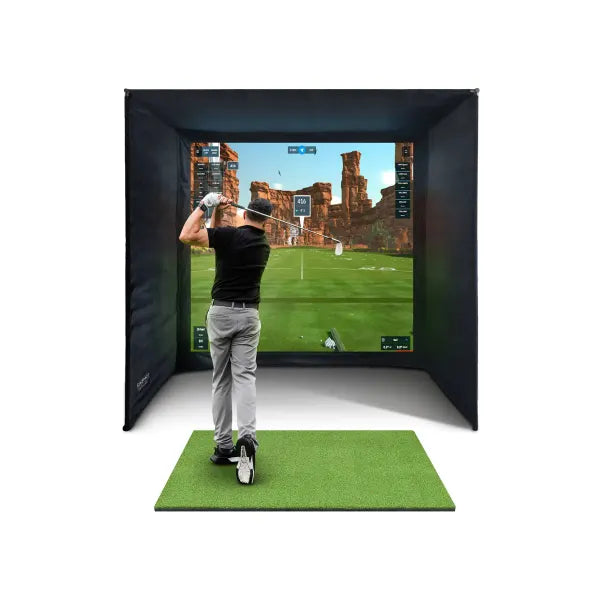
Our simulator bundles pair premium launch monitors with SimSpace enclosures that already look the part. The SimSpace's dark steel frame, premium velour-lined interior, white platinum impact screen, and foam-padded edges create a professional, immersive centrepiece for any room. From the Mevo Gen 2 bundle for those starting out, through the GC3S bundle for serious accuracy, to the GCQuad bundle and the Golfzon Wave bundle for the ultimate home experience — the equipment is only half the equation. The room around it completes the picture.
For golfers who need a more flexible setup, the Vanish 16 retractable enclosure and Vanish 13H retractable enclosure let you transform any room into a simulator space and fold it away when the room serves other purposes. The design principles in this guide still apply — good lighting, dark walls, and proper cable management enhance the experience even in a multi-use room.
If you are focused on putting practice, the ExPutt RG putting simulator pairs beautifully with the lounge area concept — set it up in front of the sofa, pour a drink, and dial in your putting stroke in total comfort. The PGA Tour Augusta putting mat and Breaking Ball putting mat are excellent additions to any simulator room, providing a practice surface that is always ready without firing up the full system.
And when it comes to your impact screen, screen quality has a direct impact on both image clarity and room noise levels. The Pro impact screen offers excellent value for standard setups, while the QuadPro screen delivers superior image quality and reduced noise for premium builds. For a different approach, the Close Knit Baffle screen is designed for net-based setups where ball containment is the priority.
Browse our full collection of golf simulators, hitting mats, and practice nets to find the right equipment for your space. And then make the room around it worthy of what is inside.
Frequently Asked Questions
How much does it cost to design a golf simulator room?
A basic design upgrade — dark paint, LED lighting, a dimmable bulb, and cable management — costs under £100. A mid-range design including acoustic treatment, rubber flooring, a soundbar, and some artwork costs £400 to £800. A comprehensive design with a feature wall, lounge seating, smart lighting, secondary monitor, and premium finishes costs £1,000 to £2,500. These figures are for the room design only, separate from the simulator equipment itself. For a full breakdown of simulator equipment costs, see our cost guide.
What colour should I paint my golf simulator room?
Dark colours — matt dark grey, charcoal, or black — are the best choice for the walls surrounding the impact screen. Dark walls reduce ambient light reflection, improve projected image quality, and create an immersive, cinematic atmosphere. Paint at least the screen wall and side walls dark. The rear wall can be lighter or treated as a feature wall. Always use matt or flat finishes, never gloss or satin, as shiny surfaces reflect light.
Do I need acoustic treatment in my simulator room?
If your room has hard, parallel walls — which most garages, spare rooms, and garden rooms do — acoustic treatment makes a meaningful difference. It reduces echo, controls the sharp crack of ball-on-screen impacts, and prevents sound from travelling through walls into the rest of your home. A basic treatment of six to eight fabric-wrapped acoustic panels costs £150 to £300 and is one of the most underrated upgrades you can make.
What flooring is best for a golf simulator room?
Interlocking rubber gym tiles (15mm thick, solid black) are the most popular and practical choice. They provide cushioning over concrete, insulate against cold, dampen vibration, and create a clean, professional look. Commercial-grade carpet tiles are an alternative for rooms inside the house where comfort is a priority. Whatever flooring you choose, your hitting mat sits on top of it.
Can I build a golf simulator in a room I also use for other things?
Yes. Many golfers share their simulator space with a home gym, office, or living area. The key is choosing equipment that can be stored or concealed when not in use. A retractable enclosure folds away against the wall, and a portable launch monitor can be stored in a drawer. Design the room primarily for its secondary purpose (office, gym) and design the simulator elements to be visually discreet when not active. Smart lighting scenes help — switch from "office mode" to "golf mode" with a single command.
How do I reduce the noise from my golf simulator?
The biggest noise source is the ball hitting the impact screen. Reduce this with: (1) a heavier, denser screen material like the QuadPro screen, (2) a 30cm air gap between the screen and the wall behind it, (3) acoustic panels on side and rear walls to reduce reverberation, (4) bass traps in room corners to absorb low-frequency impact noise, and (5) foam practice balls for late-night sessions. A quality hitting mat also absorbs more impact energy than a thin mat, reducing club-on-mat noise.
What lighting should I use in my golf simulator room?
Use a combination of dimmable overhead downlights (for general use) and warm white LED strip lighting (for atmosphere during sessions). The critical rule is that no light source should directly illuminate the impact screen — all lighting should be behind or beside the hitting position. Smart LED strips with scene control let you switch between bright setup lighting and dim atmospheric lighting with a single tap or voice command. Budget £50 to £150 for a complete lighting upgrade.
What is the best way to display shot data in my simulator room?
A secondary monitor (24 to 32 inches) mounted on a swing arm beside the hitting position gives you real-time access to launch angle, ball speed, spin rate, carry distance, and other metrics while the projector shows the course view. Most simulator software platforms support dual-screen output. Position the monitor at eye level, slightly to the side of your stance, so you can glance at it between shots without leaving the mat.
How do I make a garage golf simulator room feel less like a garage?
Five changes make the biggest difference: (1) paint the walls dark — this single change removes the "garage" feel more than anything else, (2) cover the concrete floor with rubber gym tiles, (3) add LED strip lighting for atmosphere, (4) hide all visible cables with trunking, and (5) add three or four framed prints or personal items to the walls. These five changes cost under £250 in total and transform a bare garage into a space that feels intentional and designed. For the full garage conversion process, see our garage build guide.
Should I hire an interior designer for my simulator room?
For most simulator rooms, no. The design principles are straightforward — dark walls, layered lighting, sound control, cable management, and personal touches. This guide gives you everything you need to create a stunning space. However, if you are building a high-end dedicated room with a budget of £5,000 or more for the design elements, a designer who understands home entertainment spaces can add real value. Make sure they understand the functional requirements (projector visibility, swing clearance, cable routing) before they start specifying furniture that looks great but blocks the screen.
What is the best golf simulator setup for entertaining guests?
For social use, prioritise a lounge area with comfortable seating, a drinks station, and a quality sound system. A bundle with a full enclosure and projector creates the best visual spectacle for groups. Add a secondary monitor showing shot data so non-golfers can follow along and understand what they are watching. Smart lighting that switches between "golf mode" and "social mode" sets the right atmosphere. The best simulator for beginners is often also the best for entertaining, because it prioritises fun and accessibility over advanced features that only scratch golfers appreciate.
Your golf simulator room is more than a place to practice. It is a space where technology meets design, where performance meets comfort, and where a passion for golf finds its home — literally. Invest in the room, not just the equipment, and you will build something you look forward to walking into every single day.
Ready to start? Browse our full range of golf simulators and bundles to find the centrepiece for your room, then use this guide to build the space it deserves.


Leave a comment