
Indoor Golf Simulator UK: The Complete Guide to Playing Golf at Home (2026)

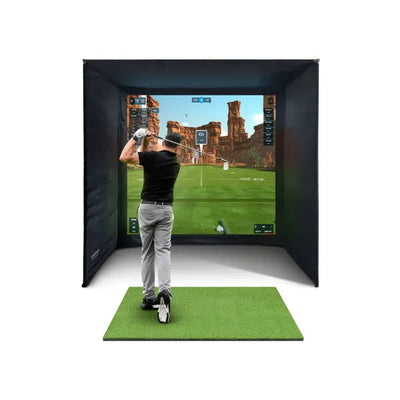

There is a reason indoor golf simulators are growing faster in the UK than almost anywhere else in the world. It is not because British golfers love technology more than anyone else. It is because British golfers lose more playing days to weather than almost anyone else, and an indoor simulator is the only solution that genuinely replaces what you lose.
An indoor golf simulator lets you hit real golf balls into an impact screen, see your shot fly on a projected virtual course, and get precise data on every swing — all from your garage, spare room, or garden building. No rain. No frost. No fading daylight at half three in December. Just golf, whenever you want it.
This guide covers what indoor golf actually feels like, how the technology and software work, why the UK weather makes a uniquely compelling case, and which setups make the most sense for British homes in 2026. If you want to compare specific bundles, our complete buying guide covers every simulator for sale. If you need to check your room dimensions first, start with our room size guide.
What Indoor Golf Actually Feels Like
The most common misconception about indoor golf simulators is that they feel like a video game. They do not. The physical act of hitting a golf ball is identical — you swing a real club at a real ball with the same technique, effort, and physical sensation as on a course. The ball launches off your clubface into an impact screen 2.5 metres away, and the satisfying crack of a well-struck iron is every bit as real indoors as outdoors.
What changes is the feedback loop. Outdoors, you watch your ball fly against the sky, estimate where it lands, and feel the wind on your face. Indoors, you watch a projected ball flight calculated from actual measured data — ball speed, launch angle, spin rate, and spin axis — while standing in a warm, well-lit room.

For some golfers, the sensory experience of outdoor golf is irreplaceable. For others — particularly those who have spent hundreds of evenings freezing at a driving range or cancelling rounds because of rain — the indoor experience is not a compromise. It is an upgrade.
What surprises first-time indoor golfers
- The data is addictive. Seeing your exact carry distance, spin rate, and shot shape after every swing changes how you think about practice. After a few sessions, hitting balls without data feels pointless
- The courses are genuinely engaging. Playing a projected round on virtual St Andrews is not the same as being there, but it is remarkably immersive. You find yourself thinking about club selection and feeling genuine disappointment when a 7-iron finds a virtual water hazard
- You practise more than expected. When practice requires zero travel, zero planning, and zero weather exposure, the golfer who visited the range twice a week becomes the golfer who hits balls every evening
- It is louder than expected. A real golf ball hitting an impact screen at driver speed makes a sharp crack that carries through walls. Something to consider for late-night sessions
- Short game needs separate work. Simulators excel at full swings and approaches. Chipping, pitching, and putting require supplementary practice — an ExPutt putting simulator helps, but full short game touch demands real turf
Indoor Golf vs the Alternatives
An indoor simulator is not the only way to practise at home. Understanding how it compares to alternatives helps you make the right choice.
vs driving range
A driving range gives you outdoor atmosphere and social interaction. An indoor simulator gives you better data, unlimited practice at any hour, weather independence, and virtual course play. We covered this in depth elsewhere, but the economics are clear: at £10 per session plus £5 travel, twice-weekly range visits cost £1,560 per year. A Mevo Gen 2 bundle at £2,498 pays for itself in under two years.
vs outdoor practice net
A garden practice net works well in summer but gives you no feedback on where the ball went. Add a launch monitor and you get data, but you remain weather-dependent with no course play or multiplayer. An indoor simulator delivers the complete package year-round.
vs commercial indoor golf venue
Commercial simulator venues are excellent for trying the technology and social events. But at £25-£50 per hour, weekly visits cost £1,300-£2,600 per year. A home setup at £2,498-£5,289 pays for itself in one to three years with unlimited access.
The Software: 200,000+ Courses from Your Garage
The software transforms a launch monitor and screen into a golf experience. It is the difference between "I hit a ball and got some numbers" and "I just played 18 holes at Carnoustie and shot 79."

Three platforms dominate the UK market in 2026 (see our full software comparison):
GSPro — the most popular platform. Over 200,000 community-created courses, the most realistic physics engine, and the largest multiplayer community. Approximately £200 per year.
E6 Connect — the most polished platform. 100+ professionally designed courses with consistent quality. Included free with Mevo Gen 2 and Full Swing KIT bundles.
Awesome Golf — the best visuals. Photorealistic courses on Windows, Mac, and iPad. Approximately £180 per year.
FSX Play — included free with all Foresight monitors (GC3S, GC3, GCQuad). Solid course library with seamless hardware integration.
Beyond course play
Modern simulator software offers virtual driving ranges with shot trails and data overlays, skills challenges, online multiplayer leagues, shot history tracking over weeks and months, and structured practice drills. The virtual range alone is far more useful than any real driving range because you see precisely where every ball lands.
Why course play changes everything
Playing a virtual round is where indoor golf becomes addictive. Every shot matters because there is a scorecard. You face hazards, doglegs, elevation changes, and wind. This engages the strategic and mental parts of your game — club selection, course management, pressure — that range practice never touches.
The multiplayer element adds another dimension. Playing online against friends, each in their own garage, with banter on the phone between shots, is the closest thing to a real fourball without leaving the house. Some golfers run weekly winter leagues with standings, handicaps, and prizes.
Why the UK Weather Makes Indoor Golf Essential
Every country has golfers who wish they could play more. But the UK has a uniquely compelling case for indoor golf.

According to Met Office data, the UK averages 156 rainy days per year — exceeding 180 in western regions. Add freezing winds, frost delays, and waterlogged fairways, and you lose 200+ days of comfortable golf annually.
From October to March:
- Daylight vanishes. December sunset is 3:50pm in southern England, 3:30pm in Scotland. Weekday golf is impossible for four months
- Courses close. Temporary greens, trolley bans, and full closures after heavy rain are routine. Full club membership, half-year access
- Range practice degrades. Numb fingers, rubber mats, and zero ball flight feedback — it is endurance, not practice
- Performance suffers. Cold muscles, stiff joints, and extra layers degrade every swing. Winter golf is not just less pleasant — it is worse golf
An indoor simulator eliminates all of this. You practise in a warm room, under good lighting, with perfect conditions, at any time. The data from a Tuesday evening in January is directly comparable to a Saturday in July because the environment is identical. We covered the full winter case in a dedicated article.
Year-round benefits beyond winter
Most simulator owners discover indoor golf is not seasonal. Summer evening sessions after the children are in bed, pre-round warm-ups on Saturday mornings, post-round diagnosis when something felt off, equipment testing in a controlled environment, and social entertainment for family and friends — the year-round value far exceeds the winter use case alone.
Indoor Golf Simulator Bundles for UK Homes
Every indoor simulator is built from the same core: a launch monitor, an enclosure with impact screen, a hitting mat, and (for the full experience) a projector, PC, and software. Buying as a tested bundle guarantees compatibility and saves 10-15% over sourcing individually.
| Bundle | Technology | UK Price (From) | Best For |
|---|---|---|---|
| FlightScope Mevo Gen 2 | Doppler radar | £2,498 | Best value, indoor + outdoor versatility |
| Golfzon WAVE | Stereoscopic camera | £6,788 | Camera accuracy, Golfzon ecosystem |
| Foresight GC3S | Photometric camera | £4,988 | Tour-level ball data, compact UK rooms |
| Full Swing KIT | Camera + radar hybrid | £5,988 | Full club data included, flexible mounting |
Every bundle includes a SimSpace steel-frame enclosure with premium velour-lined interior, Platinum triple-layer impact screen, and hitting mat. Add a projector (£300-£1,500) and PC (£0-£1,200) for the projected experience. Full cost breakdown in our price guide.
Quick recommendations
Best value entry point: The Mevo Gen 2 bundle from £2,498 includes E6 Connect software, works both indoors and outdoors, and delivers 16 measured parameters. The world's best-selling launch monitor. Read our Mevo Gen 2 review.
Best for tight UK rooms: The GC3S bundle from £4,988 uses cameras that sit beside the ball — zero rear space needed. Tour-level accuracy in rooms where a radar monitor would not fit. Ideal for single garages. Read our GC3S review.
Best for swing analysis: The Full Swing KIT bundle from £5,988 measures club path, face angle, and angle of attack as standard. The same technology Tiger Woods uses at home.
Setting Up in a UK Home
Three locations consistently work for UK indoor golf setups:
Garage — the most popular choice. A standard single garage (3.0 x 5.0m) fits a SIM 1 or SIM 2 enclosure with a camera-based monitor. Budget £320-£730 for insulation and heating to make it year-round. Our garage build guide covers every step.
Spare room — works for a net-and-monitor setup with tablet-based data display. Ceiling height at 2.4m is tight for drivers. Use foam balls. More "practice station" than full simulator, but the data quality is identical.
Garden room — the premium option. Recommended minimum: 4.0m wide x 5.5m deep x 2.8m high. Cost: £8,000-£20,000. Many designs fall under permitted development. See our garden room guide.
Minimum room dimensions
| Dimension | Camera Monitor | Radar Monitor | Comfortable |
|---|---|---|---|
| Width | 3.0m (10ft) | 3.0m (10ft) | 3.7m+ (12ft+) |
| Depth | 3.5m (11ft 6in) | 5.0m (16ft 5in) | 5.5m+ (18ft+) |
| Ceiling height | 2.5m (8ft 2in) | 2.5m (8ft 2in) | 2.7m+ (9ft+) |
If your room is between 3.5m and 5m deep, a camera-based monitor is the only practical choice. Our size and space guide covers every scenario.
How Indoor Golf Improves Your Actual Game
The entertainment value is obvious. The improvement value works through three mechanisms outdoor practice cannot match.
1. Data-driven feedback. On an indoor simulator, you know your 7-iron carried exactly 147 yards with 6,200 RPM backspin and 1.2 degrees of fade. At a range, you guess it went "about 150" with "a slight fade." This precision turns vague practice into targeted training — you work on specific, measurable goals like tightening your spin range or reducing carry distance variance.
2. Higher practice frequency. No travel, no booking, no weather barriers. A 30-minute session at 9pm on a Tuesday delivers identical data quality to a Saturday afternoon. Simulator owners consistently practise three to five times per week — double or triple their previous range frequency. And daily short sessions produce better results than weekly marathons, because skill acquisition favours frequency over duration.
3. Simulated pressure. Range balls carry no consequences. Virtual course play creates genuine pressure — a scorecard, hazards, friends competing online, scores tracked over time. This engages the mental dimensions of golf that range practice ignores but that determine a significant portion of your on-course performance.
The combination typically produces two to four strokes of handicap improvement over a full season. Not from magic technology — from doing more of the right practice, with better feedback, more often.
What Indoor Golf Cannot Replace
An honest guide should be upfront about limitations:
- Lies and terrain. Every indoor shot is from a perfect, flat mat. Adapting to slopes, rough, and divots requires outdoor play
- Wind feel. Software simulates wind effects on ball flight, but the instinctive reading of real wind comes from outdoor experience
- Short game touch. Chipping off real grass, reading real greens, and playing bunker shots demand real turf
- The walk. Golf is a four-hour walk in a beautiful setting. Indoor golf is practice and entertainment; outdoor golf is an experience
The best golfers treat indoor and outdoor as complementary. Indoor for data-driven practice, equipment testing, and winter maintenance. Outdoor for the full experience, short game, and the simple pleasure of golf under an open sky.
Frequently Asked Questions
How much does an indoor golf simulator cost in the UK?
A complete bundle costs from £2,498 (FlightScope Mevo Gen 2) to £12,999+ (Foresight GCQuad), including launch monitor, SimSpace enclosure, impact screen, and mat. Add a projector (£300-£1,500) and PC (£0-£1,200) for the projected experience. Realistic all-in cost: £3,100-£7,500 for most golfers. Our cost guide breaks down every price point.
Can I use a golf simulator in a standard UK garage?
Yes. A standard single garage (approximately 3.0 x 5.0m, 2.3-2.5m ceiling) fits a SIM 1 or SIM 2 enclosure with a camera-based monitor. The Foresight GC3S is ideal for garages because it sits beside the ball with zero rear space. Insulate and heat the garage for year-round comfort. See our garage build guide.
Is indoor golf as good as playing outdoors?
It is different rather than better or worse. Indoor golf delivers superior practice through precise data, unlimited access, and weather independence. Outdoor golf delivers terrain variety, wind, short game touch, and the full sensory experience. Most simulator owners treat them as complementary: indoor for training, outdoor for playing. The practice quality indoors is genuinely superior to a driving range; the playing experience outdoors is irreplaceable.
What courses can I play on an indoor golf simulator?
GSPro offers over 200,000 courses including St Andrews, Carnoustie, Wentworth, and Pebble Beach recreations. E6 Connect has 100+ professional courses. Awesome Golf has 200+ photorealistic courses. Between these platforms, you have more courses than you could play in a lifetime. See our software comparison.
How accurate are indoor golf simulators?
Camera-based monitors like the GC3S measure ball data to within 1% of professional fitting equipment. Radar monitors like the Mevo Gen 2 deliver 2-3% accuracy on ball speed and distance. The virtual ball flight is calculated from real measured data, not a guess. See our accuracy guide.

Getting Started
The path from decision to first shot is straightforward:
- Measure your space — width, depth, and ceiling height at the hitting position. Use our room size guide
- Choose your monitor type — camera-based for rooms under 5m deep, radar if 5m+ or you want outdoor use too
- Pick your bundle — browse the complete collection or use our buying guide
- Budget for extras — projector, PC, software, and room preparation. Our cost breakdown covers everything
- Assemble — SimSpace enclosures are home-assembly friendly. Two people, 2-4 hours, standard tools
Most customers go from order to first shot within 7-14 days. No specialist installation, no complex wiring, no building work unless your room needs modification.
An indoor golf simulator is the most practical investment a UK golfer can make. The British weather steals half your playing season. A simulator gives it back — with better data, unlimited access, and measurable improvement that carries directly onto the course. Start with the UK buyer's guide or browse the bundle range to find the right match for your space and budget.

Free Home Golf Simulator Design Consultation
Not sure on space, screen or launch monitor? Chat directly with Tom, OpenGolfer’s founder — he has designed hundreds of home setups and will tell you exactly what fits your room and budget.
- Send your room size (or a photo) — get a tailored layout and spec for your space, ceiling height included
- Personal replies from a real golfer, not a call centre
- Honest advice on what to buy — and what not to
Usually replies within the hour, 8am–8pm · prefer to talk? 02033 768500


Leave a comment