
Foresight GC3S Review UK: Is Camera-Based Worth the Premium?


The Foresight GC3S occupies a peculiar position in the UK golf simulator market. It is not the cheapest launch monitor you can buy — not by a long way. It is not the most feature-rich either, lacking club data in its base configuration. And it is essentially useless outdoors, which rules out half the use cases most golfers imagine when they spend thousands on a launch monitor.
And yet, for a specific type of UK buyer — someone building a dedicated indoor simulator in a tight single garage or spare room — the GC3S might be the smartest purchase available. Its three high-speed cameras deliver spin data that genuinely rivals monitors at double the price. It sits beside the ball, requiring zero space behind you. And it carries the Foresight name, the same brand trusted on every PGA Tour and LPGA Tour fitting van in the world.
This review is for UK golfers seriously considering the GC3S. We will cover what it does brilliantly, where it falls short, who should buy it, who should save their money on the FlightScope Mevo Gen 2 (from £2,498) instead, and whether camera-based technology is genuinely worth the premium in 2026. No fence-sitting — you will get a clear answer.
If you are still at the research stage, our complete UK buyer's guide covers the full simulator decision. If you want to see how the GC3S stacks up against its closest rival, our GC3S vs Mevo Gen 2 head-to-head comparison goes deep on that specific matchup.
Quick Verdict: Who Should Buy the GC3S?
In a hurry? Here is the short version.
Buy the Foresight GC3S if:
- Your simulator room is under 5 metres deep (typical UK single garage)
- You are building a dedicated indoor-only simulator that will never move
- Spin accuracy is your non-negotiable priority — you want to see exactly how much spin your wedge produces
- You plan to stay within the Foresight ecosystem and potentially upgrade to a GC3 or GCQuad later
Save your money and buy the Mevo Gen 2 (from £2,498) if:
- You want to use your launch monitor indoors and outdoors
- Your room is 5 metres or deeper, so the radar space requirement is not an issue
- You want club data (speed, path, angle of attack) included without paying extra
- Budget matters — the Mevo Gen 2 bundle is roughly half the price
Now, let us dig into the detail.
Foresight GC3S: Full Specifications

| Specification | Foresight GC3S |
|---|---|
| Technology | Photometric (camera-based) |
| Sensors | 3 high-speed cameras |
| Placement | Beside the ball (to the right for right-handers, left for left-handers) |
| Ball data (measured) | Ball speed, launch angle, total spin, backspin, sidespin, spin axis, carry distance |
| Club data | Available as paid upgrade (not included in base GC3S) |
| Spin measurement | Direct optical measurement from ball surface — highest accuracy at this price point |
| Metallic dot stickers | Required for optimal spin tracking |
| Space behind ball | Zero — sits beside the ball |
| Indoor use | Excellent — designed specifically for it |
| Outdoor use | Limited — no ball flight tracking beyond launch |
| Software included | FSX Play |
| GSPro compatible | Yes |
| E6 Connect compatible | Yes |
| Awesome Golf compatible | Yes |
| Connectivity | USB, Wi-Fi, Bluetooth |
| Weight | Approximately 0.5 kg |
| Battery | Rechargeable, approximately 5 hours |
| UK bundle price | From £5,289 |
The numbers tell part of the story. The rest depends on understanding what photometric technology actually does — and why it matters for indoor simulator use.
How the GC3S Works: Camera-Based Technology Explained
The GC3S belongs to the photometric family of launch monitors. Instead of bouncing radio waves off the ball (like a radar unit), it uses three high-speed cameras to photograph the ball at the exact moment of impact and during the first few centimetres of flight.
From those images, the GC3S directly measures:
- Ball speed — how fast the ball leaves the clubface
- Launch angle — the vertical angle at which the ball takes off
- Total spin — the overall rotation rate of the ball (in rpm)
- Backspin and sidespin — the individual components of that rotation
- Spin axis — the tilt angle that determines whether your shot draws, fades, or flies straight
- Carry distance — calculated from the measured launch conditions using a physics model
The critical word is directly measured. The cameras see the ball surface. They read the markings (or metallic dot stickers) on the ball to determine exactly how fast it is spinning and in which direction. This is fundamentally different from a radar monitor, which infers spin from the ball's flight characteristics.
Why does this matter? Because spin is the hardest measurement for any launch monitor to get right, and it is the measurement that separates a useful simulator from a toy. A 200 rpm error in spin rate can mean 5–8 yards of carry distance difference on a 7-iron. A 5-degree error in spin axis is the difference between a slight fade and a straight shot. The GC3S's direct optical measurement gives it a genuine accuracy advantage in exactly the data points that matter most for realistic simulation.
The trade-off is that the cameras only capture what happens at and immediately after impact. The GC3S does not track the ball through its flight — it measures the launch conditions and then uses physics to predict the trajectory. Indoors, hitting into a screen 3 metres away, this is completely irrelevant because the ball never completes a full flight anyway. Outdoors, it means the GC3S cannot tell you where your ball actually landed, which limits its practical value on the range or course.
For a deeper dive into how launch monitor accuracy works in practice, see our article on how accurate golf simulators really are.
Accuracy Assessment: Where the GC3S Excels and Where It Does Not Matter

Accuracy claims are the most common marketing battleground in launch monitors, and the most misleading. Every manufacturer claims "tour-level accuracy" because the phrase has no regulated definition. Here is an honest assessment of the GC3S based on real-world indoor simulator use.
Spin rate and spin axis — genuinely excellent
This is where the GC3S earns its premium. With metallic dot stickers applied, the cameras produce spin rate readings that are typically within 100–200 rpm of a GCQuad (the £9,000+ tour standard). For context, the Mevo Gen 2 indoors is typically within 200–400 rpm, and budget monitors can be 500+ rpm adrift.
Spin axis accuracy is even more impressive. The GC3S consistently differentiates between a 2-degree and a 5-degree axis tilt — the difference between a gentle fade and a pronounced cut. This level of precision genuinely affects your simulator experience. When you hit a wedge that should check and spin back on the virtual green, the GC3S's data makes that happen realistically in GSPro, E6 Connect, and other software.
If you are the type of golfer who wants to test different ball models for spin characteristics, compare wedge grinds, or precisely track how your spin numbers change with swing adjustments, the GC3S provides data you can trust.
Ball speed — excellent, but so is everyone else
Ball speed accuracy is a non-issue at this price point. The GC3S, Mevo Gen 2, and essentially every mid-range monitor from a reputable manufacturer measures ball speed within 1–2 mph of each other. You will not notice a difference between any of them in day-to-day simulator use. This is not a differentiator for the GC3S.
Launch angle — excellent, but again, unremarkable
Same story as ball speed. Camera-based monitors have a slight theoretical edge because they photograph the ball at impact, but in practice, the difference between the GC3S and a good radar monitor is 0.1–0.3 degrees. That is not meaningful for any golfer outside a professional fitting environment.
Carry distance — calculated, not measured
Because the GC3S does not track the ball through flight, carry distance is calculated from ball speed, launch angle, and spin using an aerodynamic model. Indoors, every launch monitor calculates carry this way (the ball hits the screen at 3 metres, so nothing is being "measured" past that point). The GC3S's calculated carry is very accurate because the launch condition inputs — particularly spin — are so reliable.
Outdoors, a radar monitor like the Mevo Gen 2 actually tracks where the ball lands, giving it a measured carry distance. If outdoor accuracy matters, the GC3S loses this comparison. Indoors, it is a draw.
The accuracy summary
The GC3S's genuine accuracy advantage is spin rate and spin axis. Everything else is comparable to its mid-range competitors. If spin precision is what you care about most, the premium is justified by real data. If you primarily care about ball speed, launch angle, and carry distance, you are paying for an accuracy edge you will not notice in practice.
Setup and Daily Use

Initial setup
The GC3S arrives as a compact, sleek unit weighing roughly half a kilogram. You place it on the floor beside your ball — slightly behind and to the right for right-handed golfers, to the left for left-handers. A guide light on the device helps you align it correctly relative to the ball position.
First-time setup involves connecting the GC3S to your computer or tablet via USB, Wi-Fi, or Bluetooth, then pairing it with your chosen simulation software. Foresight's own FSX Play is included and walks you through the calibration process. If you are using GSPro (which most UK simulator owners end up on), the connection is straightforward and well-documented in the GSPro community.
Total time from unboxing to first swing: approximately 15–30 minutes, including software installation.
The metallic dot sticker routine
This is the one daily-use friction point that potential GC3S buyers need to know about honestly. For optimal spin tracking, you need to apply small metallic dot stickers to each golf ball before hitting. The stickers give the cameras a high-contrast, reflective surface to read the ball's rotation.
Without stickers, the GC3S will still measure ball speed and launch angle reliably. But spin data becomes inconsistent — sometimes accurate, sometimes not. If you are investing in the GC3S specifically for its spin accuracy (which is the main reason to buy it), skipping the stickers defeats the purpose.
In practice, the sticker routine adds 5–10 seconds per ball. Most simulator owners apply stickers to a batch of 10–20 balls at the start of a session. The stickers are inexpensive — a few pounds for a sheet of 100+ — and they peel off easily when you are done. It is a minor inconvenience, not a dealbreaker, but it is worth knowing about before you buy.
Worth noting: the Mevo Gen 2 also benefits from metallic dot stickers for improved indoor spin accuracy. This is not a GC3S-specific limitation — it is a characteristic of indoor launch monitor use in general.
Day-to-day experience
Once positioned, the GC3S is a set-and-forget device. It does not need re-alignment between shots. It does not move. It does not interfere with your stance or swing. Many simulator owners leave it permanently installed on a small shelf or platform beside their hitting position, powered by USB from their simulation PC.
Battery life is approximately 5 hours, which is more than enough for even the longest practice sessions. If you connect via USB, it runs indefinitely from wall power. The compact form factor means it is easy to tuck away — you will barely notice it once installed.
Shot registration is fast and reliable. Hit a ball, and the data appears in your software within a second. Mis-hits and topped shots are captured accurately (and humblingly). The cameras are not confused by partial contact or thin strikes, which is important for practice value — a monitor that only captures your good shots does not help you improve.
Software compatibility
The GC3S works with every major simulator software platform available in the UK:
- FSX Play — included with the GC3S, Foresight's own platform with quality courses and fitting tools
- GSPro — the most popular simulator software in the UK, approximately £200/year, 100,000+ community courses
- E6 Connect — polished commercial platform, excellent graphics, licensed courses
- Awesome Golf — growing platform with a strong course library
- Creative Golf 3D — another solid option with wide monitor support
Software compatibility is not a differentiator in 2026. Nearly every mid-range monitor works with nearly every software platform. If you are choosing the GC3S, it is for the hardware, not the software access.
The Space Advantage: Why UK Buyers Choose Camera-Based
This is the GC3S's killer feature for the UK market, and it is not about accuracy at all — it is about geometry.
A radar-based launch monitor like the Mevo Gen 2 needs to sit 1.5–2.5 metres behind the ball. In a room that is 5 metres deep (a typical UK single garage), this layout works but is tight:
- 2 metres behind the ball for the radar unit
- 3 metres from you to the impact screen
The GC3S sits beside the ball. Every centimetre of your room's depth is available for the hitting zone and screen distance. In that same 5-metre garage:
- 1 metre from the back wall to your hitting position (for comfort and backswing clearance)
- 4 metres from you to the screen — a generous, comfortable distance
That extra metre or more of screen distance might sound trivial on paper, but in practice it makes a substantial difference. A larger screen distance means a larger projected image, a more immersive experience, and more natural depth perception. It also gives the ball more time to slow down before hitting the screen, which reduces wear and noise.
For rooms shorter than 5 metres — a spare bedroom at 3.5 metres, a compact garden room at 4 metres, or a particularly short garage — the GC3S is not just better than a radar alternative. It is the only viable option for a launch monitor at this quality level. A radar monitor physically cannot function without rear clearance.
For detailed room planning, including width, height, and layout diagrams, see our golf simulator room size guide.
The Indoor-Only Limitation: An Honest Assessment
It would be dishonest to review the GC3S without addressing its most significant weakness head-on: outdoor use is severely limited.
Because the cameras photograph the ball at impact but do not track it through the air, the GC3S cannot tell you where your ball actually lands on a driving range. It measures launch conditions and calculates a predicted landing zone, but it does not confirm what the ball actually did. Wind, altitude, temperature, and ball condition are not accounted for in real time.
For a UK golfer who wants to take their launch monitor to the range in summer, use it during a casual round with friends, or practise in the garden on a sunny afternoon, the GC3S is the wrong tool. It can technically be taken outdoors, and it will still measure ball speed, launch angle, and spin at impact. But you are using it in an environment it was not designed for, and the experience is noticeably inferior to a radar monitor.
The FlightScope Mevo Gen 2 was designed from the ground up for both indoor and outdoor use. Its radar tracks the ball from launch to landing, giving you measured carry and total distance on the range. If outdoor versatility has any weight in your decision, the Mevo Gen 2 wins this comparison decisively.
The honest question you need to answer: Will your launch monitor live permanently in your simulator room, or is there any chance — even a slight one — that you will want to take it to the range or garden? If it never leaves the room, the GC3S's outdoor limitation is completely irrelevant. If there is even a 20% chance you will use it outside, that limitation becomes a real cost.
Bundle Value Assessment: What You Get for £5,289
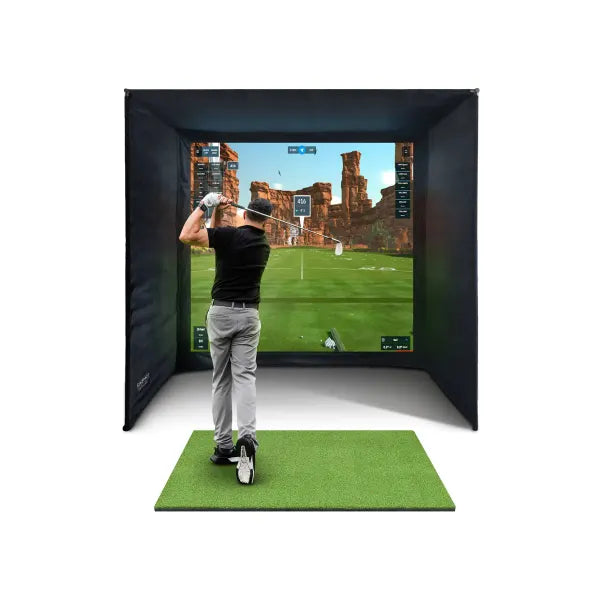
The GC3S Bundle from £5,289 includes everything needed for a complete, ready-to-hit simulator:
- Foresight GC3S launch monitor — 3 high-speed cameras, direct spin measurement, FSX Play included
- SimSpace enclosure — dark steel frame with premium dark velour-lined interior panels, fully enclosed professional design
- Platinum impact screen — triple-layer white screen rated for years of daily use, suitable for projection
- Premium hitting mat — quality surface with proper cushioning for joint protection
- Mounting hardware, bungees, and setup guidance
The enclosure deserves mention. The SimSpace is not a pop-up tent or a flimsy frame with netting. It is a steel-framed, velour-lined enclosure that looks and feels like a permanent installation. The foam-padded frame edges dampen sound, the velour panels absorb light for better projection quality, and the overall build quality is a genuine step above budget alternatives. For a detailed look at enclosure options, see our enclosures and impact screens guide.
What you still need to buy separately
- A projector (£350–£800) — unless you plan to view simulation on a tablet or monitor
- A computer or laptop (£600–£1,200 for GSPro-capable) — unless you already own one
- Simulation software (£0–£200/year) — FSX Play is included; GSPro is approximately £200/year extra
- Metallic dot stickers (£5–£10 per sheet) — ongoing consumable for spin tracking
- Club data upgrade (price varies) — if you want club head speed, path, and face angle
All-in, a complete GC3S-based simulator with projector, PC, and GSPro subscription costs roughly £6,500–£7,500 depending on your projector and computer choices. That is a significant investment, and it is worth being upfront about the total cost rather than focusing only on the bundle price.
GC3S vs GC3: Is the Upgrade Worth It?
The Foresight GC3 bundle starts from £8,959 — roughly £3,670 more than the GC3S bundle. What does that premium buy you?
The GC3 uses the same photometric camera platform as the GC3S but adds dedicated club head tracking. This means the GC3 directly measures:
- Club head speed
- Club path
- Face angle
- Dynamic loft
- Angle of attack
The GC3S does not measure any of these in its base configuration. You can unlock club data on the GC3S via a paid firmware upgrade, but even then, the GC3's dedicated club tracking hardware delivers more reliable readings.
Who should upgrade to the GC3:
- Golfers actively working on swing mechanics who need to see how their club path and face angle change between sessions
- Anyone doing informal club fitting at home — testing shafts, lofts, or lie angles
- Coaches or teaching professionals who need full data for student feedback
- Golfers who want the most complete data set possible without paying for upgrades
Who should stick with the GC3S:
- Golfers primarily focused on ball data and simulation play
- Buyers who want excellent indoor accuracy without stretching to £9,000+
- Anyone who uses GSPro or E6 Connect mainly for virtual rounds rather than swing analysis
The honest answer for most home simulator owners: the GC3S gives you 90% of the GC3's value for roughly 60% of the price. Club data is genuinely useful for improvement, but many golfers get more value from simply playing more virtual rounds and tracking their ball data trends over time. The £3,670 price gap buys a lot of GSPro subscription years.
Pros and Cons
| Pros | Cons |
|---|---|
| Outstanding indoor spin accuracy — direct optical measurement | No club data in base configuration (paid upgrade required) |
| Zero space needed behind the ball — ideal for tight UK garages | Severely limited outdoor use — no ball flight tracking |
| Compact and lightweight (0.5 kg) — sits discreetly beside hitting area | Metallic dot stickers required for best spin data |
| Excellent build quality and reliability | Bundle price (from £5,289) is roughly double the Mevo Gen 2 bundle |
| Full software compatibility — GSPro, E6 Connect, FSX Play, Awesome Golf | No included club data means less out-of-the-box value vs Mevo Gen 2 |
| Foresight ecosystem — seamless upgrade path to GC3 or GCQuad | Indoor specialist only — if your needs change, the monitor does not adapt |
| PGA Tour and LPGA Tour proven technology | Carry distance is calculated, not measured (irrelevant indoors but worth noting) |
| Rechargeable battery lasts approximately 5 hours; USB for unlimited sessions | The premium over radar alternatives is large and not justified for every buyer |
Who Should Buy the Foresight GC3S
The GC3S is the right choice if:
- Your room is under 5 metres deep. This is the number one reason UK buyers choose the GC3S. In a 4–4.5-metre garage, spare room, or garden room, a radar monitor cannot function. The GC3S can. End of discussion.
- You are building an indoor-only, permanent simulator. The monitor will sit in the same spot for years. It does not need to be portable. It does not need to work at the driving range. You want the best possible indoor data, full stop.
- Spin accuracy matters to your practice. You test ball models, track wedge spin trends, and want data reliable enough to base equipment decisions on. The GC3S delivers.
- You value the Foresight brand and ecosystem. Foresight is the gold standard in professional fitting. The GC3S shares software, accessories, and a clear upgrade path with the GC3 and GCQuad. If you plan to grow within this ecosystem, starting with the GC3S makes strategic sense.
The GC3S is the wrong choice if:
- You want indoor and outdoor versatility. The GC3S is an indoor specialist. If there is any chance you will use your launch monitor at the range, in the garden, or on the course, the Mevo Gen 2 does both for half the price.
- Budget is your primary constraint. At from £5,289 for the bundle (before projector and PC), the GC3S is a serious investment. The Mevo Gen 2 bundle from £2,498 delivers an excellent simulator experience at a dramatically lower price point. The £2,791 you save buys a quality projector, a year of GSPro, and still leaves change.
- You want club data included. The Mevo Gen 2 includes club head speed, smash factor, angle of attack, and club path as standard. The GC3S charges extra for club data. If club metrics are important to your practice, the Mevo Gen 2 offers better out-of-the-box value.
- Your room is 5.5 metres or deeper. In a generous room, the radar space requirement is a non-issue. The GC3S's primary advantage — space efficiency — becomes irrelevant, leaving you paying a significant premium for a spin accuracy edge that most golfers will not notice in day-to-day play.
Final Verdict: Is Camera-Based Worth the Premium?

The question in our title deserves a straight answer: camera-based is worth the premium, but only for specific buyers with specific needs.
If your simulator lives in a tight UK single garage (under 5 metres deep) and you never plan to use the monitor outdoors, the Foresight GC3S is not just worth the premium — it is the obvious, logical, and arguably only sensible choice at this quality level. No radar monitor can function in that space. The GC3S solves a real, physical constraint that no amount of money spent on a radar unit will overcome. The spin accuracy is a genuine bonus on top of the space advantage.
If your room is 5.5 metres or more, if you have any interest in outdoor use, or if budget is a significant factor, the FlightScope Mevo Gen 2 (from £2,498) is the smarter purchase. You get indoor and outdoor capability, club data included, and a complete simulator experience for roughly half the price. The spin accuracy gap exists, but for the vast majority of home golfers, it does not meaningfully affect the quality of their practice or virtual rounds.
The Foresight GC3S is an excellent, specialist product. The key is understanding whether you are the specialist buyer it was built for.
Our recommendation by scenario
| Your situation | Our recommendation | Why |
|---|---|---|
| Single garage, 4–5m deep | GC3S Bundle (from £5,289) | Zero rear space needed — the only premium option that works |
| Double garage or large room, 5.5m+ | Mevo Gen 2 Bundle (from £2,498) | Space is not a constraint — better value |
| Indoor only, spin accuracy priority | GC3S Bundle (from £5,289) | Best indoor spin data at this price point |
| Indoor and outdoor use | Mevo Gen 2 Bundle (from £2,498) | The GC3S is severely limited outdoors |
| Budget is the primary concern | Mevo Gen 2 Bundle (from £2,498) | £2,791 saved with excellent accuracy |
| Want club data included | Mevo Gen 2 Bundle (from £2,498) | Club speed, path, AoA included as standard |
| Want the best possible data — budget no object | GC3 Bundle (from £8,959) | Camera accuracy plus full club data built in |
| Spare room or small garden room | GC3S Bundle (from £5,289) | Compact rooms need beside-the-ball placement |
Still deciding? Our complete launch monitor comparison guide covers every monitor worth considering, and our GC3S vs Mevo Gen 2 head-to-head goes deeper on the most common comparison. Browse our full range of UK simulator bundles to see the GC3S and every other monitor packaged with everything you need.
Frequently Asked Questions
Is the Foresight GC3S accurate enough for serious practice?
Yes. The GC3S's three high-speed cameras deliver ball speed and launch angle accuracy on par with monitors costing two to three times more, and its spin rate and spin axis measurements are among the best available under £5,000. For indoor simulator use, the GC3S provides data that is reliable enough for equipment testing, spin trend tracking, and meaningful practice improvement. It is used in the same product family as the GCQuad, which is the standard on professional tour fitting vans.
Does the GC3S work outdoors?
Technically, yes — it will still measure ball speed, launch angle, and spin at impact. But it does not track the ball through its flight, so you will not get measured carry or total distance. For practical outdoor range or course use, a radar monitor like the FlightScope Mevo Gen 2 is significantly more capable. If outdoor use is even a minor consideration, choose a radar-based monitor.
Do I need to use metallic dot stickers with the GC3S?
For optimal spin tracking, yes. The cameras need high-contrast reflective markings on the ball surface to accurately measure rotation. Without stickers, ball speed and launch angle remain accurate, but spin data becomes inconsistent. The stickers are inexpensive (a few pounds per sheet) and take seconds to apply. Most GC3S owners apply stickers to a batch of balls at the start of each session.
How much space do I need for a GC3S simulator?
The GC3S requires zero space behind the ball — it sits beside your hitting position. Your room's entire depth is available for the hitting zone and screen distance. A room as shallow as 3.5 metres can work with a net setup, and 4–4.5 metres is comfortable for a full simulator with an impact screen. This makes the GC3S the most space-efficient premium monitor available. For detailed layout planning, see our room size guide.
Is the GC3S worth it over the Mevo Gen 2?
It depends entirely on your room size and use case. If your room is under 5 metres deep and the monitor will live indoors permanently, the GC3S solves a space problem the Mevo Gen 2 cannot. If your room is 5.5 metres or deeper and you want indoor/outdoor versatility plus included club data, the Mevo Gen 2 bundle (from £2,498) is the better value at roughly half the price. Our GC3S vs Mevo Gen 2 comparison covers this in full detail.
Should I buy the GC3S or step up to the GC3?
The GC3 (from £8,959 as a bundle) adds built-in club head tracking — speed, path, face angle, and dynamic loft. If club data is central to your practice goals and you are committed to the Foresight platform, the GC3 is a meaningful upgrade. If you primarily care about ball data and playing virtual rounds, the GC3S gives you nearly identical ball tracking at a significantly lower price. The £3,670 bundle price gap is substantial.
What software works best with the GC3S?
The GC3S works with all major simulator software. Most UK owners use GSPro (approximately £200/year, 100,000+ courses) for the best combination of course variety and value. FSX Play is included with the GC3S and offers quality courses plus Foresight's fitting tools. E6 Connect is another strong option with polished graphics. Software compatibility is a non-issue — the GC3S connects to everything worth connecting to.


Leave a comment