Buying Guides

The Complete Golf Net & Cage Buying Guide: UK Prices, Sizes & Best Picks (2026)

23 min read
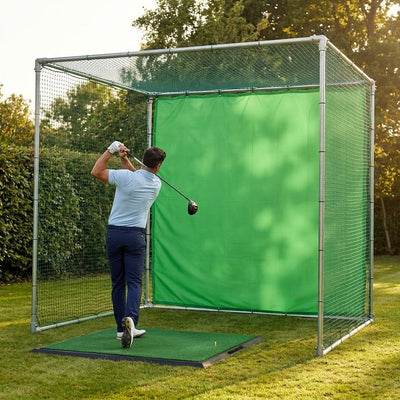
Golfer practising with a large golf practice net in a UK back garden

A golf practice net is one of the best investments a golfer can make. For the price of a few range sessions, you get unlimited full-swing practice in your garden or garage, year-round. No booking, no driving, no waiting for a bay. Just grab a club and hit.

But the market is flooded with options, from flimsy pop-up nets that collapse in a stiff breeze to premium steel-frame cages that could survive a hurricane. The wrong choice means chasing balls across the garden, replacing torn netting after a month, or worst of all, a shanked 7-iron through the neighbour's greenhouse.

This guide covers every type of golf net and cage available in the UK, with real prices in GBP, practical advice for British weather and garden sizes, and honest recommendations at every budget. If you're already thinking about a full simulator build, our complete UK golf simulator buyer's guide covers that journey from start to finish. For now, let's focus on nets and cages.

Nets vs Cages vs Enclosures: What's the Difference?

Comparison infographic showing three types of golf nets: pop-up, fixed frame, and full cage

These three terms get used interchangeably, but they describe genuinely different products with different purposes. Understanding the difference saves you buying something that doesn't match your needs.

Practice Nets

A practice net is the simplest option: a frame (usually fibreglass poles or lightweight metal tubes) with netting stretched across it. You hit balls into the net, and the net catches them. That's it. Practice nets range from tiny pop-up chipping targets to large driving nets that handle full-swing shots with a driver.

Best for: Garden practice, portability, budget builds, golfers who want quick setup and teardown. Most nets fold down for storage, and some pop-up nets assemble in under 60 seconds.

Limitations: Nets only catch balls from the front. Side shanks and topped shots can escape. Most nets aren't designed for projection (so no simulator screen), and the netting wears faster than cage mesh because it takes the full force of every shot at a single point.

Practice Cages

A cage is a fully enclosed frame with netting on all sides, top, and back. Think of it as a net that surrounds you. Cages use stronger frames (typically steel tube), heavier-duty netting, and provide ball containment from every direction. Even a wild shank stays inside the cage.

Best for: Serious practice at home, golfers who hit full driver, outdoor permanent installations, paired use with a launch monitor. A cage with a good launch monitor and tablet gives you data-driven practice without needing a projector or impact screen.

Limitations: Larger footprint than a net. Most cages need at least 3m x 3m of space. They're heavier and more involved to assemble. Not easily portable.

Simulator Enclosures

An enclosure is a purpose-built frame designed to hold an impact screen for projector-based simulation. Enclosures use rigid frames (aluminium or steel box tube), a taut impact screen at the front, and side barriers. The key difference from a cage is that the front surface is a solid screen you can project onto, not netting.

Best for: Full golf simulator builds with a projector, launch monitor, and simulation software. This is the premium path. Our impact screens and enclosures guide covers this category in detail.

Limitations: Most expensive option. Requires a dedicated indoor space. Not suitable for outdoor use without a permanent structure (garden room, outbuilding).

Quick Comparison

Feature Practice Net Practice Cage Simulator Enclosure
Price range £20 - £300 £200 - £2,650 £999 - £2,500+
Ball containment Front only All sides All sides
Projector compatible No No (net front) Yes (impact screen)
Outdoor suitable Yes (with limits) Yes Indoor only
Portability High Low - Medium Low
Setup time 1 - 10 minutes 30 - 90 minutes 2 - 4 hours
Space needed 2m x 2m minimum 3m x 3m minimum 3m x 5m minimum
Typical use Garden warm-up, chipping Full swing practice Full simulator experience

Indoor vs Outdoor Use in the UK

This is probably the most important decision for UK golfers, because our weather is genuinely hostile to outdoor equipment. Rain, wind, UV from occasional sunshine, and the freeze-thaw cycles of British winters all take their toll on netting and frames.

Outdoor Use (Garden)

If your net or cage is going in the garden, you need to think about:

  • Wind resistance: A large net acts like a sail. Pop-up nets blow over in moderate wind (15+ mph gusts are common in the UK, even in summer). Cages with heavy steel frames handle wind better, but the netting still catches wind. Anchor stakes or guy ropes are essential for any outdoor net
  • Rain and moisture: UK gardens are damp for roughly eight months of the year. Netting that doesn't dry quickly develops mould and mildew. Look for UV-treated polyethylene or polypropylene netting, which resists moisture better than nylon. Metal frames should be galvanised or powder-coated to prevent rust
  • UV degradation: Even British sunshine degrades netting over time. UV-treated netting lasts 2-3 times longer than untreated alternatives. If your net will be permanently outdoors, UV treatment is non-negotiable
  • Ground conditions: British lawns get soft and muddy from October through April. Heavy steel-frame cages can sink into wet ground. Use base plates or concrete pads for permanent installations

Indoor Use (Garage, Spare Room, Outbuilding)

Indoor nets avoid most weather issues, but you need to consider:

  • Ceiling height: You need at least 2.7m (9 feet) of clearance for a comfortable full swing with a driver. Most UK garages have 2.3-2.5m ceilings, which works for irons and wedges but is tight for woods. Measure before buying. Our room size guide has detailed ceiling height requirements
  • Noise: A golf ball hitting netting at 130+ mph makes a surprisingly loud snap. In a garage attached to the house, this noise carries. Thicker, looser netting is quieter than thin, taut netting. Adding an impact screen or foam backing behind the net reduces noise significantly
  • Bounce-back: Some nets don't fully absorb ball energy, and the ball bounces back towards you. This is annoying with a wedge and genuinely dangerous with a driver. Quality nets use deep pockets or baffle systems that trap the ball. Budget nets with shallow, taut netting are the worst offenders
  • Wall protection: Even with a net, the occasional mis-hit can go sideways or over the top. Protect walls with foam mats or side netting, especially in rooms with windows or plasterboard walls

Garage Setups: The UK Sweet Spot

For most UK golfers, the garage is the ideal location for a practice net or cage. It's weatherproof, usually has enough space (a standard UK single garage is approximately 5m x 2.7m), and doesn't require planning permission. If you're serious about a garage build, our garage golf simulator guide covers insulation, flooring, electrics, and layout in detail.

Size Guide: Which Net Fits Your Space?

Before spending anything, measure your space. Here's a practical sizing guide for UK properties:

Available Space Recommended Product What You Can Practice
Small garden (under 3m x 3m) Pop-up chipping net Chipping, pitching (50m and under)
Medium garden (3m x 4m+) Pop-up driving net or freestanding net Full swing irons, careful driver
Large garden (4m x 5m+) Full-size driving net or practice cage Full swing all clubs including driver
Single garage (5m x 2.7m) Hitting net or compact cage Full swing irons, woods if ceiling allows
Double garage (5m x 5m+) Full cage or simulator enclosure Everything including driver
Garden room / outbuilding Cage or simulator enclosure Full simulator or data-driven practice

Critical measurement: For any net you plan to hit driver into, you need at least 3m of clearance above the ball position at address. Driver swing arcs are wider and higher than iron swings. If your ceiling is below 2.7m, stick to irons and hybrids to avoid ceiling strikes.

For garden builds, remember that the ball needs a clear flight path of at least 2-3 metres before it reaches the net. Standing too close to the net risks the ball bouncing back before energy is fully absorbed. Allow 3m behind the ball to the net minimum.

What to Look For: Key Features That Matter

Net Material and Construction

The netting material determines durability, ball catch, and weather resistance. Here's what to look for:

  • Polyethylene (PE): The most common material for quality nets. UV-resistant, water-resistant, and durable. High-density PE netting lasts 3-5 years outdoors. This is what you'll find on most mid-range and premium nets
  • Polypropylene (PP): Similar to PE but slightly stiffer. Good weather resistance. Often used in budget to mid-range nets
  • Nylon: Strong but absorbs water. Nylon netting gets heavier when wet and takes longer to dry, making it less ideal for permanent outdoor UK use. Better suited for indoor applications
  • Knotted vs knotless: Knotted netting is cheaper to produce but knots create stress points that wear faster. Knotless netting distributes force more evenly and lasts longer. Premium nets use knotless construction

Frame Material

  • Fibreglass poles: Used in pop-up and portable nets. Lightweight, flexible, inexpensive. Snap in cold weather if bent too aggressively. Fine for temporary setups but not for permanent outdoor use
  • Aluminium tube: Lightweight, rust-proof, easy to assemble. Good for semi-permanent setups and indoor use. Won't handle severe wind loading without anchoring
  • Steel tube: The strongest option. Powder-coated or galvanised steel handles UK weather, wind, and heavy use. Most premium cages use steel frames. Heavier to assemble but significantly more stable
  • Steel box tube: Square or rectangular steel profile. More rigid than round tube at the same weight. Used in premium cages like the linkscube Pro Golf Cage. The gold standard for permanent installations

Safety Features

This matters more than most people realise. A golf ball leaving a driver at 150+ mph carries enough energy to cause serious injury or property damage.

  • Ball return: Some nets funnel balls back to your feet after each shot. This isn't just convenient, it means balls aren't collecting in the base of the net where repeated impacts in the same spot wear through the netting faster
  • Side containment: Cages win here because they're enclosed on all sides. Nets only catch balls from the front. If you shank a shot 30 degrees right, a driving net won't help. Side netting extensions are available for some nets and are worth adding
  • Overlap and baffle design: Better nets use a baffle or pocket system, where the main net catches the ball and a secondary backing stops any passthrough. This is critical for driver practice where ball speeds are highest
  • Ground anchoring: Outdoor nets need proper anchoring. Wind gusts, even moderate ones, can topple a freestanding net. Look for included ground stakes, anchor points, or heavy base weights

Portability and Storage

If you don't have space for a permanent setup, portability matters:

  • Pop-up nets: Fold into a carry bag, set up in under 2 minutes. The Leadbetter Pop-up Driving Net is the benchmark for quick-deploy practice nets
  • Freestanding nets: Require 5-15 minutes to assemble with push-fit poles. Stable enough for full swings but can be taken down and stored. The EazyNet Golf Practice Net sits in this category
  • Permanent cages: Take 30-90 minutes to build and are designed to stay up. Some cages like the Forza Practice Cage can be disassembled, but they're heavy and cumbersome to move regularly

Chipping Nets: Short Game Practice Under £50

Chipping nets are the entry point to home golf practice. They're small, cheap, and work anywhere with a few square metres of space, including indoors on carpet with foam balls.

Product Price Key Feature Best For
PGA TOUR Pop Up Chipping Net ~£20 Instant pop-up, ultra-portable Beginners, indoor use
Leadbetter Pop-Up Chipping Net ~£25 Leadbetter branding, compact fold Garden warm-ups
Pure2Improve Chipping Net ~£25 Simple pop-up design Budget practice
Pure2Improve Chipping Net With Target ~£30 Target zones for accuracy Structured short game work
Masters Pop Up Chipping Target ~£25 Multi-ring target design Competitive practice
Me And My Golf Target Chipping Net ~£35 Multi-zone targets, quality build Focused accuracy drills
Longridge Quad Golf Chipping Net ~£30 Four-compartment design Distance control drills
PGA TOUR Perfect Touch 3 Ring Net ~£25 Three concentric target rings Scoring zone practice

Our pick: The Me And My Golf Target Chipping Net offers the best combination of build quality and practice structure. The multi-zone targets make practice sessions more purposeful than simply hitting into a net. For pure value, the PGA TOUR Pop Up Chipping Net is hard to beat at around £20.

Chipping nets are genuinely useful training aids. The short game accounts for roughly 60% of your strokes, and 15 minutes of focused chipping practice in the garden every evening will lower your scores faster than pounding drivers at the range. Pair a chipping net with some foam practice balls and you can practise indoors on rainy evenings too.

Best Nets by Budget

Budget tier infographic for golf nets from under £50 to £300+ with recommendations

Under £50: Pop-Up Nets for Casual Practice

At this price, you're getting a portable net for chipping, pitching, and light iron practice. Don't expect to survive a winter outdoors, but for quick garden sessions in fair weather, these do the job.

£50 - £150: Freestanding Nets for Regular Practice

This is where you get into proper driving nets that handle full-swing shots. Frames are sturdier, netting is thicker, and these can stay up semi-permanently in a garden or garage.

  • Pure2Improve Golf Practice Net (240 x 210cm) — ~£75. Good-sized net with a sturdy frame. The 240 x 210cm face catches most shots, including slightly off-centre hits. A solid entry point for regular full-swing practice
  • Pure2Improve Square Golf Practice Net (210 x 210cm) — ~£65. Square format net that's slightly more compact but still handles full swings comfortably
  • EazyNet Golf Practice Net — ~£100. Quick assembly design with a generous hitting area. Good for golfers who want to set up and take down between sessions
  • PGA TOUR Pro Golf Training Net — ~£80. Reliable branded net with a clean design. The frame is sturdy enough for regular use and the net catches balls cleanly with minimal bounce-back
  • SimSpace Deluxe Wide Golf Practice Net — ~£130. The widest net in this price range. The extra width gives you more margin for error on off-centre hits, which is particularly valuable when you're working on swing changes and your strike pattern is less predictable

£150 - £300: Premium Nets and Entry-Level Cages

At this price, you're choosing between a premium freestanding net with better build quality and weather resistance, or stepping up to a basic cage that gives you full ball containment.

  • SimSpace Deluxe Home Driving Net Impact Screen — ~£100. Not a net per se, but a heavy-duty impact screen with bungee attachments. Pair this with any frame for a superior ball-catching surface. The impact screen material absorbs energy better than standard netting, reducing bounce-back and noise
  • Leadbetter Pop-up Driving Net — ~£160. The premium pop-up net. The Leadbetter brand isn't just marketing here; the build quality, netting weight, and frame rigidity are genuinely better than sub-£50 pop-ups. If you want a portable net that handles real driver swings, this is the one
  • Net Return Mini — ~£250. The Net Return system is in a category of its own. The patented design returns the ball to your feet after every shot, so you never have to collect balls. The Mini is the compact version, suitable for gardens and garages where space is limited
  • Net Return Home Large Golf Net — ~£280. The full-size Net Return for home use. Larger hitting area than the Mini, with the same ball-return technology. If your space can accommodate it, the Home Large is the better investment

£300 - £500: Full-Size Cages and Premium Nets

This is where you start getting proper enclosed cages with steel frames and full ball containment. You're also in Net Return Pro territory, which is the gold standard for ball-return nets.

  • Forza Golf Practice Cage (3m x 3m x 3m) — ~£460. A complete 3m cube cage with steel frame and full netting. The 3m x 3m x 3m dimensions give you enough room for comfortable full swings with every club. The steel frame handles UK wind and weather, and the netting is UV-treated for outdoor longevity
  • Net Return Pro 8 Large Golf Net — ~£500. The professional-grade Net Return. The Pro 8 is used by tour players for home practice. The frame is heavier, the netting is thicker, and the ball-return action is more consistent than the Home models. If you're serious about practice quality and your budget stretches to £500, this is the finest net you can buy

£500+: Premium Cages and Integrated Systems

Above £500, you're into premium cage territory where build quality, weather resistance, and features step up significantly. These are permanent installations designed for years of daily use.

  • linkscube Pro Golf Cage (3m x 3m x 3m) — ~£1,250. Steel box tube construction, archery-grade baffle netting, and a design that handles the worst UK weather. The Pro Cage is built like commercial equipment. The archery-grade netting is significantly tougher than standard golf netting, and the box-tube frame won't flex or wobble in wind
  • linkscube Max Integrated Golf Cage — ~£1,900. The premium all-in-one cage that includes integrated tee turf and a putting green surface. This is a complete practice station, not just a hitting bay. The integrated surfaces eliminate the need for separate mats and create a cohesive practice environment

Garden Use in the UK: Practical Considerations

Golf practice cage set up in a British garden during rainy weather showing year-round use

Practising golf in a British garden is entirely feasible, but it requires more thought than golfers in sunnier climates need to give it. Here's what actually matters when setting up outdoor practice in the UK.

Weather Resistance: What Survives British Winters

UK weather is the single biggest factor in how long your net lasts outdoors. Here's a realistic breakdown:

  • Pop-up nets (sub-£50): Take these inside after every session. They're not designed to live outdoors. Leaving a pop-up net in a British garden over winter will destroy it within weeks. The fibreglass poles become brittle in cold temperatures, and the lightweight netting rots quickly when constantly damp
  • Freestanding nets (£50-£150): Can survive outdoors for a season if the netting is UV-treated, but will degrade noticeably over a British winter. Roll up or cover the netting when not in use. The frame can usually stay out but check for rust at joints monthly
  • Steel-frame cages (£300+): Designed for outdoor permanence. Galvanised or powder-coated steel frames handle rain, frost, and wind. UV-treated netting lasts 2-4 years outdoors. These are the only realistic option for a year-round garden installation

Wind: The Hidden Destroyer

Wind causes more damage to garden golf nets than rain. A 3m x 3m net presents roughly 9 square metres of sail area to the wind. In a 30 mph gust (common in UK autumn and winter), that's a tremendous force.

Practical solutions:

  • Use proper ground anchors, not just the basic pegs included with most nets. Screw-in ground anchors rated for gazebos or trampolines work well and cost under £20
  • Position your net against a fence or wall to reduce wind exposure on one side
  • Consider a cage with a smaller profile mesh rather than solid netting. Smaller mesh allows some wind to pass through rather than catching it all
  • If you're in an exposed area (coastal, hilltop, open countryside), budget for a heavier steel-frame cage. Lightweight nets simply won't survive

Neighbours and Safety

This is worth addressing directly. Hitting golf balls in your garden carries risk, and you're responsible for any damage or injury caused by balls leaving your property. A few practical guidelines:

  • Always use a cage, not just a net, if neighbours are within 20 metres. Nets don't catch side shots. A full cage does
  • Never hit towards a fence, road, or neighbouring property without a cage that fully contains every possible shot angle
  • Tell your home insurer. Most home insurance policies cover accidental damage to third-party property, but it's worth checking your specific cover
  • Start with wedges and irons. Get comfortable with your setup and ball containment before working up to driver. Driver mis-hits travel further and faster than iron mis-hits
  • Consider foam or limited-flight balls for garden practice if you have any safety concerns. They work well for swing practice and won't cause damage

Ground and Surface Preparation

For permanent cage installations, a level surface matters. Options from simplest to most involved:

  1. Flat lawn: Works for most garden cages. Trim the grass short and level any bumps. Expect the grass under the cage to die within a few months from lack of light
  2. Artificial turf: A popular UK garden upgrade that doubles as a practice surface. Lay artificial turf under the cage for a clean, all-weather hitting area
  3. Concrete pad: The most stable option for permanent installations. A 3m x 3m concrete pad (100mm thick) costs approximately £500-£800 to have laid professionally, and provides a rock-solid base that eliminates sinking in wet ground
  4. Rubber gym tiles: Lay interlocking rubber tiles on existing hard surfaces (patio, concrete) to create a comfortable stance surface with drainage

Using a Launch Monitor with a Net or Cage

A net or cage on its own gives you swing practice but no feedback. Pair it with a launch monitor and you get ball speed, carry distance, spin rates, and club path data for every shot. This transforms a simple hitting net into a data-driven practice station.

You don't need a projector or impact screen for this. The launch monitor connects to a tablet or phone, and you see your data on-screen while hitting into the net. It's a fraction of the cost of a full simulator build and delivers 80% of the practice benefit.

Popular launch monitor pairings with nets and cages:

  • FlightScope Mevo+/Mevo Gen 2 — Radar-based, sits behind the ball. Works brilliantly with any net or cage because it reads the ball before it hits the net. Our beginner's simulator guide covers the Mevo range in detail
  • Garmin Approach R10 — Compact radar unit that also sits behind the ball. Affordable entry point for data-driven practice
  • Rapsodo MLM2PRO — Camera and radar hybrid. Sits beside the ball and reads impact data. Works well with nets as long as the unit has a clear view of the ball

If you're considering this path, our golf simulator cost breakdown explains how a net + launch monitor setup compares to a full simulator on price.

Upgrading from a Net to a Full Simulator

Progression path infographic from basic net to full golf simulator setup

Many golfers start with a practice net and gradually build towards a complete simulator. This is actually the smart approach. You learn what you value in practice, you understand your space constraints, and you spread the cost over time rather than committing thousands upfront.

Here's the typical progression path we see from customers:

Stage 1: Net + Balls (£50 - £200)

Start with a quality freestanding net and some practice balls. This gives you full-swing practice in the garden or garage. You'll quickly discover whether you use it enough to justify further investment. If the net is gathering dust after three months, you've saved yourself thousands. If you're out there every evening, move to Stage 2.

Stage 2: Net + Launch Monitor (£400 - £700)

Add a launch monitor to your net setup. Now every shot gives you data: ball speed, launch angle, carry distance, spin. This is the biggest single upgrade in practice quality. A FlightScope Mevo Gen 2 or Garmin R10 paired with a decent net gives you professional-level feedback for a fraction of the cost of range sessions.

Stage 3: Cage + Launch Monitor + Hitting Mat (£800 - £2,000)

Upgrade the net to a proper cage for better ball containment, add a quality hitting mat for realistic turf feel and joint protection. Now you have a serious practice station that can handle daily use year-round. Most golfers who reach this stage and use it regularly find it already pays for itself versus range fees within 12-18 months.

Stage 4: Full Simulator with Enclosure and Projector (£2,500 - £10,000+)

The final step: replace the cage with a simulator enclosure and impact screen, add a projector, and run simulation software. Now you're playing virtual rounds at Pebble Beach, practising on a driving range with trajectory visualisation, and getting the full indoor golf experience.

Our simulator bundles make this step straightforward. The FlightScope Mevo Gen 2 Bundle starts from around £2,500 and includes everything: enclosure, impact screen, hitting mat, and launch monitor. The Foresight GC3S Bundle from around £5,300 steps up to photogrammetric camera technology for tour-level accuracy. And the linkscube Launch Monitor Bundle combines a quality cage with a launch monitor for those who want data-driven practice without a projector.

The beauty of this progression is that nothing is wasted. Your hitting mat transfers to the simulator. Your launch monitor becomes the heart of the simulator. Even the cage can be repurposed for outdoor practice or sold to fund the upgrade.

What About an Impact Screen Behind Your Net?

An interesting middle-ground option is adding an impact screen behind a practice net or inside a cage. This gives you:

  • Better ball catch: Impact screens absorb more energy than netting, reducing bounce-back
  • Less noise: The screen material dampens the snap of ball-on-net impact significantly
  • Future-proofing: When you're ready to add a projector, the screen is already in place
  • Wall protection: An extra layer between the ball and whatever's behind the net

The SimSpace Deluxe Home Driving Net Impact Screen at around £100 is purpose-built for this. It comes with bungee cords for easy attachment to any frame or cage.

Our Honest Recommendations

After selling hundreds of nets and cages to UK golfers, here's what we've learned:

  • Buy one category above what you think you need. If you're considering a pop-up net, get a freestanding net. If you're considering a freestanding net, get a cage. Golfers almost always outgrow their first net within 6 months and wish they'd spent more upfront
  • For gardens, a cage is always safer than a net. The extra cost of a cage versus a net is trivial compared to one broken window or an injured neighbour. Full ball containment gives you peace of mind on every shot
  • Don't leave cheap nets outdoors year-round. British weather destroys anything below £300 in one winter. Either bring it inside after sessions or invest in a weather-resistant cage
  • A launch monitor transforms any net from a ball-catching device into a practice system. If you can only afford a net now and a launch monitor in three months, that's the right order. But budget for both from the start
  • Think about the end game. If you suspect you'll end up building a full simulator eventually, choose products that fit that path. A cage that accepts an impact screen is more future-proof than a net that can only ever be a net

Complete Product Range at a Glance

Here's our full range of practice nets and cages, sorted by type, so you can compare options side by side. Browse the complete collection at OpenGolfer Practice Nets.

Driving and Practice Nets

Product Approximate Price Size Type
Pure2Improve Pop-Up Triangular Net ~£45 Large Pop-up
Pure2Improve Square Practice Net ~£65 210 x 210cm Freestanding
Pure2Improve Golf Practice Net ~£75 240 x 210cm Freestanding
PGA TOUR Pro Golf Training Net ~£80 Large Freestanding
EazyNet Golf Practice Net ~£100 Large Freestanding
SimSpace Deluxe Wide Practice Net ~£130 Extra wide Freestanding
Leadbetter Pop-up Driving Net ~£160 Large Premium pop-up
Net Return Mini ~£250 Compact Ball-return
Net Return Home Large ~£280 Large Ball-return
Net Return Pro 8 ~£500 Extra large Ball-return (pro)

Practice Cages

Product Approximate Price Size Frame Material
Forza Golf Practice Cage ~£460 3m x 3m x 3m Steel tube
linkscube Pro Golf Cage ~£1,250 3m x 3m x 3m Steel box tube
linkscube Max Integrated Cage ~£1,900 3m x 3m Steel, integrated turf

Frequently Asked Questions

What is the best golf practice net for a UK garden?

For gardens, a steel-frame cage like the Forza Golf Practice Cage (~£460) is the safest and most durable option. It contains balls from every direction and the galvanised frame handles British weather. If you only want a net (not a cage), the Net Return Home Large (~£280) is the best garden-suitable driving net because the ball-return system prevents ball accumulation that stretches netting.

Can I use a golf net indoors?

Yes, with caveats. You need at least 2.7m ceiling height for a comfortable swing with irons (3m+ for driver). The ball-on-net impact is loud in enclosed spaces, so consider adding an impact screen behind the net to reduce noise. Protect surrounding walls with foam mats or side netting. Our room size guide covers indoor space requirements in detail.

How long does a golf net last outdoors in the UK?

It depends entirely on the net quality and whether the netting is UV-treated. Budget pop-up nets (under £50) last one season outdoors at best. Quality freestanding nets (£100-£200) with UV-treated netting last 1-2 years. Premium steel-frame cages (£300+) with heavy-duty netting last 3-5 years. Galvanised steel frames last 10+ years. Bringing the netting inside or covering it when not in use extends lifespan significantly.

What's the difference between a golf net and a golf cage?

A golf net catches balls from the front only. It's an open-front target. A golf cage is fully enclosed on all sides (front, back, sides, and top) with netting or mesh. The cage contains every shot, including shanks, tops, and mis-hits that would escape a standard net. For safety, especially in gardens near neighbours, a cage is always the better choice.

Do I need planning permission for a golf cage in my garden?

In most cases, no. Garden structures under 2.5m in height (or 3m if more than 2m from a boundary) are generally permitted development in England and Wales. However, if your property is in a conservation area, listed, or subject to specific local conditions, check with your local planning authority. A standard 3m x 3m x 3m cage would typically need to be at least 2m from the boundary to avoid planning requirements. Our garden room guide covers planning permission rules in more detail.

Are ball-return nets worth the extra money?

Yes, for two reasons. First, convenience: the ball rolls back to your feet after every shot, so you never have to walk to the net to collect balls. This means faster practice sessions and a natural rhythm between shots. Second, durability: balls that return to you aren't sitting in the bottom of the net, repeatedly pummelled by incoming shots. This extends the netting life significantly. The Net Return Mini and Net Return Pro 8 are the market leaders.

Can I turn a practice net into a golf simulator later?

A standard net, no. But a practice cage can form the foundation of a simulator if you add an impact screen to the back, mount a projector behind you, and connect a launch monitor. The linkscube Pro Golf Cage and linkscube Max are specifically designed with this upgrade path in mind. Alternatively, our simulator bundles include purpose-built enclosures that are optimised for projection from day one.

What golf balls should I use with a practice net?

Use real golf balls for the most accurate practice. Your launch monitor needs a real ball to provide accurate spin and speed data. However, if safety is a concern (indoor use, small garden, neighbours nearby), limited-flight balls or foam practice balls are a sensible compromise. They won't give accurate data but they're safe for swing practice and won't damage property if they escape the net.

How do I stop a golf net blowing over in the wind?

Four strategies: (1) Use heavy-duty screw-in ground anchors instead of the basic pegs most nets include. (2) Position the net against a fence or wall on the windward side. (3) Add sandbags or weights to the base of the frame legs. (4) Take the net down in severe weather, any net can become dangerous in storm-force winds. For permanent outdoor setups in exposed locations, a steel-frame cage with proper anchoring is the only reliable solution.

Is a driving range or a home net better value?

Over time, a home net wins convincingly. A typical UK driving range session costs £6-£10 for a bucket of balls. Three sessions a week adds up to £1,000-£1,500 per year. A quality freestanding net costs £100-£300, and even a premium cage costs £500-£1,900. Within 6-18 months, the home setup pays for itself, and you keep it for years. Our simulator vs driving range article breaks down the full economics. Add a launch monitor and the data quality from home practice exceeds what most ranges offer.

What's the minimum garden size for a golf practice cage?

You need at least 4m x 4m for a standard 3m x 3m cage: the cage dimensions plus 0.5m clearance on each side for assembly and access. You also need at least 3m of clear space behind where you'll stand (between your hitting position and the back of the cage) for a comfortable swing. In practice, a space of approximately 4m x 7m (cage footprint plus swing clearance) is comfortable for a full-size practice cage.

Ready to choose your practice setup? Browse our full practice nets collection, explore hitting mats to pair with your net, or jump straight to a complete simulator bundle if you're ready for the full experience. For the complete build picture, our UK golf simulator buyer's guide and winter golf guide cover everything from planning to playing.

Recommended

SimSpace Builder

Design your perfect simulator setup step by step — enclosure, screen, mat, projector & launch monitor.

Start Building

Newsletter

Level up your golf game

Tips, guides and deals — straight to your inbox.

Share
O
OpenGolfer
Golf simulator expert at OpenGolfer. Helping golfers build their perfect indoor setup.

Leave a comment

This site is protected by hCaptcha and the hCaptcha Privacy Policy and Terms of Service apply.