
Golf Simulator Sound & Noise Guide: Keep the Peace While You Play

Introduction: Golf Simulators Are Louder Than You Think
You've measured the room, chosen your launch monitor, and you're ready to build the home golf simulator you've been dreaming about. But there's one thing that catches almost every new owner off guard: the noise.
The first time you stripe a driver into an impact screen at full speed, you'll understand. It's not a gentle tap — it's a sharp, percussive crack that reverberates through walls, floors, and ceilings. In a detached house with a dedicated garage, that might not matter much. But if you live in a terraced house in Manchester, a semi-detached in Surrey, or a flat anywhere in the UK, that sound is travelling straight to your neighbours.
And it's not just ball impact. Projectors hum. Gaming PCs whir. You'll be chatting, celebrating, and occasionally swearing. At 10pm on a Tuesday, none of that is going to win you any popularity contests next door.
This guide is built from real-world experience helping UK golfers set up simulators in every type of property imaginable — from converted garages in new-build estates to basement rooms in Victorian terraces. We'll cover actual decibel readings, the three types of noise you need to manage, and practical solutions at every budget from £50 to £1,500. The goal isn't perfect silence — it's reducing noise enough that you can play comfortably without damaging relationships with the people you live with or next to.

How Loud Is a Golf Simulator? Real Decibel Readings
Before you can solve a noise problem, you need to understand how big it actually is. We've taken decibel readings from dozens of simulator setups, and the numbers consistently surprise people. Here's what you're actually dealing with:
| Noise Source | Decibel Level (dB) | Everyday Comparison |
|---|---|---|
| Ball hitting impact screen (driver) | 85–95 dB | Lawnmower / food blender |
| Ball hitting impact screen (iron) | 80–90 dB | Vacuum cleaner on hard floor |
| Ball hitting net/mesh | 70–80 dB | Shower running / dishwasher |
| Club striking ball on mat | 70–85 dB | Loud conversation / alarm clock |
| Club striking mat (practice swing) | 60–75 dB | Normal conversation |
| Standard projector fan | 30–45 dB | Quiet library / whisper |
| Gaming PC (under load) | 35–50 dB | Refrigerator hum / quiet office |
| Normal conversation in the room | 55–65 dB | Background music |
To put those numbers in context: every 10 dB increase represents a doubling of perceived loudness to the human ear. So a driver hitting a screen at 90 dB doesn't just sound a bit louder than a 70 dB net — it sounds roughly four times louder.
The critical threshold for neighbour complaints is usually around 40–50 dB as perceived through a shared wall. In a typical UK semi-detached house, a party wall might reduce noise by 40–50 dB. That means a 90 dB impact could still arrive next door at 40–50 dB — clearly audible in a quiet living room, and potentially sleep-disrupting at night.
The good news? These numbers represent untreated setups. With the right combination of equipment choices and acoustic treatment, you can reduce transmission by an additional 15–30 dB, which makes all the difference.

The Three Sources of Simulator Noise
Not all noise travels the same way, and understanding the three distinct types is essential for choosing the right solutions. Treating one while ignoring another is the most common mistake we see.
1. Impact Noise: The Big One
Impact noise is generated when the golf ball strikes the impact screen, net, or enclosure frame. It's by far the loudest component, peaking at 85–95 dB for a full driver swing. This isn't just airborne sound — the energy transfers directly into the screen frame, which vibrates the wall it's attached to or standing against, which then radiates sound into adjacent rooms or properties.
This is called structure-borne noise, and it's the hardest type to manage. You can stuff a room full of acoustic foam and it'll do almost nothing for impact noise, because the sound isn't travelling through the air — it's travelling through the physical structure of your home.
Impact noise is worst when:
- The screen frame is bolted directly to a shared wall
- The enclosure sits on a suspended timber floor (common in UK homes)
- The room shares a party wall with a neighbour's bedroom or living room
- You're using a tightly woven, rigid screen material
2. Airborne Noise: Easier to Manage
Airborne noise is the sound that travels through the air — your voice, the projector fan, the PC fans, music if you're playing it, and the initial "crack" of ball impact before it becomes structural vibration. This is the type of noise that acoustic foam and insulation are designed to address.
In most setups, airborne noise is a secondary concern. If you solve the impact noise problem, the airborne component is usually manageable with basic treatment. The exception is if you're planning to play music or have friends round for simulator sessions — group noise levels can easily hit 75–80 dB, which is a different challenge entirely.
3. Vibration Transfer: The Hidden Problem
Vibration transfer is a subset of impact noise, but it deserves its own category because it behaves differently and requires different solutions. When you hit a ball on a mat sitting directly on a timber floor, the impact energy travels through the mat, through the floor, through the joists, and into the ceiling of the room below — or through the floor into the walls and into an adjacent property.
This is particularly problematic in these common UK scenarios:
- First-floor rooms above living spaces — the floor is a direct transmission path
- Rooms above garages in semi-detached homes — the garage ceiling is often uninsulated
- Any room with a suspended timber floor — timber transmits vibration far more than concrete
- Terraced houses — vibration can travel through party walls and floor joists that are shared between properties
If you're setting up in a garage with a concrete floor, vibration transfer is much less of a concern. If you're on a first-floor spare bedroom, it's potentially your biggest challenge.
Impact Screen & Enclosure Solutions
Since impact noise is the dominant issue, this is where your first investment should go. The good news is that your choice of impact screen and enclosure has a massive effect on noise levels — often more than any after-the-fact acoustic treatment.
Screen Material Makes a Huge Difference
Impact screens vary enormously in their acoustic properties, and the key factor is how much the screen can absorb and distribute the ball's kinetic energy versus transmitting it into the frame.
- Looser weave screens absorb more energy by deforming on impact — the ball sinks into the screen slightly, spreading the force over a longer time period and a larger area. This reduces peak noise by 5–10 dB compared to rigid screens.
- Heavier screen materials (measured in GSM — grams per square metre) tend to absorb more energy. Look for screens rated 350+ GSM for better noise performance.
- Screen tension matters — a screen pulled drum-tight will be louder than one with slight slack. When installing, aim for taut enough to give a clear projected image but not so tight that it rebounds the ball aggressively.
Enclosure Frame Damping
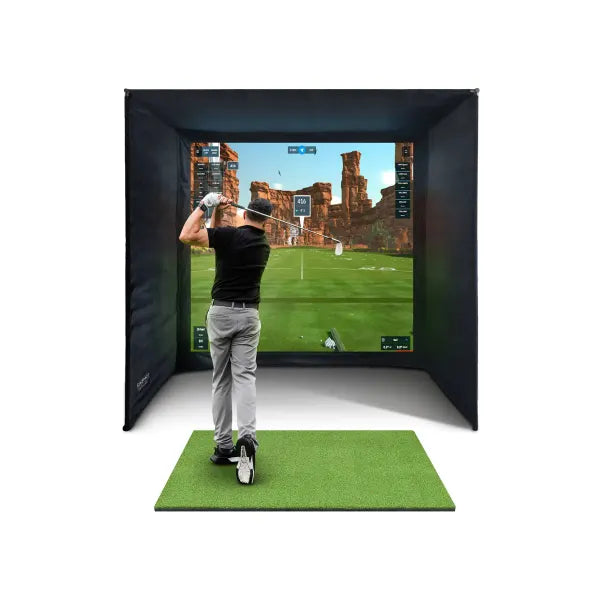
The SimSpace enclosure range uses foam padding on the steel frame specifically to dampen vibration transfer. This is more important than most people realise — an unpadded metal frame acts like a tuning fork, transmitting impact energy directly into whatever surface it's touching.
If you're using an enclosure without built-in damping, you can retrofit it:
- Pipe insulation foam (£3–5 per 2m length from any DIY store) wrapped around frame members
- Rubber feet or pads under every point where the frame contacts the floor
- Neoprene strips between the frame and any wall it's positioned against
Baffle Systems Behind the Screen
A baffle is a secondary layer of material hung 100–200mm behind the impact screen. When the ball hits the screen, any energy that passes through is caught by the baffle rather than reaching the wall. Common baffle materials include:
- Moving blankets (£10–20 each) — surprisingly effective, readily available on Amazon UK
- Old duvets — free if you have spare ones, genuinely useful as a first line of defence
- Acoustic blankets (£30–60 each) — purpose-made with mass-loaded vinyl core, the professional option
A simple baffle system can reduce wall-transmitted impact noise by 10–15 dB — that's the difference between your neighbour hearing every shot and barely noticing.
Net vs Screen: Noise Comparison
If noise is your primary concern, it's worth considering whether you need an impact screen at all. A high-quality golf net is typically 10–15 dB quieter than an impact screen because the net deforms significantly on impact, absorbing energy over a longer period.
The trade-off is obvious: no screen means no projected image. But if you're using a launch monitor bundle with a tablet or laptop for your visuals, a net setup in a noise-sensitive location might be the pragmatic choice. You can always upgrade to a screen later if noise concerns turn out to be manageable.
Wall & Ceiling Acoustic Treatment
Once you've optimised your screen and enclosure setup, wall and ceiling treatment addresses the airborne noise component and provides additional damping for structure-borne sound. Here's what actually works, in order of effectiveness per pound spent.

Mass Loaded Vinyl (MLV) — The Gold Standard
Mass loaded vinyl is a thin, dense, flexible membrane that you hang on walls or lay on floors. It works by adding mass to surfaces, which reduces their ability to vibrate and transmit sound. For simulator rooms, it's the single most effective wall treatment.
- Cost: £10–20 per m² depending on thickness (2mm is standard, 4mm for maximum effect)
- Installation: Hang from battens or adhesive, overlap joints by 50mm, seal edges with acoustic sealant
- Effectiveness: 2mm MLV adds approximately 15–20 dB of sound reduction to a standard plasterboard wall
- Where to apply: Priority is the wall behind your impact screen and any shared party wall. Ceiling is next if you have rooms above.
UK suppliers include Acoustafoam, Sound Reduction Systems (SRS), and Acoustic Insulation Online. Buying direct from UK acoustic specialists typically works out cheaper than Amazon for this product.
Acoustic Foam Panels
Acoustic foam is the product most people think of first, but it's important to understand its limitations. Foam panels are excellent at reducing echo and reverberation within the room (making your sim room sound better inside), but they do relatively little to stop sound passing through walls to adjacent spaces.
- Cost: £30–80 for a pack of 12 panels (typically 300mm × 300mm × 50mm)
- Best for: Reducing the harshness of impact noise within the room, controlling echo that makes the room feel louder
- Not effective for: Blocking sound transmission through walls (use MLV for that)
- Placement: Focus on the wall opposite the screen (first reflection point) and corners of the room where bass frequencies accumulate
Acoustic foam is worth including but should never be your only treatment. Think of it as the finishing touch after you've addressed structural transmission.
Rockwool in Stud Walls
If you're building out a dedicated simulator room or renovating a space, filling stud wall cavities with Rockwool RWA45 acoustic insulation is extremely effective and relatively inexpensive (£5–8 per m² for 100mm slabs). This is particularly relevant if you're converting a garage, as the internal stud wall you build can incorporate acoustic insulation from the start.
For existing rooms where you can't access the wall cavity, you can build a secondary stud wall with a 25mm air gap in front of the existing wall, filled with Rockwool. This "room within a room" approach is the gold standard for serious soundproofing, though it does steal 75–100mm of floor space per treated wall. In a room that's already tight on dimensions for a golf simulator, that trade-off needs careful thought — check our room size guide to see if you can spare the space.
Seal Every Gap
Sound behaves like water — it finds and exploits every tiny gap. A wall with perfect acoustic insulation but a 5mm gap under the door will leak noise like a sieve. These small fixes deliver outsized results:
- Door draught excluders — £5–15 from any hardware shop. Fit brush or rubber strips to all four edges of the door.
- Acoustic sealant around any penetrations: cable holes, vent openings, gaps between skirting board and wall
- Replace hollow-core doors with solid-core alternatives if your budget allows (£80–200 per door). A hollow interior door blocks about 15 dB; a solid-core door blocks 25–30 dB.
- Vent covers: If the room has air vents connecting to other rooms, fit acoustic baffles inside them (or temporarily close them during play, ensuring adequate ventilation for the projector)
Floor Vibration Solutions
Floor treatment serves double duty in a simulator room: it reduces vibration transfer to rooms below and adjacent, and it protects your floor from club strikes and ball impacts. If you're setting up on anything other than a ground-floor concrete slab, floor treatment should be a top priority.

Rubber Gym Tiles
Interlocking rubber gym tiles are the most popular flooring choice for UK home simulators, and for good reason — they're affordable, easy to install, provide excellent vibration damping, and protect the floor underneath.
- Cost: £15–30 per m² for 15–20mm thickness
- Thickness guide: 15mm is adequate on concrete; 20mm+ recommended on timber floors for noise reduction
- Coverage: Ideally the entire room, but at minimum cover the hitting area and 1m either side
- UK suppliers: Gym Flooring UK, Mats4U, Amazon UK — look for tiles rated for gym/CrossFit use as they're denser than generic rubber tiles
For comprehensive advice on simulator flooring options, see our flooring guide.
Anti-Vibration Mat Under the Hitting Area
The hitting area is the single point of greatest vibration generation. Placing a dedicated anti-vibration mat beneath your hitting mat can reduce floor vibration transmission by 50–70%. Options include:
- Dense rubber anti-vibration pads (25–30mm thick) — cut to size, placed under the hitting mat. £20–40 for a sufficient piece.
- Washing machine anti-vibration mats — a budget hack that genuinely works. £10–15 from Argos or Amazon, stack two for extra effect.
- Horse stall mats — the heavy-duty option at 18mm solid rubber. £40–60 per 1.8m × 1.2m mat. These are extremely dense and provide superb vibration isolation.
The Floating Floor Concept
For maximum vibration isolation — especially important in flats, above living spaces, or in terraced houses — a floating floor decouples the simulator surface from the structural floor. The principle is simple: create a surface that isn't rigidly connected to the building structure, so vibration can't transfer.
A basic floating floor for a simulator room:
- Lay a layer of 20mm rubber gym tiles directly on the existing floor
- Place 18mm OSB or plywood sheets on top (these distribute weight and create a flat surface)
- Add your hitting mat and any additional flooring on top of the board
The rubber layer absorbs vibration before it reaches the structural floor. This approach costs £150–300 for a typical simulator area and can reduce vibration transfer by 15–25 dB. It's particularly effective on timber suspended floors, which are the most common type in UK homes built before 2000.
Garage vs Upper Floor: Different Challenges
Your garage setup on a concrete slab has a natural advantage — concrete doesn't transmit vibration nearly as readily as timber. Floor treatment in a garage is primarily about comfort and club protection rather than noise control.
An upper-floor room (spare bedroom, loft conversion) is the opposite extreme. Every impact sends vibration through timber joists directly into the rooms below. If your simulator room is above a living room or bedroom, invest heavily in floor treatment — it's the single most impactful thing you can do for the people living below.
For anyone considering a small room or low ceiling setup, noise management becomes even more critical because you're typically closer to walls and the enclosed space amplifies reflections.
Projector & PC Noise Management
While impact noise dominates, the constant background hum of projectors and PCs matters more than you might think — especially during quiet moments between shots or when you're playing late at night.
Projector Noise Levels
Projector noise varies significantly by model and type:
| Projector Type | Typical Noise Level | Notes |
|---|---|---|
| Ultra short throw (UST) | 28–35 dB | Quietest option, positioned near screen |
| Short throw | 30–38 dB | Good balance of noise and flexibility |
| Standard throw | 32–45 dB | Loudest, but positioned furthest from player |
| Any projector in "eco mode" | -3 to -8 dB | Reduced brightness but notably quieter |
When choosing a projector for a noise-sensitive setup, check the dB rating in the specifications — anything under 32 dB is considered quiet. Most modern short-throw projectors suitable for simulators fall in the 30–36 dB range, which is comparable to a quiet room's ambient noise.
Eco mode is worth considering for evening sessions. Most projectors reduce fan speed (and therefore noise) by 3–8 dB in eco mode, with a brightness reduction of 20–30%. For indoor simulator use with controlled lighting, this brightness reduction is rarely noticeable.
PC Placement Strategy
A gaming PC under load can generate 40–50 dB of fan noise, which adds up in an enclosed room. The simplest solution is also the most effective: put the PC in a different room.
- Long HDMI cable (10–15m active HDMI cables are £20–40) — run from a PC in an adjacent room, utility room, or cupboard
- If the PC must stay in the room: Place it as far from the hitting position as possible, ideally inside a ventilated cabinet or behind an acoustic barrier
- USB extension for launch monitor connection — pair with the long HDMI to keep the PC completely out of the simulator room
- Consider a mini PC or NUC if your sim software allows it — these are dramatically quieter than tower PCs (15–25 dB under load)
Fan Noise Quick Fixes
For PCs that must stay in the room:
- Replace stock fans with Noctua or be quiet! branded fans — these are specifically designed for silent operation (£15–25 each)
- Clean dust from all fans and heatsinks quarterly — dust buildup increases fan speed and noise
- Ensure adequate ventilation around the PC — a hot PC runs fans harder and louder
- Set a custom fan curve in BIOS or software — most PCs run fans faster than necessary at low-to-moderate loads
Timing & Etiquette: The Human Side
All the acoustic treatment in the world won't help if you're smashing drivers at midnight. The human element of noise management is just as important as the technical solutions — arguably more so, because a good relationship with neighbours buys you tolerance that no amount of foam panels can.
Sensible Playing Hours
There's no hard legal rule about when you can use a golf simulator, but practical guidelines based on UK noise expectations:
- Safe hours (minimal restrictions): 9am – 8pm weekdays, 10am – 8pm weekends
- Courtesy hours (keep volume moderate): 8am – 9am, 8pm – 9:30pm
- Avoid if possible: Before 8am, after 9:30pm — especially in terraced or semi-detached properties
- Never: After 11pm unless you have excellent soundproofing and genuinely detached neighbours
These aren't legal requirements — they're practical guidelines that keep relationships healthy. If you've invested in good soundproofing, you can likely extend these windows. If your setup is untreated, err on the conservative side.
Communicating With Neighbours
The single best investment in noise management costs nothing: talk to your neighbours before you start. Let them know you're setting up a golf simulator, acknowledge it might be audible, and ask them to let you know if it ever becomes a problem. This approach works because:
- People are far more tolerant of noise they've been warned about
- It opens a dialogue before frustration builds
- It shows respect, which is reciprocated
- You can ask them to text you if it's ever too loud — real-time feedback helps you calibrate
If you're in a flat or terraced property, consider inviting your immediate neighbours for a session. People who understand what is making the noise and have positive associations with it are dramatically more tolerant.
Council Noise Regulations
UK local councils can investigate noise complaints under the Environmental Protection Act 1990. The key term is "statutory nuisance" — noise that unreasonably interferes with someone's use and enjoyment of their property. In practice:
- There is no specific decibel limit for domestic noise in UK law — it's assessed on reasonableness
- Councils consider time of day, frequency, duration, and the character of the area
- Regular impact noise (like repeated ball strikes) can be treated more seriously than continuous noise because it's more disruptive to concentration and sleep
- A council noise team will typically visit, assess, and issue a warning before any formal action
The realistic risk of council action for a reasonably timed, moderately treated home simulator is very low. But it's worth knowing the framework so you can make informed choices about your setup and schedule.
Budget Soundproofing Packages
Here's how to approach soundproofing at three budget levels. Each builds on the previous one, so start with the budget package and add more if needed.

Budget Package: £50–£150
The essentials that deliver the biggest bang for the buck. Start here and see if it's enough for your situation.
| Item | Approximate Cost | Noise Reduction |
|---|---|---|
| Door draught excluder strips (full perimeter) | £10–15 | 3–5 dB (airborne) |
| Moving blankets (2–3, hung behind screen) | £25–45 | 8–12 dB (impact on wall) |
| Rubber anti-vibration pad under hitting mat | £15–30 | 5–10 dB (floor vibration) |
| Thick rug on floor of room above (if applicable) | £0–50 | 3–5 dB (overhead transfer) |
| Pipe foam on enclosure frame contact points | £5–10 | 3–5 dB (structural vibration) |
Total estimated reduction: 10–20 dB at the neighbour's wall, depending on building construction. This is often sufficient for detached houses and well-built semi-detached properties during reasonable hours.
Mid-Range Package: £200–£500
Adds proper acoustic materials for a noticeable step up in isolation. Recommended for semi-detached homes and anyone playing in the evenings.
| Item | Approximate Cost | Noise Reduction |
|---|---|---|
| Everything in the Budget Package | £50–150 | 10–20 dB baseline |
| Mass loaded vinyl on party wall (8–12m²) | £80–200 | 15–20 dB (through-wall) |
| Rubber gym tiles (full room, 20mm) | £60–120 | 8–12 dB (floor vibration) |
| Acoustic foam panels (12-pack, first reflection wall) | £30–60 | 3–5 dB (echo/reverberation) |
| Acoustic sealant for gaps and penetrations | £10–15 | 2–4 dB (sealing leaks) |
Total estimated reduction: 20–35 dB at the neighbour's wall. This level of treatment makes evening play comfortable in most semi-detached properties and is sufficient for all but the most noise-sensitive terraced house situations.
Premium Package: £500–£1,500
The full treatment for terraced houses, flats, or anyone who wants to play late with complete peace of mind.
| Item | Approximate Cost | Noise Reduction |
|---|---|---|
| Everything in the Mid-Range Package | £200–500 | 20–35 dB baseline |
| MLV on ceiling (if rooms above) | £80–160 | 12–18 dB (overhead) |
| Floating floor system (rubber + board) | £150–300 | 15–25 dB (floor vibration) |
| Solid-core door replacement | £80–200 | 10–15 dB (door transmission) |
| Secondary stud wall with Rockwool (party wall) | £150–400 | 15–25 dB (through-wall) |
| Professional acoustic blankets behind screen | £60–120 | 12–18 dB (impact on wall) |
Total estimated reduction: 35–50+ dB at the neighbour's wall. At this level, a full driver swing into the screen at 90 dB could arrive at your neighbour's wall at around 40–55 dB — equivalent to a quiet conversation or less. Late-evening play becomes genuinely feasible even in terraced properties.
Putting It All Together
The most effective approach to simulator noise management combines equipment choices, room treatment, and common sense. Here's the priority order for maximum impact:
- Choose the right screen and enclosure — this alone can reduce peak noise by 10–15 dB. Browse our simulator collection for enclosures with built-in acoustic features.
- Decouple from structure — rubber under the frame, rubber under the mat, rubber on the floor. Break every physical connection between your equipment and the building structure.
- Treat the party wall — if you share a wall, MLV plus a baffle behind the screen is the highest-value investment.
- Seal the gaps — doors, vents, cable penetrations. Cheap and surprisingly effective.
- Add absorption — foam panels to tame echo within the room.
- Manage electronics — relocate the PC if possible, use eco mode on the projector for evening sessions.
- Talk to neighbours — build goodwill and set expectations.
For design inspiration on making your acoustically treated room look great rather than like a padded cell, see our simulator room design ideas.
Frequently Asked Questions
Can I use a golf simulator in a flat?
Yes, but it requires serious investment in floor vibration isolation and wall treatment. A floating floor system (£150–300) is essential, and MLV on the floor/ceiling boundary is strongly recommended. We'd suggest the premium soundproofing package as a minimum for flat setups. Also consider a net rather than an impact screen to reduce peak noise, and restrict play to daytime hours until you've confirmed with neighbours that the treatment is adequate.
Will acoustic foam panels stop my neighbours hearing the simulator?
On their own, no. Acoustic foam panels are designed to reduce echo and reverberation within the room, not to block sound transmission through walls. They'll make the room sound better from inside and slightly reduce the sharpness of impact noise, but for meaningful noise reduction at the neighbour's wall, you need mass (MLV) and decoupling (rubber mats, floating floor). Think of foam as the finishing touch, not the foundation.
How much does professional soundproofing cost for a simulator room?
A professional acoustic consultant will typically charge £200–500 for a survey and recommendation report. Full professional installation of acoustic treatment for a typical 4m × 3m simulator room ranges from £2,000 to £5,000 depending on the level of isolation required and the building construction. For most home simulators, the DIY approach described in this guide achieves 80–90% of professional results at 20–30% of the cost. Professional installation is most justified for terraced houses or flats where the consequences of inadequate treatment are highest.
Is a garage quieter than a spare bedroom for a golf simulator?
Generally yes, for two reasons. First, garages typically have concrete floors rather than suspended timber, which dramatically reduces vibration transfer. Second, garages are usually attached at only one wall rather than sharing walls on multiple sides. The main disadvantage of garages is that the single shared wall with the house often lacks insulation, so treat that wall with MLV and consider adding Rockwool insulation. If your garage has a room above it, ceiling treatment becomes the priority.
What's the single most cost-effective soundproofing measure?
Hanging two or three moving blankets behind your impact screen, between the screen and the wall. At £10–20 per blanket, this provides 8–12 dB of impact noise reduction at the wall for a total investment of £25–45. It's not elegant, but it's remarkably effective. The second best investment is a rubber anti-vibration pad under your hitting mat (£15–30 for another 5–10 dB of floor vibration reduction). Together, these two measures cost under £75 and address the two loudest noise transmission paths.
Do I need planning permission for soundproofing a room?
No. Internal acoustic treatment (MLV, foam, rubber flooring, baffles) is classified as interior decoration and does not require planning permission or building regulations approval in the UK. The only exception would be if you're making structural changes — for example, building a completely new internal wall or altering load-bearing elements. Adding a secondary stud wall in front of an existing wall is generally fine as it's non-structural, but if in doubt, check with your local building control office. Converting a garage to a habitable room is a separate matter that may require building regulations approval regardless of soundproofing.


Leave a comment