
Golf Simulator for Small Rooms & Low Ceilings: UK Solutions That Actually Work (2026)

If you have spent any time researching golf simulators online, you will have noticed a pattern. Almost every guide assumes you have a cavernous American basement with a 3-metre ceiling and enough floor space to park a car beside your enclosure. The dimensions are in feet, and the advice boils down to: make sure your room is enormous.
That is not particularly helpful when you are standing in a spare bedroom in Bristol with a 2.4-metre ceiling and 3.5 metres from wall to wall.
British houses are built differently. Our standard ceiling height is 2.4 metres (7 feet 10 inches), compared to 2.7 metres (9 feet) in the US. Our garages are single-width. Our spare bedrooms are genuinely spare. This guide is written for UK rooms with UK dimensions. If you have been searching for a golf simulator for a small room or wondering whether a golf simulator with a low ceiling is even possible, the answer is yes — and we are going to tell you exactly what is possible in the space you already have.
For a broader overview of all room types, our room size guide covers the full picture. If you are planning a garage conversion, our step-by-step garage build guide walks through the process. This article focuses specifically on making small and low-ceilinged spaces work.

The Real Minimum Dimensions: What You Genuinely Need
There are three dimensions that matter. Each has a genuine minimum, but those minimums are lower than most guides suggest.
Width: 3m Is Enough
Good news first. The standard UK room width of 3 metres (10 feet) is perfectly adequate for a golf simulator. You need enough room to swing a club without hitting the walls, and 3 metres provides that for the vast majority of golfers. Taller golfers with very flat swing planes may occasionally feel tight, but an upright address position solves it.
Below 2.7 metres, full iron swings become problematic for most adults. Below 2.5 metres, you are limited to chipping, putting, and very short swings. But most UK rooms clear the 3-metre threshold comfortably.
Depth: 3.5m Gets You Started, 4m Opens Up Projection
At 3.5 metres, a net-based setup with a camera-based launch monitor works well. The monitor sits beside the ball (no rear space needed), and you hit into a net 2 metres in front of you. No projection, but full shot data on a tablet or laptop. This is a legitimate, satisfying setup that thousands of golfers use daily.
At 4 metres, you can introduce an impact screen and an ultra-short throw projector. The projected image will be modest in size, and the viewing distance is closer than ideal, but it works. This is the threshold where a room transitions from practice station to proper simulator.
Height: 2.4m Is Workable, Not Ideal
At 2.7 metres, most golfers can make a full swing with every club. At 2.4 metres — the standard UK ceiling height — you will hit the ceiling with a driver if you are over about 170cm (5ft 7in) tall. But 2.4 metres is absolutely workable with the right adjustments.
Room Size vs What Is Possible
| Room Dimensions | Ceiling | What You Can Build | Launch Monitor Type | Projection? |
|---|---|---|---|---|
| 3m x 3m | 2.4m | Chipping/putting practice only | Any floor-level unit | No |
| 3m x 3.5m | 2.4m | Net + launch monitor practice station | Camera-based (GC3S, Falcon) | No (use tablet/TV) |
| 3m x 4m | 2.4m | Compact simulator with UST projector | Camera-based | Yes (UST or small TV) |
| 3m x 4.5m | 2.4m | Full simulator with short-throw projector | Camera-based | Yes |
| 3m x 5m | 2.4m | Full simulator, any launch monitor type | Camera or radar | Yes |
| 3.5m x 5m | 2.7m | Comfortable full simulator, no compromises | Any | Yes |
The critical takeaway: even a room as small as 3m by 3.5m can house a genuine golf simulator practice setup with real shot data and course play on a screen.
Low Ceiling Solutions for 2.4m (8ft) Rooms
A golf simulator with a low ceiling is the reality for most UK homeowners, and the standard 2.4 metres is the single biggest obstacle for British builds. Here is every practical solution.

The Three-Quarter Swing
This is the solution most UK garage simulator owners actually use. A three-quarter backswing — hands at roughly shoulder height rather than fully overhead — keeps the club below a 2.4-metre ceiling for most golfers up to about 183cm (6ft) tall. You lose perhaps 5 to 10 per cent of driver swing speed. With irons and wedges, the difference is negligible.
On a simulator, a three-quarter swing often produces better results. The shorter backswing promotes better contact and more consistent strike. Many golfers find their simulator numbers actually improve indoors. The technique transfers to the course too — Jon Rahm and Tony Finau both use a controlled, shorter backswing.
If you are over 188cm (6ft 2in) and cannot accept any swing restriction, consider a garden room build with a higher ceiling.
Remove False Ceilings
A surprising number of UK garages and older rooms have false or dropped ceilings stealing valuable height. Many garages built from the 1960s onward have plasterboard installed 15 to 30 centimetres below the actual roof structure.
How to check: Tap your ceiling. If it sounds hollow, there is a void above. Even gaining 15 centimetres turns a 2.4-metre ceiling into 2.55 metres, noticeably improving comfort. Victorian and Edwardian homes may also have ceilings lowered during 1970s renovations.
Cost: DIY plasterboard removal is a weekend job. Budget £200 to £500 if you want the exposed ceiling neatened up. Always check for electrical cables and pipes above before removing anything.
Ceiling Padding: Essential at 2.4m
Ceiling padding is non-negotiable in a 2.4-metre room. Even a careful three-quarter swing occasionally drifts higher than intended.
- Interlocking EVA foam gym tiles (£20 to £50): The most popular choice. Fix 15 to 20mm thick tiles using spray adhesive. Cheap to replace if damaged
- Acoustic foam panels (£30 to £60): Egg-crate texture provides excellent energy absorption
- Marine-grade closed-cell foam (£40 to £80): Does not absorb moisture — ideal for damp garages
Cover an area at least 1.5m x 1.5m, centred on your hitting position.
Other Adjustments
Recessed hitting position: Removing thick floor coverings in the hitting zone gains centimetres from below. Minor but meaningful when combined with other solutions.
Shortened clubs: Clubs cut by 1 to 2 inches reduce the swing arc height by 5 to 8 centimetres. Use your standard clubs for irons and wedges (rarely a ceiling issue at 2.4m) and keep a shortened driver for indoor use — about £30 at a pro shop.
Launch monitor positioning: In rooms under 2.7 metres, use floor-level monitors only. Camera-based units like the Foresight GC3S or Falcon are completely unaffected by ceiling height. Avoid overhead-mounted systems — at 2.4 metres, there is insufficient clearance.
Small Room Layouts That Actually Work
Here are three specific layouts for common small UK room sizes.

Layout 1: The 3m x 3.5m Practice Station (Minimum Viable)
The smallest space in which a meaningful simulator setup works — suits a box bedroom or utility room end.
Equipment: Practice net (0.5m from far wall), camera-based launch monitor at ball level, compact 1.2m x 1.2m mat, tablet for data display and course play.
What you get: Full shot data for every club, course play via GSPro or E6 Connect on your tablet, and meaningful practice that directly improves your game. The net catches the ball, the launch monitor reads the data, and the software shows where the ball would have gone.
What you sacrifice: No projected visuals on a big screen. The experience is driven by data on your tablet rather than an immersive projected course. For many golfers focused on improvement rather than entertainment, this is perfectly fine.
Cost: £900 to £3,500 depending on launch monitor choice.
Layout 2: The 3m x 4m Compact Simulator
At 4 metres, projection becomes possible using an ultra-short throw projector.
Equipment: Compact enclosure or wall-mounted screen (2.5m wide), UST projector floor-mounted 0.5m from screen, camera-based launch monitor, standard 1.5m x 1.5m mat.
What you get: A projected course on the impact screen, full shot data, and the immersive feeling of hitting toward a visual target. The UST projector fills a 2.5-metre screen from just 60 centimetres, sitting at floor level with zero ceiling clearance needed.
What you sacrifice: The screen is smaller than a standard simulator bay, the viewing distance is closer than ideal, and the UST projector needs a very flat screen to avoid image distortion. This is a compromise setup, but it is a genuine simulator.
Cost: £2,200 to £5,500 including projector.
Layout 3: The 3m x 4.5m Standard Small-Room Simulator
At 4.5 metres you cross into comfortable simulator territory — the depth of many UK single garages.
Equipment: SimSpace SIM 1 or SIM 2 enclosure, short-throw projector ceiling-mounted 1.5 to 2m from screen, camera-based launch monitor, full-size 1.5m x 1.5m mat.
What you get: A full simulator experience with a ceiling-mounted short-throw projector filling a 2.5 to 3-metre screen. Room to swing comfortably, proper distance between you and the projected image, and a setup that looks and feels like a real simulator bay.
What you sacrifice: A radar-based launch monitor would be very tight at this depth, so camera-based is strongly recommended. The room is also too narrow for side seating. But the core simulator experience is uncompromised.
Cost: £2,800 to £6,500 including projector. Our full UK cost breakdown has detailed figures for every component.
Best Launch Monitors for Small Spaces
Your launch monitor choice is the most important decision when building a golf simulator in a small room. The wrong choice can make a workable room impossible.

Camera-Based: The Small-Room Standard
Camera-based (photometric) launch monitors sit at or beside the ball. They measure ball and club data from high-speed images captured at impact. Because they do not need to track the ball in flight, they require zero space behind you. This makes them the default choice for any room under 5 metres deep.
Foresight GC3S (from £3,299 standalone, from £3,799 as bundle): The best camera-based monitor for tight spaces. Sits beside the ball at floor level, delivers tour-grade spin accuracy, and works with all major simulator software including GSPro and E6 Connect. If room depth is the limiting factor, the GC3S removes it from the equation entirely.
Falcon (£699): The budget-friendly photometric option. Sits at ball level, provides accurate ball speed, launch angle, spin rate, and carry distance. Pair it with a net and tablet for under £1,200 total.
SkyTrak+ (approximately £2,200): Another proven photometric option that sits beside the ball. Accurate ball data, integrated simulator platform, and a compact form factor suitable for small rooms.
Radar-Based: Proceed With Caution
Radar monitors like the FlightScope Mevo Gen 2 are excellent devices, but they need 1.5 to 2.5 metres behind the ball to track accurately. In a 5-metre room, this is manageable. In a 4-metre room, it is physically impossible — the monitor would need to sit behind the rear wall.
If your room is under 4.5 metres deep, do not buy a radar-based launch monitor for indoor use. It is not a question of quality; it is a question of physics. The Mevo Gen 2 is superb outdoors and in larger rooms, but it simply needs more depth than small rooms provide.
Overhead-Mounted: Not for Low Ceilings
The Full Swing KIT can be mounted overhead, which keeps the floor clear. However, in a 2.4-metre room, an overhead mount positions the device directly in the path of your club. Use the Full Swing KIT in its floor-level configuration only at low ceiling heights.
Launch Monitor Comparison for Small Rooms
| Launch Monitor | Technology | Position | Min Room Depth | 2.4m Ceiling? | UK Price |
|---|---|---|---|---|---|
| Falcon | Camera | Beside ball | 3.5m | Yes | £699 |
| SkyTrak+ | Camera | Beside ball | 3.5m | Yes | ~£2,200 |
| Foresight GC3S | Camera | Beside ball | 3.5m | Yes | From £3,299 |
| Foresight GC3 | Camera | Beside ball | 3.5m | Yes | From £4,299 |
| Mevo Gen 2 | Radar | 1.5-2.5m behind | 5m | Yes (floor only) | From £1,999 |
For full details including software compatibility, see our launch monitor comparison guide.
Best Enclosures for Compact Rooms
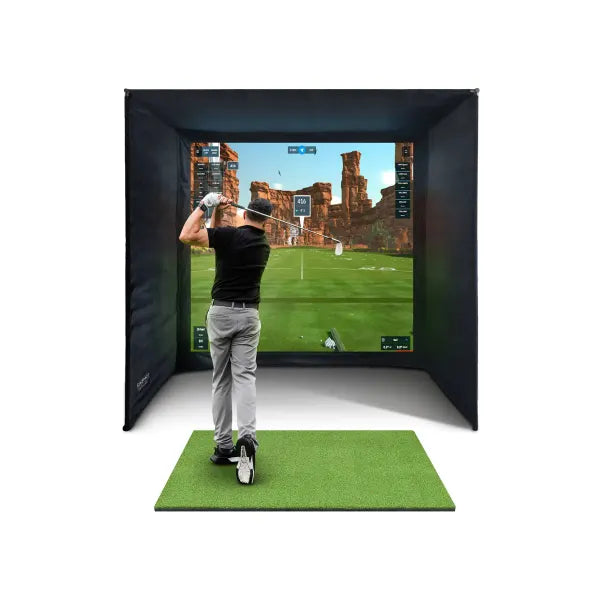
The SimSpace SIM 1 and SIM 2 are specifically designed for tight spaces, fitting rooms as narrow as 3 metres wide with clearance for frame legs. They include impact screen, side barriers, and steel frame construction. Browse our golf simulator collection for sizing options.
In rooms under 3.5 metres deep, skip the enclosure. A quality practice net is the honest alternative — and the data from your launch monitor is identical whether you hit into a net or a screen.
A wall-mounted impact screen offers a middle ground, saving 15 to 30 centimetres of depth by eliminating the free-standing frame. You will want side netting for stray shots. See our enclosures guide for details.
Projector Solutions for Low Ceilings
A ceiling-mounted projector hangs 15 to 25 centimetres below the ceiling — at 2.15 to 2.25 metres in a 2.4-metre room. That is directly in the swing arc for many golfers.
Ultra-Short Throw (UST) Projectors
UST projectors sit 30 to 60 centimetres from the screen at floor level, projecting upward. They require zero ceiling clearance and are often the only viable projection option in 2.4-metre rooms.
- Optoma GT1080HDR (~£700): 0.49:1 ratio, 3,800 lumens. Fills a 2.5m screen from 1.25 metres
- XGIMI Aura (~£2,000): 4K laser UST, 0.233:1 ratio. Fills a 3m screen from 70cm
- Epson LS800 (~£2,500): 4K laser UST, 4,000 lumens. Bright enough for rooms with ambient light
Trade-off: UST projectors are more sensitive to screen flatness. Impact screens flex when hit, briefly distorting the image. A foam backing layer reduces this significantly.
Rear Shelf Mount
In rooms 4.5 metres or deeper, a short-throw projector on a shelf at the rear wall (about 2 metres high) avoids the ceiling-mount issue entirely. You may cast a shadow when addressing the ball — position the projector slightly off-centre and use lens shift to compensate.
Screen Size vs Throw Distance in Small Rooms
In a small room, you may need to accept a smaller projected image. Here is a quick reference:
| Projector Type | Distance From Screen | Image Width | Notes |
|---|---|---|---|
| UST (0.25:1) | 0.6m | 2.4m | Floor-mounted, no ceiling clearance needed |
| UST (0.25:1) | 0.75m | 3.0m | Full-size image from under a metre |
| Short throw (0.49:1) | 1.2m | 2.5m | Low shelf or offset ceiling mount |
| Short throw (0.69:1) | 2.1m | 3.0m | Standard ceiling mount (needs headroom) |
For full projector guidance including recommended models and mounting options, see our complete projector guide.
Real UK Room Examples

Single Garage (2.4m Ceiling, 3m x 5m)
The most common UK simulator location, and for good reason. At 3 metres wide and 5 metres deep, it comfortably fits a full setup.
Recommended setup: Compact 2.5m-wide enclosure (leaving clearance in the 3m-wide space), camera-based launch monitor to avoid consuming rear depth, short-throw projector (check headroom — may need rear shelf mount at 2.4m ceiling), and ceiling padding over the entire hitting zone.
The ceiling reality: At 2.4 metres, most golfers over 175cm will brush the ceiling with a full driver swing. The combination of ceiling padding and a three-quarter backswing solves this completely. Irons from 7-iron down are generally fine at full swing for golfers up to 183cm.
Budget: £3,000 to £6,000 including room preparation (insulation, electrics, flooring, heating). See our garage build guide for a detailed step-by-step process and cost breakdown.
Box Bedroom (2.4m Ceiling, 3m x 3.5m)
The typical UK box bedroom — the smallest bedroom in a house, often used as a home office or storage room — is the most challenging space. At 3m x 3.5m, projection is not practical, but a quality practice setup absolutely is.
Recommended setup: Freestanding practice net against the far wall, camera-based launch monitor (Falcon for budget, GC3S for accuracy), compact hitting mat, and a 32 to 43-inch TV mounted on the wall for data display and course play. Foam practice balls are optional for quieter sessions.
Think of it as a high-tech driving range in your spare room. The launch monitor reads everything at impact — whether the ball then flies 200 yards or 2 metres into a net makes no difference to the data. You get full shot data, virtual course play via GSPro, and meaningful practice that directly improves your game.
Budget: £900 (Falcon + net + mat + tablet) to £4,000 (GC3S + premium net + mat + TV).
Basement (Variable Height)
Ceiling heights vary from 1.8m in old cellars to 2.7m in proper conversions. At 2.4m or above, treat it like a garage. Between 2.0m and 2.4m, focus on irons, wedges, and short game — the part that actually lowers scores. Below 2.0m, putting and chipping only. Watch for damp (invest in a dehumidifier), load-bearing columns that reduce usable width, and access — measure your staircase before ordering a large enclosure.
Conservatory (Variable Height, Glass Walls)
Conservatories offer good floor area and sometimes higher ceilings (2.4m at the house wall rising to 3m at the ridge), but light is the enemy. Projected images wash out in daylight — even 5,000 lumens cannot compete with direct sunlight through glass.
Solutions: Blackout blinds on every panel (£100 to £300), evening-only use (many golfers are happy with this), or a bright TV instead of a projector. Modern 4K TVs are visible in sunlit rooms where projectors fail.
Other concerns: Temperature extremes (freezing in winter, boiling in summer — electronics suffer), glass breakage risk from mis-hits (an enclosed setup with side netting is essential), and floor strength for heavy enclosures. Check before installing.
What to Avoid: Common Mistakes in Small Spaces
- Buying a radar launch monitor for a short room. The most common mistake. The Mevo Gen 2 needs 1.5 to 2.5m behind the ball — impossible in rooms under 4.5m deep. Use camera-based instead
- Choosing an oversized enclosure. Leave at least 15cm clearance on each side from the walls for assembly and access
- Ignoring the ceiling until after buying. Check ceiling height first. It determines everything else
- Ceiling-mounting a projector without checking clearance. At 2.4m, the projector sits at 2.15 to 2.25m — directly in the swing path. Use UST or rear shelf mount instead
- Forgetting enclosure frame depth. Frames add 15 to 30cm. In a 4m room, that shrinks usable hitting depth to 3.4m
- Dismissing a TV-based setup. At 2 metres viewing distance, a 55-inch TV looks much larger than from the sofa. It is cheaper, brighter, and works in any light
- Not testing with your tallest club first. Stand in the room with a driver and make a slow backswing before committing to any setup
Frequently Asked Questions
Can I use a golf simulator with a 2.4m ceiling?
Yes. Thousands of UK golfers do. You need ceiling padding, and most golfers over 175cm will use a three-quarter backswing with driver. Irons and wedges are comfortable for most adults. Use a camera-based launch monitor at floor level — overhead-mounted units need more clearance.
What is the smallest room for a golf simulator?
3 metres wide by 3.5 metres deep with a 2.4m ceiling accommodates a net, camera-based launch monitor, and hitting mat with full shot data on a tablet. For projected visuals on a large screen, you need at least 3m x 4m.
Which launch monitor is best for a small room?
Camera-based monitors that sit beside the ball. The Foresight GC3S for accuracy, the Falcon for budget. Avoid radar monitors like the Mevo Gen 2 in rooms under 5 metres deep.
Can I use a golf simulator in a spare bedroom?
Yes. A typical UK spare bedroom at 3m x 3.5m to 3m x 4m supports a net-based setup with a launch monitor and TV display. Full shot data, course play via simulator software, and meaningful practice. Projection requires at least 4 metres of depth.
Do I need a projector for a golf simulator?
No. Many golfers use a launch monitor with a practice net and TV or tablet. The shot data is identical — the monitor reads everything at impact. In small rooms where projection is impractical, a TV-based setup is perfectly valid. See our projector guide for more.
How do I protect my ceiling from golf club damage?
Install foam padding tiles above the hitting zone. EVA gym tiles (15 to 20mm thick, £20 to £50) are the most popular choice. Fix with spray adhesive, covering at least 1.5m x 1.5m centred on your hitting position. See our garage build guide for full room preparation advice.
Making It Work: A Practical Summary
Setting up a golf simulator in a small room with a low ceiling is absolutely possible. The constraints are real but manageable, proven by thousands of UK golfers who practice daily in exactly these conditions.
- Measure your room — width, depth, and ceiling height at the hitting position
- Check ceiling height first. At 2.4m, plan for ceiling padding and a three-quarter driver swing
- Match depth to setup type. Under 3.5m: net + monitor + tablet. 3.5 to 4m: compact projection with UST. 4.5m+: standard simulator
- Choose a camera-based launch monitor for any room under 5m deep
- Consider UST projection if ceiling height prevents a standard ceiling mount
- Do not dismiss a net + TV setup. In a truly small room, this delivers better practice quality than a cramped projected setup
The best golf simulator is the one you actually use. A compact net-and-monitor setup in your spare bedroom that you hit into every evening beats a grand projected simulator in a room you never quite finish building. Start with what your space allows, get swinging, and upgrade later if you outgrow it. For help with other aspects of your build, see our guides to simulator PCs and simulator lighting.
Ready to find equipment that fits your space? Browse our simulator bundles, explore our launch monitor range, or check our practice nets for compact setups. And if you are still unsure whether your room will work, our complete UK buyer's guide is the best place to start.


Leave a comment