
How to Practice Golf at Home Without a Simulator


Effective golf practice at home does not require thousands of pounds worth of technology. While golf simulators offer an incredible training experience, plenty of golfers across the UK improve their handicaps using nothing more than a putting mat, a few training aids, and some structured drills in the living room, garage, or garden. Whether you are a complete beginner looking to build fundamentals or a single-figure player maintaining your game through the winter months, this guide covers every way to get meaningful golf practice at home without spending a fortune.
Why Home Golf Practice Matters More Than You Think
Most amateur golfers struggle to improve because they simply do not practise enough. A weekly round and the occasional bucket of range balls is not sufficient volume to build muscle memory or make lasting swing changes. Home golf practice solves the access problem by putting your training space steps away from your sofa. There is no drive to the range, no queue for a bay, and no time pressure to rush through balls before the session ends. Even fifteen minutes of focused golf practice each evening adds up to nearly two hours per week, which is more dedicated training than most club golfers manage in a month.
The other advantage of home practice is isolation. On the range, it is tempting to hit driver after driver and watch balls fly. At home, without ball flight to admire, you are forced to focus on the process — grip, posture, alignment, tempo, and strike quality. These are the fundamentals that actually drive improvement, and they are best developed in a distraction-free environment where you can give each repetition your full attention.
We tested a four-week home practice routine using only a net, mat, and putting strip — and found measurable improvement in ball striking consistency after just two weeks of daily fifteen-minute sessions.

Putting: The Fastest Way to Lower Your Scores
If you only do one type of golf practice at home, make it putting. Putting accounts for roughly forty percent of your strokes in a typical round, yet most amateurs spend less than ten percent of their practice time on the green. A quality putting mat and ten minutes a day will have a measurable impact on your scores within weeks.
A good putting mat simulates the speed and feel of a real green. Look for mats that are at least three metres long, as shorter mats do not give you enough distance to practise pace control on medium-length putts. The surface should be smooth and consistent with a realistic stimp speed — most quality mats run at around 10 to 11 on the stimp meter, which matches the average UK club green in summer.
Structure your putting practice rather than mindlessly rolling balls at the hole. Start with twenty straight three-foot putts — these are the putts that should be automatic on the course. If you miss one, start the count again. This builds the pressure tolerance that translates directly to competitive play. Then move to six-foot putts, focusing on a consistent stroke length rather than the outcome. Finally, practise lag putting from the far end of the mat, trying to stop the ball within a clubhead length of the target.
For alignment, place two alignment sticks or even two pencils on the mat creating a gate just wider than your putter head. Stroke through the gate repeatedly to groove a straight putter path. This simple drill corrects the most common putting faults — an open or closed face at impact and a push or pull stroke path.
Chipping: Build Touch and Consistency Indoors
Chipping is the second-highest impact area for golf practice at home. A pop-up chipping net and a handful of foam or low-flight practice balls let you work on your short game in the living room, hallway, or garden without any risk to windows or walls. Foam balls weigh roughly the same as real golf balls but travel only a fraction of the distance, making them safe for indoor use.

FORZA ProFlex Pop-Up Golf Net/Cage
£280
Practice your full swing at home with just a net and mat.
View ProductSet up a chipping target at various distances — two metres, four metres, and six metres if your space allows. Use different clubs for each distance to develop feel with your pitching wedge, sand wedge, and lob wedge. The goal is not distance control (foam balls do not fly like real ones) but rather consistency of strike and trajectory. If you can consistently land foam balls on target with a clean strike, the same technique will produce accurate results with real balls on the course.
A particularly effective indoor chipping drill is the towel drill. Lay a hand towel on the floor at your target distance and try to land every chip on the towel. Start with ten chips per club and track your percentage. Over weeks, shrink the target from a bath towel to a hand towel to a flannel. This progressive difficulty builds genuine precision that shows up in your greenside play.

Swing Trainers: Groove Your Full Swing at Home
Full swing golf practice at home is possible without hitting a single ball. Weighted swing trainers, speed sticks, and alignment training aids let you work on swing mechanics, tempo, and speed in your garage, garden, or any space with adequate ceiling height.
Weighted swing trainers like the Orange Whip or SKLZ Gold Flex are popular for good reason. The flexible shaft and weighted head force you to maintain proper swing sequence — if you rush the transition or cast from the top, the weight lags and the timing feels wrong. Swinging a weighted trainer for five minutes builds the sensation of a smooth, connected swing that you can then replicate with a real club.
Speed training sticks such as the SuperSpeed Golf system use overspeed training principles to increase your clubhead speed over time. The protocol involves swinging lightweight sticks as fast as possible, teaching your neuromuscular system to fire faster. Studies show an average gain of five to eight percent in clubhead speed after consistent use, which translates to ten to fifteen extra yards with the driver. This is genuine golf practice that produces measurable results without a ball, a range, or a course.
If you prefer something simpler, a simple alignment stick makes an excellent swing plane trainer. Hold the stick against the butt end of your grip so it extends beyond the handle. On the backswing, the stick should not hit your body. On the downswing and through-swing, the stick should not hit your lead hip. If it does, your plane is off. This free drill gives you immediate feedback on swing plane without any specialist equipment.
Mirror Drills: See What Your Body Actually Does
A full-length mirror is one of the most underrated tools for golf practice. Most swing faults persist because the golfer cannot see what their body is actually doing — they feel one thing but do something completely different. A mirror provides instant visual feedback that closes this perception gap.
Set up facing the mirror for face-on feedback. Check your posture at address — are your feet shoulder-width apart, knees slightly flexed, spine tilted forward from the hips with a straight back? Take the club to the top of the backswing in slow motion and freeze. Is your lead arm straight? Is the club shaft parallel to the ground or past parallel? Is your weight loaded into your trail hip?
Turn side-on for down-the-line feedback. Check your takeaway — is the clubhead moving straight back along the target line or drifting inside or outside? At the top, is the club pointing at the target? On the downswing, are you maintaining your spine angle or standing up through impact?
Film yourself from both angles using your phone propped against the mirror base. Compare your positions to tour player reference images that are freely available online. The discrepancies between your swing and a good model reveal exactly what you need to work on, making your golf practice sessions dramatically more efficient.

Golf Fitness: Train Your Body for Better Golf
Physical conditioning is golf practice that many amateurs overlook entirely. Flexibility, core strength, balance, and rotational power directly influence swing mechanics, consistency, and injury prevention. You do not need a gym — a yoga mat and your own body weight are sufficient.
Hip mobility is the single most important physical quality for golf. Tight hips restrict rotation, forcing compensations that cause inconsistency and back pain. The 90/90 hip stretch, performed for two minutes each side daily, will noticeably improve your ability to turn through the ball within two to three weeks. Add a standing hip rotation drill where you set up in your golf posture and rotate your hips as far as possible in both directions without moving your feet.
Core stability prevents energy leaks in the swing. A plank hold, side plank, and dead bug exercise performed as a three-minute circuit provides the core strength needed for a stable, powerful swing. The dead bug is particularly valuable because it teaches your core to stabilise while your limbs move independently — exactly what happens during the golf swing.
Rotational power generates clubhead speed. Medicine ball throws against a wall (or just the movement without a ball if space is limited) train the explosive rotational pattern of the downswing. Perform ten throws from each side, focusing on driving the rotation from the ground up through the hips and into the upper body. This movement pattern transfers directly to the golf swing and can be done in any room with a clear wall.
Alignment Sticks: The Multi-Purpose Training Aid
A pair of alignment sticks costing under five pounds is arguably the most versatile golf practice tool you can own. At home, they serve dozens of purposes across every aspect of the game.
For alignment, lay one stick on the ground pointing at your target line and another parallel to it along your toe line. This simple setup ensures your feet, hips, and shoulders are aligned correctly — a fundamental that drifts without regular checking. Most golfers who think they aim straight actually aim significantly right or left of their target.
For ball position, place a stick perpendicular to your target line at the correct ball position for each club. For a driver, the stick sits opposite your lead heel. For a mid-iron, it sits in the centre of your stance. For a wedge, slightly back of centre. Rehearsing the correct setup with visual guides builds the spatial awareness to replicate it on the course without aids.
For swing plane, hold a stick against the shaft of your club so it extends beyond the grip. The extension makes it visually obvious if your backswing is too flat, too upright, or on the correct plane. Use this in front of a mirror for the most complete feedback. These drills require no balls, no space, and no expense — just focused golf practice repetitions.

Garden Golf Practice: Hitting Real Balls at Home
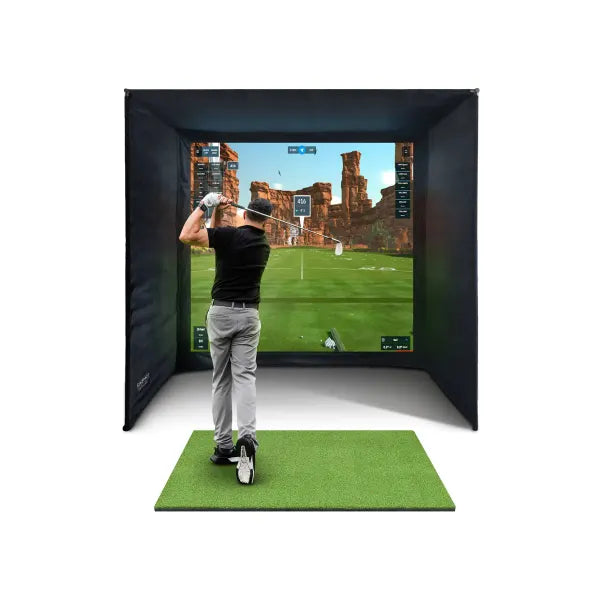
If you have a garden, you can progress from drills and aids to hitting real golf balls. A golf practice net or a golf cage provides the ball containment needed for safe full-swing practice outdoors. Pair it with a quality hitting mat to protect your lawn and provide a consistent striking surface.
For golfers who enjoy outdoor golf practice and want data on every shot, adding a launch monitor transforms your garden setup into a serious training facility. The FlightScope Mevo Gen 2 and Foresight GC3S both work excellently in garden net setups, providing ball speed, launch angle, spin rate, and estimated carry distance for every shot. This data turns your golf practice from guesswork into measurable progress.
An impact screen mounted inside your net or cage protects the netting and provides a visible target. Higher-end setups can add a projector and simulation software, creating a full golf simulator experience — but that is the upgrade path rather than the starting point. The beauty of a garden practice area is that you can begin with a simple net and mat, then add technology over time as your budget and enthusiasm allow.
Browse our simulator bundles if you decide to upgrade your garden setup into a complete simulator. Our buyer's guide walks through every option from budget-friendly nets to premium simulator packages. For practice routines that work in any setup, read our practice drills guide.
Building a Weekly Golf Practice Routine at Home
Consistency matters more than volume. A structured weekly routine of four to five short sessions delivers better results than one marathon weekend session. Here is a sample weekly plan that covers every aspect of the game using only home-based drills and equipment.
Monday — Putting (15 minutes): Twenty straight three-foot putts (restart if you miss), then ten six-foot putts tracking makes, then five lag putts from maximum distance focusing on pace.
Tuesday — Chipping (15 minutes): Ten chips with pitching wedge, ten with sand wedge, ten with lob wedge. Use a towel target and track your landing percentage. Switch between bump-and-run and lofted trajectories.
Wednesday — Swing mechanics (15 minutes): Mirror work focusing on one specific position — address, top of backswing, impact, or finish. Take ten slow-motion swings checking each position, then ten at half speed maintaining the correct positions.
Thursday — Fitness (20 minutes): Hip mobility stretches (five minutes), core circuit of plank, side plank, dead bug (five minutes), rotational power with medicine ball throws or unweighted rotations (five minutes), balance drills standing on one foot in golf posture (five minutes).
Friday — Speed training (10 minutes): Weighted swing trainer or speed sticks protocol. Follow the manufacturer's programme or simply perform three sets of five maximum-effort swings from each side.
This routine totals roughly seventy-five minutes per week. Every session is short enough to fit before work, during a lunch break, or after putting the children to bed. The cumulative effect of consistent, focused golf practice across all these areas will outperform sporadic range sessions by a significant margin.

When to Upgrade to a Simulator
Home golf practice without a simulator is genuinely effective, but there comes a point where technology adds significant value. If you find yourself hitting balls into a net every day and wishing you could see where they would land, a launch monitor is the natural next step. If you want to play virtual rounds on famous courses during winter evenings, a full simulator setup opens up that experience.
The upgrade path is gradual and does not need to happen all at once. Start with a net and mat, add a launch monitor when the budget allows, then add a projector and screen when you are ready for the full experience. Each step adds value to your golf practice without making the previous investment redundant — the net still catches the balls, the mat still protects your surface, and the launch monitor still tracks your data.
Read our setup guide for the complete process of building a home simulator from scratch, and our cost breakdown guide for realistic UK pricing on every component.
For structured practice plans, England Golf offers free resources covering all aspects of the game from putting to driving.
Recommended Products


Not Sure What You Need?
Book a free virtual consultation with our team. We'll walk you through the options, help you measure your space, and recommend the right setup for your budget.
Book Free Consultation →Frequently Asked Questions
Can I genuinely improve my golf with home practice alone?
Yes. Putting, chipping, swing mechanics, and physical conditioning can all be trained effectively at home. Many teaching professionals recommend that the majority of golf practice should focus on these fundamentals rather than hitting full shots at a range. Home practice builds the muscle memory and physical preparation that make your on-course time more productive.
What is the single best golf practice aid for home use?
A quality putting mat delivers the highest return on investment. Putting improvements translate directly to lower scores because every round includes thirty to forty putts. A three-metre mat with a consistent surface and a hole or target at the end costs between thirty and eighty pounds and provides thousands of hours of effective practice.
How much space do I need for golf practice at home?
Putting requires a space roughly one metre wide by three metres long — a hallway works perfectly. Chipping with foam balls needs a clear area of about two by three metres. Full swing drills without a ball need enough ceiling height for your backswing (approximately 2.5 metres) and enough width to extend the club fully (about 2 metres). A single-car garage or a medium living room provides enough space for all of these.
Are foam practice balls effective for chipping practice?
Foam balls are excellent for developing consistent strike and trajectory. They do not replicate the exact feel or distance of a real golf ball, but they provide enough feedback to train the clubface control and contact quality that matter most for chipping accuracy. For realistic distance feedback, move to a garden setup with real balls and a net.
How often should I practise golf at home to see improvement?
Four to five sessions of fifteen to twenty minutes per week is the sweet spot. This provides enough volume for motor learning without risking burnout or repetitive strain. Consistency is far more important than session length — fifteen minutes every day outperforms two hours once a week by a significant margin in terms of skill development and retention.


Leave a comment