
Practice Golf Nets UK: The Complete 2026 Guide

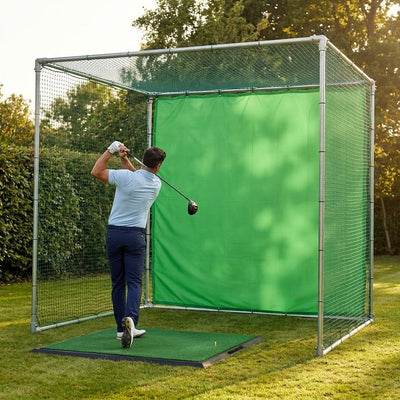
Practice golf nets are the cheapest way to hit real balls at home, and for most UK golfers they are the sensible first purchase — well before a launch monitor, an impact screen, or anything with a projector attached. But the market is a mess. Search for practice golf nets and you will find everything from £40 pop-ups that fold like a beach tent to £700 steel-framed structures that need two people and an afternoon to assemble. I have tested plenty of them in my own garden and talk buyers through them every week, so this guide covers what actually separates a good net from a bad one: the three main types, how ball-stopping really works, where each net belongs, what breaks first, and the point at which you should stop buying nets and buy a cage instead.


What Counts as a Practice Net (and What Doesn't)
A practice net is a standalone piece of netting on a frame, designed to catch golf balls hit directly into it from a few metres away. It is not a full golf cage — a cage is an enclosed structure with a roof and side walls that contains the ball even when you miss badly. The distinction matters because it determines where you can safely use each one. A net asks you to hit reasonably straight; a cage forgives almost anything.
I have written a full comparison of the two in my golf cage vs golf net guide, so I will not re-litigate that decision here. The short version: if you are hitting wedges and short irons, or you are a reasonably consistent ball-striker, a net is fine. If you want to hit driver flat out, or you have neighbours within shanking distance, read that guide before you buy anything.
The Three Types of Practice Golf Nets

Pop-up nets
Pop-up nets use a sprung steel hoop sewn into the fabric edge, so they twist open in seconds and fold flat into a carry bag. They are light, cheap (typically £40–£150) and genuinely portable — you can set one up on the lawn after work and have it back in the shed before dinner. The trade-off is size and stability. Most pop-ups are around 2m to 2.5m wide and under 2m tall, which is a small target for a driver, and in any real breeze they want to become airborne unless properly pegged down.
The best of this breed blur the line with cages. The Forza ProFlex pop-up net cage is the one I recommend most often because it adds short side wings and a more generous face than a basic flat pop-up, while still packing down small. After 500 shots on the ProFlex in my own garden — including plenty of full irons — the netting showed no wear at the impact zone, which is more than I can say for the budget pop-ups I have tested alongside it.
Frame nets
Frame nets hang netting from a rigid pole structure, usually powder-coated steel or fibreglass, in a flat or slightly concave face. They run from about £100 to £400 depending on size and steel quality. Because the netting hangs loose rather than being stretched drum-tight, it absorbs the ball and drops it at the base rather than trampolining it back at your shins. Frame nets are a semi-permanent proposition: you can take them down, but most owners leave them up from spring to autumn.
Socked (baffle) nets
Socked nets — sometimes called baffle or sock nets — funnel the ball into a fabric tube or pocket behind the target panel. The sock decelerates the ball progressively and drops it into a collection area, which makes them the quietest and gentlest option on both the ball and the netting. They are common in garage and indoor setups where rebound is dangerous and space is tight. Expect £150–£450 for a decent one.
Ball-Stopping: What Actually Matters
Every net claims to stop a golf ball. The questions that separate them are how many balls, at what speed, and what happens on the shot that misses the middle.
Netting material and ply. Look for knotted or braided polyester/nylon netting with a quoted twine thickness. Thin, knotless netting sold on the cheapest pop-ups will stop a wedge all day but will start to fray under repeated driver impacts, which arrive at 60–80 mph ball speed even for average golfers and well over 100 mph for stronger players.
A second impact layer. The best nets hang a smaller secondary panel (a baffle) in front of the main net at the impact zone. The baffle takes the abuse and is cheap to replace; the structural net behind it stays intact. If you plan to hit more than 100 balls a week, I would treat a replaceable baffle as close to essential.
Tension. Counter-intuitively, a slightly loose net stops balls better than a tight one. Tight netting acts like a trampoline and fires balls back at you — I measured rebound of nearly four metres off an over-tensioned budget net during testing, which is genuinely dangerous indoors. Loose netting cradles the ball and kills its energy.
Coverage beyond the target. A 2m-wide net looks big until you hit a heel-strike that leaves the face 15 degrees offline. Wider faces, angled side wings and returns dramatically reduce escapees. This is the single biggest practical difference between a cheap net and a good one.
Garden, Garage or Indoors: Where Each Net Belongs

Garden. Outdoors you have height and room to stand back, so any net type works. Your enemies are wind and UV. Pop-ups must be pegged and ideally taken down after each session; frame nets should be anchored or weighted. UV degrades netting over two to three summers, so a net that lives outside permanently will need replacement panels regardless of quality.
Garage. A single UK garage is typically about 2.4–2.6m wide with a ceiling of 2.1–2.4m, which rules out most driver swings for taller golfers but suits irons and wedges well. Socked nets shine here: no rebound off the back wall, no balls rattling around your car. Measure your swing clearance with the actual club before buying — swing slowly in the space with a towel on the clubhead and check the ceiling, walls and light fittings.
Indoors. A spare room or conservatory can work for chipping and slow-speed work, but I only recommend full-speed hitting indoors with a socked net or a proper enclosure, plus a decent golf hitting mat to protect the floor and your joints. Bare carpet over concrete is a wrist injury waiting to happen.
Comparison: Pop-Up vs Frame vs Socked
| Pop-up | Frame net | Socked net | |
|---|---|---|---|
| Typical price | £40–£150 | £100–£400 | £150–£450 |
| Setup time | Under 2 minutes | 20–45 minutes | 30–60 minutes |
| Driver-safe | Only the best (e.g. ProFlex) | Yes, on quality models | Yes |
| Best location | Garden, occasional use | Garden, semi-permanent | Garage / indoors |
| Wind tolerance | Poor — peg it or lose it | Moderate with anchors | N/A (usually inside) |
| Typical lifespan | 1–3 years | 3–5 years | 5+ years |
Prices are typical UK ranges at the time of writing. You can browse current options in our golf nets collection.
Durability: What Breaks First

Having repaired and replaced a fair number of these, the failure points are remarkably consistent:
1. The impact zone. Everyone hits the same square metre of netting. On nets without a baffle, this area frays first — usually visible as fuzzy, whitened strands after a few thousand impacts. Once individual strands snap, retire the net for anything above wedge speed.
2. Stitching at the frame. On pop-ups, the seam where netting meets the sprung hoop takes load on every shot and every fold. Cheap nets fail here within a season of regular use.
3. Fibreglass poles. Frame nets with fibreglass rods splinter where the sections join, particularly after being left flexed in wind. Steel frames outlast fibreglass by years.
4. UV rot. The silent killer. A net can look pristine at two years old and still tear like paper if it has faced south, uncovered, through two summers. If your net lives outside, buy one with replaceable netting panels and budget for a new panel every couple of years.
When to Upgrade to a Cage
A net stops being the right answer when any of these become true: you want to hit driver without a second thought about mishits; you are hitting daily and chewing through netting; you share a fence line with neighbours or a road; or you are adding a launch monitor and want a permanent hitting bay. At that point a four-sided golf cage — something like Forza's 3×3×3m steel-framed cage — is the safer, longer-lived investment, and it becomes the skeleton of a full simulator build later if you go down that road. For a full breakdown of sizes and prices across nets and cages, my complete net and cage buying guide covers the whole market.
One more thing worth saying: a net does not give you ball flight. You will groove contact and swing shape, but you cannot see curvature or carry distance. That is fine — the R&A's practice and rules resources are full of drills that work purely on strike and start line — but if feedback matters to you, pair the net with a basic launch monitor rather than upgrading the net itself.
Frequently Asked Questions
Can I hit driver into a practice golf net?
Into a good one, yes. You need heavy-duty knotted netting, ideally a replaceable baffle at the impact zone, and enough face width that an offline strike still catches net. I would not hit driver into a basic flat pop-up — the ProFlex-style net cages and steel frame nets are the minimum I trust at driver speed.
How far should I stand from the net?
Around 2.5–3m from ball to net. Closer and mishits can deflect around the edges before the face can gather them; much further and you need a bigger net to cover the dispersion. Never hit from so close that a rebound could reach you before you can react.
How long does a practice net last?
Regular use (say 200 balls a week) wears out a budget pop-up in about a season, a quality net in two to four years, and a net with a replaceable baffle almost indefinitely — you just swap the baffle. UV exposure roughly halves outdoor lifespan if the net is left up year-round.
Are practice nets safe to use in the garden?
Yes, with honest self-assessment. Position the net so an escaping ball travels into your own property, not over a fence. Check pegs and anchors before every session, take pop-ups down in wind, and keep children and pets behind the hitting position. If you cannot guarantee containment on your worst strike, that is the signal to move up to a cage.
⛳ Free resource: the 90-Day Golf Cage Practice Programme
A cage stops your golf balls — a plan lowers your scores. The free interactive golf cage practice programme gives you 39 structured 25-minute sessions, a 24-drill library, and progress scorecards you can track online — built around the Pro Golf Cage & Hitting Mat Bundle and open to every garden golfer.
Free email series: Dream Home Golf Cage Setup
Six short emails from Tom on the five decisions behind a brilliant garden practice space.
📏 Free tool: the Garden Golf Cage Planner
Planning a garden golf cage? The free Garden Golf Cage Planner answers the space, base, netting and cost questions in one place — including the Will-It-Fit calculator: enter your garden size and see which cages fit. No sign-up.

Free Home Golf Cage Setup Design Consultation
Not sure on size, base or mat? Chat directly with one of our experts — real golfers who practise from their own garden cage most days and has designed hundreds of home setups.
- Send a photo of your garden with rough measurements — get a tailored layout and spec for your space
- Personal replies from a real golfer, not a call centre
- Honest advice on what to buy — and what not to
Usually replies within the hour, 6am–10pm · prefer to talk? 02033 768500


Leave a comment