
Is a 3m Golf Cage Tall Enough to Hit Driver? The Geometry

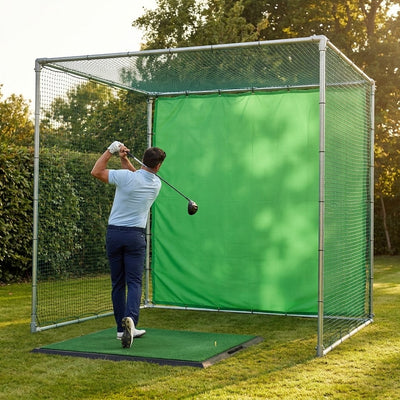
Yes. A 3 m tall golf cage clears a driver swing for almost every golfer, and the ball meets a net 2.5 to 3 m away well below the top. A driver is about 1.15 m long, the club head peaks around 2.3 to 2.6 m, and a 10 to 15 degree launch hits the net under 1 m high.

The swing: how high does a driver head go?
Start with the club. A men's driver is 45 to 46 inches long, which is 1.14 to 1.17 m. The club head traces an arc around your body, and the question is how high that arc gets at the top of the backswing and in the follow-through. This is arithmetic, not a test, so I'll show the working.
For a golfer of 1.80 m, the shoulders are at about 1.45 m. At the top of the backswing the hands are roughly at head height, call it 1.70 to 1.80 m, and the shaft points back behind the head on a tilted plane, not straight up. The club head therefore sits above the hands by a fraction of the shaft length, not the whole of it. If the shaft sits 45 degrees above horizontal at the top, the head is about 0.8 m above the hands, so around 2.5 to 2.6 m. If the shaft is nearer horizontal, as it is for many golfers, the head is lower, nearer 2.3 m. The follow-through is similar: hands around head height, shaft angled behind, club head in the same 2.3 to 2.6 m range.
Add the tee peg, which lifts the ball but not the swing, and the mat you stand on, which does lift the swing. A hitting mat on a rubber base adds roughly 5 cm. That puts the highest point of a full driver swing around 2.4 to 2.7 m above the ground the cage stands on, inside a 3 m frame with 30 to 60 cm to spare.
The exceptions are real but narrow. A golfer of 1.95 m with a very upright finish could get the head to about 2.8 m. That is still inside 3 m, but it is close enough that I'd want the frame on level ground and the mat kept thin. Nobody in normal play swings a driver in a vertical circle with arms and shaft in a straight line, which is the only geometry that puts the head above 3 m.
The ball: where it meets the net
Driver launch angle is the angle the ball leaves the ground at. A typical amateur launches a driver at 10 to 15 degrees; a very high launch is 18 to 20 degrees, and anything above that is a skied shot off the top of the club. The height of the ball when it reaches the net is the distance to the net multiplied by the tangent of the launch angle, plus the tee height. The table does the sums for the distances you can get inside a 3 m deep cage.
| Launch angle | Height at 2 m | Height at 2.5 m | Height at 3 m |
|---|---|---|---|
| 10° | 0.35 m | 0.44 m | 0.53 m |
| 15° | 0.54 m | 0.67 m | 0.80 m |
| 20° | 0.73 m | 0.91 m | 1.09 m |
| 30° (skied) | 1.15 m | 1.44 m | 1.73 m |
| 45° (badly skied) | 2.00 m | 2.50 m | 3.00 m |
Read it this way. A normal drive hits the net below hip height. A high launch hits it around chest height. A proper sky, 30 degrees, is still a metre and a half below the roof of the cage at full depth. Only a ball launched at 45 degrees from the very back of a 3 m cage reaches the top edge, and that is the shot the roof net exists for. Over that distance the ball has not had time to curve, so the launch angle is all that matters for height.
In our experience the mishit that worries people, the thinned drive that comes off low and hot, is the easy one for a cage. It hits the net at knee height and the net does its job. The ones that test a cage are the sky into the roof and the shank into the side panel, and a 3 m cube covers both with margin.
Width and depth matter as much as height
A 3 m cube gives you 3 m of width. If you tee up in the middle, you have 1.5 m each side of the target line. A drive that starts 10 degrees off line is 0.44 m off centre at 2.5 m, and 0.53 m at 3 m, so even a wild start angle of 20 degrees lands inside the side nets. The shank is different; it comes off the hosel and heads right at a steep angle, which is why the side panels are part of the cage and not optional.
Depth decides how fast the ball is travelling when it meets the net and how much the net bellies back. Stand so the ball is 2 to 2.5 m from the front net, which leaves 0.5 to 1 m behind you for the backswing inside the frame. The net needs clear space behind it to flex, so don't butt the back of the cage against a fence or a wall; leave half a metre. Garmin's own indoor caution for its launch monitors says the same thing: a net needs adequate free space behind it, needs to be high and wide enough for high-lofted and errant shots, and any frame should be padded to reduce ricochet.
Net types and what "driver-rated" means
Height is the easy part. The net itself is what stops a drive at 150 mph ball speed, and not every net is built to take that every day.
- Knotless twine outer net. Our Pro cage and mat bundle uses a weatherproof 2.3 mm knotless green net on a 42 mm galvanised steel frame. Knotless means the mesh is woven rather than tied, so there are no knots to fray or to send the ball back at odd angles. It is rated for full-speed drives and lives outside all year.
- Archery-grade baffle panel. A heavier polyester mesh panel hung inside the front of the cage. The FORB cage frame and net offers it as an upgrade. It takes the first hit and slows the ball before the outer net, which extends the life of the outer net if you hit a lot of driver.
- Pop-up impact panel. The FORZA ProFlex pop-up is an 8 ft cage, about 2.4 m, with a robust impact panel and a wheeled bag. It will take a drive, but at 2.4 m it has far less margin above the swing than a 3 m frame, and I'd keep it for irons and the occasional driver rather than daily driver sessions.
The frame matters too. A 34 mm frame, as on our Standard cage bundle, is fine for regular garden practice. The 42 mm Pro frame is the one I recommend if driver is most of what you hit, because the heavier tube holds the net taut and the whole cage moves less on impact. For a fixed bay, the Socketed Pro cage concretes its uprights into ground sockets and does not need pegs. Nets wear before frames; a replacement 3 m net is a few years away for most people, not a few months.
When 3 m is not enough
There are a handful of cases where I'd say measure again or change the plan.
- Sloping ground. If the cage stands on a slope and you tee up on the high side, the effective height at your end is less than 3 m. Level the base, or put the mat at the low end.
- A raised platform. If you build a deck or thick sub-base under the mat but the cage stands on the ground around it, you have shortened the cage by the height of the platform. Build the platform under the whole cage, or set the frame on it.
- Branches and gutters overhead. The net does not need the headroom, your swing does. Check 3 m up and around 2 m either side of the tee for anything a club could catch.
- Indoors under 2.7 m. A 3 m cage does not fit a 2.4 m garage, and a lower net inside that garage leaves no margin for a driver. For a garage, use the room's ceiling height as the limit, not the net's, and our minimum advice for a full swing indoors is a 2.7 m ceiling.
- A launch monitor behind you. If you want a Garmin R10 or similar radar with the cage, it needs 1.8 to 2.4 m behind the tee, so it sits behind you at the open end of the cage, outside the frame. Allow for that in the garden plan.
Planning and the garden
A freestanding net cage is not normally treated as a building, but if you are building a permanent platform, concreting sockets near a boundary or putting a roof over it, read the Planning Portal's guidance on outbuildings and planning permission, which sets out height limits near boundaries under permitted development. If in doubt, a quick note to your council's planning team costs nothing.
Neighbours care less about height than about noise and stray balls. The 3 m cube keeps the balls in. A hitting mat on a rubber base keeps the thud down. Our hitting mats collection has the options we pair with the cages, and the full golf cage collection shows every frame and net side by side with live prices.
Frequently asked questions
Is a 3 m golf cage tall enough for a tall golfer?
For almost everyone, yes. A 1.95 m golfer with an upright finish gets the club head to roughly 2.8 m, which is inside 3 m. Keep the mat thin and the ground level and you have margin. Above 2 m tall, I'd want to talk through the mat and base before you buy.
How far from the net should I stand to hit driver?
2 to 2.5 m from the ball to the front net. Closer than 2 m and the ball hits the net before it has slowed at all and the net bellies further; further than 2.5 m and you are swinging with your back against the rear of the cage.
Will a skied drive go over the top?
Not out of a 3 m cube. A 30 degree sky is 1.7 m high at 3 m. It would take a 45 degree launch from the very back of the cage to reach the top edge, and the roof net is there for exactly that. The ProFlex pop-up at 2.4 m has less margin, which is why I'd keep driver sessions in the 3 m cage.
Can I hit driver into the pop-up net?
Yes, the ProFlex impact panel is built for it, but 2.4 m of height leaves little room above the swing for anyone tall, and the lighter frame moves more on impact. For daily driver practice, I found the 3 m steel cage the one people keep.
A 3 m cage is tall enough for a driver, with the ball meeting the net below a metre on a normal drive and the club head peaking around 2.3 to 2.6 m. Buy for the net and the frame, not the height. The Pro cage and mat bundle is the one I'd put in most gardens.
Not sure which option fits your space or budget? Message Tom on WhatsApp for a free consultation — no obligation.

Free Home Golf Cage Setup Design Consultation
Not sure on size, base or mat? Chat directly with one of our experts — real golfers who practise from their own garden cage most days and has designed hundreds of home setups.
- Send a photo of your garden with rough measurements — get a tailored layout and spec for your space
- Personal replies from a real golfer, not a call centre
- Honest advice on what to buy — and what not to
Usually replies within the hour, 6am–10pm · prefer to talk? 02033 768500


Leave a comment