
How to Set Up a Golf Net Cage in Your Garden: Step-by-Step

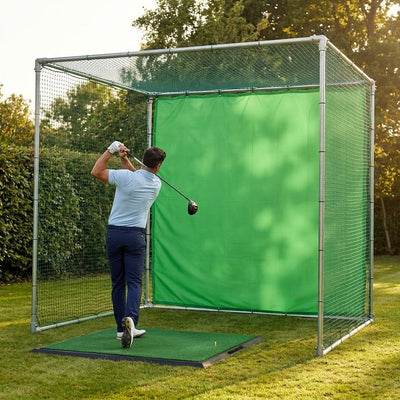
The last cage I put up was on a slightly sloping lawn in a terraced garden in Bristol, boxed in by a fence on one side and the kids' trampoline on the other. Frame up, net on, mat down, anchored, hitting balls, roughly 40 minutes start to finish. That is the honest bar for a decent 3m garden cage: it is not a weekend building project, but it is also not the ten-minute job some product photos imply. Get the order of operations right and you avoid every mistake I see people make, from a sagging net that leaks balls into next door's garden to a frame that lifts in the first proper gust. Here is the process I actually follow.
Before you build: pick a cage that fits your garden
Half of a clean setup is buying the right thing in the first place. The three questions that decide it are: how much space you have behind the ball, whether you are anchoring into grass or hard standing, and how permanent you want it. A pop-up net folds away after every session. A socketed steel cage is a genuine fixture that lives outside year-round. Most people who are hitting more than a bucket a week end up wanting the steel.
These are the four setups I sell and install most, with live prices:
| Cage | Frame | Footprint | Best for | Price |
|---|---|---|---|---|
| FORZA ProFlex Pop-Up | Folding fibreglass | Packs away flat | Small gardens, renters, storing between sessions | £279.99 |
| Standard Cage & Mat Bundle | 34mm steel | 3m × 3m × 3m | A permanent cage on a sensible budget | £459.99 |
| Pro Cage & Mat Bundle | 42mm steel, double net | 3m × 3m × 3m | Drivers, daily hitting, the setup most people should buy | £734.99 |
| Socketed Pro Cage | 42mm steel, ground sockets | 3m × 3m × 3m | A truly fixed, wind-proof installation | £734.99 |

My default recommendation is the Pro Cage & Hitting Mat Bundle at £734.99. The 42mm galvanised steel and double-layer net are rated for driver speed, and it ships with a proper tour-density mat rather than the thin doormat that ruins your wrists. If you are on hard standing and want it bolted down permanently, the Socketed Pro Cage is the same frame with ground sockets for a fixed install. Now, the build.
Step 1: Find the flattest, safest spot
Walk the garden and look for the flattest stretch that gives you a clear swing arc. For a 3m cage you want the cage footprint plus about 50cm of breathing room on each side, and enough room behind the hitting position to take a full backswing without clipping the net. Two things people forget: look up, and think about the neighbours.
Overhead is where cages get damaged. Tree branches rub and tear netting over a season, and I have seen a top rail catch a low washing line. Give yourself clear sky above the frame. On neighbours, a cage kills the ball almost instantly so it is quiet in flight, but the strike itself — club on ball off a mat — carries. If a fence is shared, keep a metre or two of gap so the noise is not landing straight into next door's patio.
Step 2: Sort the ground before anything else
The ground is what makes or breaks a garden cage, and it is the one step people skip. Put a spirit level across the footprint in both directions. A gentle slope is fine — the frame will cope and the net hides it — but a noticeable fall means the mat sits on a tilt and your ball position drifts, which quietly wrecks your strike.
On grass: mow it short first so the base tubes sit flat and your stakes bite cleanly. If the ground is boggy or churns up in winter, lay a bed of compacted gravel roughly 5cm deep under the hitting position and let the mat sit on that. It drains, it stays level, and it stops the mat sinking into a muddy divot by February. On a patio, decking or concrete you cannot stake into, plan from the outset to weight the base — sandbags or base plates on every corner — because a steel frame with nothing holding it down is a sail.
Step 3: Build the frame
Lay every pole out on the grass and group them by length before you connect a single joint. Five minutes sorting parts saves you dismantling a half-built frame because a corner tube went in the wrong slot. Build the base rectangle first, stand the four uprights, then bridge the top — it goes together far more easily as a floor-up sequence than trying to hold a full frame in the air.
If you have a click-fit steel cage, listen for the click on every joint. A connection that has not clicked home is a connection that can pop apart when a driver ball smashes the net and shocks the frame. On the Socketed Pro Cage, this is also where the ground sockets go in — set them, drop the uprights into them, and you have a frame that genuinely cannot walk in the wind. A bolt-together frame is slower and wants a spanner, but click-fit needs no tools at all.

Step 4: Hang the net so nothing escapes
Drape the net over the top of the frame and clip or tie the top edge first, working around the roof so it hangs evenly. Then bring the sides down and secure them, keeping a bit of tension so the net does not billow. You do not want it drum-tight — a slightly loose net absorbs a driver much better than a taut one — but you do not want folds and gaps either.
The one thing to obsess over is the bottom edge. Any gap wider than a golf ball at the base is where balls escape, and a low screamer will find it every time. Peg or weight the skirt of the net all the way along the ground so the base is sealed. If your net has ever let a ball through, this is almost always why. If you already own a good frame and just need fresh netting, a replacement 3m cage net is £172.99 and takes ten minutes to swap.
Step 5: Anchor it against British weather
This is the step that separates a cage that is still standing in November from one you find folded over the flowerbed. Use every ground stake supplied — not two out of four because it feels solid enough. Drive them fully and give the frame a firm shove from a couple of directions; there should be almost no movement.
If your garden is exposed or funnels wind between houses, add guy ropes from the top corners out to pegs at roughly 45 degrees, the same way you would steady a gazebo. On hard standing, this is where the sandbags or weighted base plates from Step 2 earn their keep. A socketed frame set into the ground sidesteps most of this, which is exactly why I steer windy-garden customers towards it.
Step 6: Drop in the mat and hitting kit
Sit the hitting mat centrally, far enough back that your longest club's follow-through clears the front of the frame. The mat matters more than people expect — a thin one transmits every fat shot straight into your wrists and elbows, which is why the Pro and Standard bundles ship with a proper thick mat rather than an afterthought. If you are building from a frame-and-net cage like the FORB Practice Cage at £459.99, budget for a decent mat separately; browse the hitting mats collection and buy the thickest you can justify.

Add a target sheet or an impact panel at the back if you like a visual to aim at, keep a ball tray within reach so you are not bending for every shot, and if you plan to hit into the evenings, a clip-on light on the top rail turns it into an all-year setup. That is genuinely it — you are hitting balls.
Keeping it standing through a British winter
A galvanised steel frame with UV-stabilised netting is built to live outside all year, and that is how most of mine are used. Galvanising is there specifically to shrug off rain, so you do not need to take it down for winter. What does age a cage is neglect: check the joints and stakes after the first few big storms, brush leaves and debris off the net so it is not sitting wet and heavy, and re-tension anything that has worked loose. Netting is the wear part, not the steel — and when it eventually frays, you replace the net, not the whole cage.
The pop-up FORZA ProFlex at £279.99 is the exception here: it is designed to fold away between sessions, so it is the one I would actually pack down rather than leave out in a winter of gales.

FAQ
How long does it take to set up a garden golf cage?
Budget around 30 to 45 minutes for your first build of a 3m steel cage on grass, including levelling the ground and anchoring properly. A click-fit frame with one person goes up fastest; a bolt-together frame or a socketed install adds time. A pop-up net is a couple of minutes because it has no assembly.
Do I need tools to build a golf cage?
Click-fit steel cages and pop-up nets need no tools at all — the poles connect by hand. Bolt-together frames want a spanner or screwdriver. For a socketed cage you will also be setting ground sockets, so a mallet and a spirit level make the job cleaner.
How do I stop golf balls escaping under the net?
Seal the bottom edge. Any gap wider than a golf ball at the base is where low shots leak out, so peg or weight the net skirt along the whole ground line. It is the single most common cause of escaping balls and takes two minutes to fix.
Can I set up a golf cage on a patio or decking?
Yes, but you cannot stake into hard standing, so plan to weight it. Sandbags or base plates on all four corners hold a steel frame down; add guy ropes if the spot is exposed. If you want a truly fixed cage on a surface you can drill, the socketed frame is the more secure route.
Will a steel golf cage survive a UK winter outside?
A galvanised steel frame with UV-stabilised netting is designed to stay up year-round — the galvanising exists to handle the rain. Keep the joints and stakes checked after big storms and brush debris off the net. A pop-up net is the one I would fold away between sessions rather than leave out in winter winds.

Free Home Golf Cage Setup Design Consultation
Not sure on size, base or mat? Chat directly with one of our experts — real golfers who practise from their own garden cage most days and has designed hundreds of home setups.
- Send a photo of your garden with rough measurements — get a tailored layout and spec for your space
- Personal replies from a real golfer, not a call centre
- Honest advice on what to buy — and what not to
Usually replies within the hour, 6am–10pm · prefer to talk? 02033 768500


Leave a comment