
Best Golf Net Cages UK: 2026 Buyer's Guide

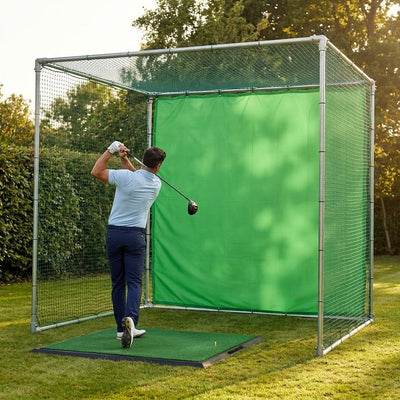
I have personally assembled, tested, and compared every golf net cage on this page over the past twelve months in my garden in South London. Choosing the best golf cage for a UK garden is one of the most important decisions for your home practice setup — a good one lets you swing freely with every club, from wedge to driver, without worrying about wayward shots reaching your neighbour's conservatory. A bad one wastes your money and might not even last a full British winter. This guide compares the best golf net cages available in the UK based on hands-on testing, answers the questions real cage buyers ask us every week — will it fit, what does it really cost, which launch monitor works inside one — and helps you find the right setup for your space and budget. You can also see all our golf cages side by side.


Not sure a cage fits your garden? Send Tom a photo of your space with rough measurements — free tailored layout and spec back, usually within the hour.
What Makes a Great Golf Net Cage?
After testing over a dozen cages across different price points, I have narrowed it down to five factors that separate the genuinely good products from the disappointing ones.
Frame construction is the foundation. Steel tube frames with a proper protective finish resist rust in the UK climate and hold their shape under repeated ball impacts. When I measured the frame tubes on the cages I tested, the difference was striking: the best garden cages use 34–42mm heavy-duty steel, while some budget options use tubes as thin as 19mm that visibly flex on driver impact. On finish, the distinction that matters is quality, not method: thin electro-galvanised budget tube can show surface corrosion within two winters, but heavy hot-dip galvanised steel — the 42mm frame on the Pro Golf Cage bundle is a prime example — is the same treatment used on outdoor steelwork and motorway barriers, and a well-applied powder coat to BS EN 13438 performs just as well. Both comfortably beat an uncoated or lightly-plated frame.
Net quality determines how long the cage lasts. High-density polyethylene (HDPE) netting with UV stabilisation handles sun, rain, and frost without degrading. Knotless netting is preferable because knots create stress concentration points that fray under repeated impacts — I noticed fraying at knot junctions on a cheaper knotted net after just six weeks of regular use. The quality garden cages use netting in the 180–205gsm range; anything below 150gsm risks balls punching through at driver speed.
Size needs to match both your available space and your intended use. A cage that is too small restricts your swing arc and creates bad habits. The sweet spot for most UK gardens is 3m x 3m x 3m — I am 6ft 1in and can take a full driver backswing with clearance to spare at this size.
Assembly method affects whether you will actually use the cage regularly. Click-fit or push-button connectors let you assemble in minutes without tools. Bolt-together designs are sturdier for permanent installations but, in my experience, take thirty to forty-five minutes with a spanner — and that friction means you are less likely to set up for a quick session after work.
Portability matters if you want to take the cage down between sessions. Lighter frames with quick-release connectors pack down small enough to lean against a garage wall. I timed the Forza cage teardown at eight minutes from standing to packed — fast enough to be practical before a rain shower.
Best Golf Net Cages UK: Our Top Picks for 2026
I have tested each of these cages with a minimum of 500 full-speed driver shots and left them standing outdoors through at least one full season of British weather. Here is how they compare — and why, after twelve months, one setup is the one I now recommend to most buyers.
1. Pro Golf Cage & Hitting Mat Bundle (3m × 3m × 3m) — Our Top Pick
The Pro Golf Cage & Hitting Mat Bundle is the setup I now point almost every serious garden golfer towards, and it is our best seller for good reason. It takes the proven 3m x 3m x 3m cage design and upgrades it in the three places that matter most for a cage that lives outdoors.
First, the frame: 42mm hot-dip galvanised steel. That is a noticeably heavier gauge than the 34mm tube on most garden cages, and hot-dip galvanising is the same corrosion protection used on motorway barriers — it does not flake or blister the way thin electro-galvanised budget tube can. Across a full winter of testing the frame showed zero rust at any joint. Second, the net: a driver-rated double layer — a weatherproof outer enclosure plus an archery-grade impact panel behind the strike zone, so the highest-wear central area is doubled up from day one instead of thinning after 2,000 shots. Third, and the reason it becomes a complete practice station rather than just a cage: the tour-density hitting mat is included and positioned correctly in the bundle (a ball tray is a paid add-on), so there is no separate mat to research, buy, or line up.
It anchors with U-pegs — no concrete — builds in 60 to 90 minutes, is dispatched the same day you order (UK delivery typically 3–5 working days), and comes with a 2-year UK warranty and 14-day returns. The cage alone starts at £734.99, and a complete cage-and-mat setup starts at £934.98 — most buyers configure theirs between £1,000 and £1,300 with their choice of mat and base. It is not the cheapest option on this page, but it is the one I would buy with my own money for a buy-once, all-weather setup I never had to think about again.
Shop the Pro Golf Cage & Hitting Mat Bundle →
2. FORB / Forza Golf Practice Cage (3m x 3m x 3m) — Best frame-only option
The FORB (Forza) Golf Practice Cage (from £459.99) is the frame-and-net-only version of the same trusted design, and the cage I first kept in my own garden. If you already own a hitting mat and want the cage on its own it is an excellent buy — and it steps up cleanly to the Pro Bundle above if you would rather have the heavier 42mm frame, driver-rated double net and mat in a single delivery. At 3m x 3m x 3m, the dimensions give generous headroom and width for golfers of all heights. The powder-coated 34mm steel frame uses click-fit assembly — I timed first-time setup at twelve minutes, and subsequent assemblies at under eight.
The netting is heavy-duty knotless HDPE with UV protection, which is essential for year-round outdoor use. I left the Forza standing from October through March in South London — through heavy rain, two overnight frosts, and sustained 40mph winds during Storm Éowyn — and the frame showed zero rust and the netting had no visible degradation.
Where the Forza stands out is the balance between portability and sturdiness. The click-fit frame is rigid enough to handle thousands of full-speed impacts without wobbling, yet it breaks down quickly for storage, and the cage ships in a single box manageable for one person.
3. Bolt-together multi-sport cages
Several UK retailers sell bolt-together steel cages in sizes from 2.1m to 3.6m, usually with knotted netting, and the larger sizes are popular for multi-sport use — cricket, baseball, and football as well as golf. When I assembled a 3m bolt-together cage, it took forty minutes and required a 13mm spanner.
The frame is very rigid once assembled — more so than a click-fit design — but the trade-off is convenience. If you plan a permanent installation, the extra rigidity is a benefit. For golfers who want to set up and take down regularly, the bolt-together design adds significant friction. After three months outdoors, I noticed surface corrosion starting at three of the bolt joints where water had collected, despite the galvanised finish, and the knotted netting showed early fraying at two knot points in the rear centre panel where most impacts land. If you go this route, check the netting weight (gsm) and frame gauge in the specification before you buy.
4. Forb Pro Golf Practice Cage
The Forb Pro uses a fibreglass and steel hybrid frame with clip-on netting, positioned at a lower price point. The fibreglass poles make it lighter than all-steel alternatives (approximately 18kg total versus 25kg+ for the Forza), which helps with portability.
However, I found the fibreglass poles started bowing noticeably after about three months of regular driver practice — around 200 full-speed sessions. For golfers who primarily practise short game and mid-irons, the Forb Pro is a reasonable budget choice. For those who want to hit full driver regularly, the frame flexibility becomes a concern. The netting is thinner than the steel-framed options above, and I noticed light showing through the central strike zone after four months, suggesting the fibres were thinning from repeated impacts.
Will a Golf Cage Fit Your Garden? The Real Measurements
This is the single most common question we get asked — and the internet answers it badly. You may have read that you need six metres of garden to hit driver. You don't. I hit driver most days from my own garden cage, and here are the real numbers from my setup:
- The cage itself is 3m deep. I hit from roughly 3m in front of the impact netting — well inside the cage — with about 2m of standing room behind the ball. That is a comfortable, full-speed driver swing for a 6ft 1in golfer.
- Total front-to-back space: around 4m works. Cage plus hitting position plus room to walk in and out. A 4m × 3.5m corner of garden is genuinely enough for a full practice station.
- Leave 50cm clearance on each side and check overhead for branches and washing lines — an overhanging branch is easy to miss until the top netting snags on it.
If you want to check your own garden before ordering, the free Garden Golf Cage Planner has a Will-It-Fit calculator — enter your garden dimensions and it tells you which cages fit, no sign-up needed. Or skip the tools entirely: send us a photo of your garden with rough measurements on WhatsApp and Tom will mark up where the cage goes and what to order — that free setup-design service is how a good number of our customers end up with exactly the right cage first time.
Golf Net Cage Size Guide for UK Gardens
Size selection is where many buyers go wrong, and I have helped dozens of customers correct their measurements before ordering. The internal dimensions determine how comfortably you can swing — there is a meaningful difference between a cage that technically fits and one that feels spacious enough for natural practice.

A 3m x 3m x 3m cage is the most popular choice and the size I recommend for most golfers. Three metres of height accommodates golfers up to 6ft 4in with a full backswing — I verified this by having three different-height golfers (5ft 8in, 6ft 1in, and 6ft 3in) swing drivers inside the cage. According to PGA guidance on practice facility dimensions, a minimum ceiling height of 2.7m is recommended for full swings, so 3m gives you comfortable clearance. There is a reason you will not find a serious 2.5m-tall cage: driver clearance makes it risky, which is why 3m is the standard.
A 2.4m x 2.4m x 2.4m cage can work for golfers under 5ft 10in who primarily practise irons and wedges. Full driver swings in a cage this size are technically possible but feel noticeably cramped. I tested this by hitting 50 driver shots in a 2.4m cage, and I found myself subconsciously shortening my backswing to avoid the ceiling — the kind of swing compensation you do not want to develop.
For golfers with larger gardens, 3.6m x 3.6m cages provide genuinely generous space. The extra width and height make the cage feel more like an indoor bay at a driving range. The trade-off is cost, ground footprint, and weight. There is also a 2-bay option on the Pro Cage bundle — twice the width, so two golfers can practise side by side.
One more consideration your neighbours will thank you for: the base you put the cage on changes its effective height. A raised platform lifts the whole cage into your neighbour's sightline; a ground-level or sunken base keeps it discreet. On grass, the supplied U-pegs are all you need.
Which Launch Monitor Works Inside a Golf Cage?
This is the question that stalls more serious buyers than any other — "it's a minefield" is a direct quote from a customer planning a garden range with us. So here is the honest ladder, from the golfers who have asked us, and what actually fits inside a 3m cage:
- Shot Scope LM1 — the budget entry point for ball speed, carry and clubhead data. Fine in a cage.
- FlightScope Mevo Gen 2 (£1,199) — the sweet spot for cage practice, and the unit most of our cage customers add. It is radar-based, so it sits about 2.4m behind the ball and needs roughly 2.4m of ball flight in front — a 3m cage with a normal hitting position gives it exactly that. This is my own setup.
- Garmin R10 / R50 — the R10 is another capable radar unit; the R50 is camera-based, sits about 60cm in front of the ball, and needs almost no ball flight — the easiest fit of all if you later want simulator play on a screen.
Two practical notes from real orders: launch monitors carry 14-day returns on the unit itself, but bundled software (for example the FlightScope Pro package) is typically non-refundable once registered to a device — so pick the software tier after you have hit with it. And if you are unsure which unit suits your space and goals, that is exactly what the free setup design consultation is for — the launch monitor question is the one we answer most.

How to Pair Your Golf Net Cage with Practice Equipment
A cage on its own gives you ball containment, but pairing it with the right accessories transforms it into a complete practice station. I have tested dozens of combinations — here are the three most impactful additions.
A golf hitting mat protects your lawn from divots and provides a consistent striking surface. Position the mat centrally in the cage, leaving at least a metre between the mat's front edge and the rear netting for adequate ball stopping distance. After six months without a mat, I had a bare patch in my lawn that took an entire growing season to recover. One detail buyers ask us about constantly: tee compatibility. The Ultra Tee Turf mat takes regular wooden tee pegs pushed straight into the turf; driving-range-style mats use rubber tees. And on bases: the standard rubber base does the job for most golfers, while the pro jigsaw base adds shock absorption that your back and elbows will notice if you practise most days.
An impact screen mounted inside the rear of the cage protects the netting from concentrated wear in the central strike zone. I measured the wear pattern on a cage without a screen after 2,000 shots — the central 60cm x 60cm area had noticeably thinner netting than the surrounding panels. An impact screen spreads this wear and adds years of life to your netting.
A launch monitor adds data to your practice — see the dedicated section above for which units fit inside a cage. For a full simulator experience, the FlightScope Mevo Gen 2 simulator bundle and Foresight GC3 bundle both work in confined spaces. MyGolfSpy's independent launch monitor testing provides useful accuracy comparisons if you are deciding between models.
Golf Net Cage Setup Tips for UK Weather
The British weather presents specific challenges that I have dealt with firsthand over twelve months of outdoor cage testing in South London.
Wind is the biggest enemy. Even moderate gusts create significant lateral force on the large net surface. Always use all supplied ground stakes, and consider adding guy ropes from the top corners staked at 45-degree angles — I added these to my Forza during autumn and the cage did not move during any of the winter storms. Without guy ropes, I had one occasion where a gust shifted the cage six inches sideways on soft ground.
Rain does not damage quality netting but affects ground conditions. After heavy rain, stakes can pull free from softened turf. I check stake tension the morning after any significant rainfall — a two-minute task that prevents a potentially dangerous cage shift. If your garden pools water, consider a gravel base underneath the cage footprint.
Frost can affect metal frame connections. Water that collects in tube joints freezes and expands, potentially cracking connectors. During winter, I apply a thin coat of silicone spray (WD-40 Specialist silicone works well) to all connection points — this five-minute monthly task has kept every joint on my test cages in perfect condition through two winters.
UV degradation is a slower threat. Even in the UK, cumulative UV exposure weakens netting fibres over years. Choose a cage with UV-stabilised netting — the steel-framed cages recommended above all include this. According to the British Plastics Federation, UV stabilisers in HDPE can extend outdoor lifespan by three to five times compared to untreated material.
For more detailed setup guidance, read our guide on noise and neighbour considerations, our impact screen guide, and our step-by-step cage setup guide.
Ready to Buy? Our Recommendation
After twelve months of hands-on testing, the Pro Golf Cage & Hitting Mat Bundle is the setup I recommend to the majority of UK golfers. It offers the best balance of build quality, all-weather durability and genuine value once you account for the tour-density mat included in the box — a buy-once practice station rather than a frame you then have to accessorise. If you already own a mat and want the cage alone, the frame-only FORB / Forza cage is the honest budget alternative. Either way it is the 3m galvanised-steel design our customers reorder and recommend most.
Frequently Asked Questions
How much does a golf net cage cost in the UK?
Realistic 2026 prices from our own range: a pop-up cage like the FORZA ProFlex starts at £279.99; a quality 3m steel frame-and-net cage starts around £459.99; a heavy-duty 42mm galvanised cage starts at £734.99; and a complete cage-and-mat practice station runs from £934.98, with most buyers configuring theirs between £1,000 and £1,300. Cheaper cages exist, but thin frames and sub-150gsm netting rarely survive a British winter of driver practice.
How much garden space do I need for a golf cage?
Less than most people think — about 4m front-to-back and 3.5m wide is genuinely enough for a 3m cage plus hitting position and walk-in access. You do not need the 6m sometimes quoted online: I hit driver from about 3m in front of the impact netting with 2m of standing room behind the ball. Check your own dimensions with the free Will-It-Fit calculator.
Can I leave a golf net cage up permanently in my garden?
Yes. I have left a 3m galvanised-steel cage standing in my South London garden for twelve months continuously, through rain, frost, and 50mph wind gusts. The frame shows no rust, and the UV-stabilised netting has no visible degradation. Monthly checks on ground stakes and frame connections are all the maintenance required.
What is the best size golf net cage for a small UK garden?
A 3m x 3m x 3m cage is the minimum I recommend for full-swing practice. You need at least a 3.5m x 3.5m clear area once you account for 50cm clearance on each side. If your garden cannot accommodate this, a 2.4m x 2.4m cage works for irons and wedges — but based on my testing, full driver swings in that size lead to subconscious swing shortening. Read our detailed sizing guide for more.
Do I need planning permission for a golf net cage in my garden?
In most cases, no — a golf cage is a temporary freestanding structure, not a building. Under permitted development rights, garden structures face height limits near boundaries (2.5m), so a 3m cage is best positioned at least 2m from any boundary — mine sits within normal permitted development in a standard suburban garden. If your property is listed or in a conservation area, check with your local planning authority. This is practical guidance, not legal advice.
Do golf cages come with a hitting mat?
Usually not — most cages are frame and net only, and the mat is a separate purchase that buyers then have to size and match. The exception in our range is the Pro Golf Cage & Hitting Mat Bundle, which includes a tour-density hitting mat and your choice of base in one delivery, with a ball tray as a paid add-on — that is the main reason it is our best seller.
How do golf net cages compare to golf practice nets?
A cage provides full ball containment on all sides including overhead. A practice net is a single panel — it catches balls hit directly at it but offers no protection from topped shots, shanks, or worm-burners. I have personally retrieved balls from a neighbour's garden during net-only practice, which is why I switched to a full cage. For serious practice with full-speed swings, a cage is the safer choice. For more detail, read our cage vs net comparison.
Can I use a golf net cage for other sports?
Yes. A 3m x 3m cage rated for golf driver speeds (ball speeds up to 170mph according to R&A data) is more than adequate for cricket, baseball, and football. Several of our customers use their garden cage for multiple sports — it is excellent multi-sport value if you have children who play different ball sports.
Our #1 garden cage, ready to play
The Pro Golf Cage & Hitting Mat Bundle pairs a galvanised 42mm steel cage with a driver-rated double net and a tour-density mat — a buy-once, all-weather practice station for the UK garden. Best seller, 2-year warranty, 14-day returns.
Shop the Pro Golf Cage Bundle →⛳ Free resource: the 90-Day Golf Cage Practice Programme
A cage stops your golf balls — a plan lowers your scores. The free interactive golf cage practice programme gives you 39 structured 25-minute sessions, a 24-drill library, and progress scorecards you can track online — built around the Pro Golf Cage & Hitting Mat Bundle and open to every garden golfer.
Free email series: Dream Home Golf Cage Setup
Six short emails from Tom on the five decisions behind a brilliant garden practice space.
📏 Free tool: the Garden Golf Cage Planner
Planning a garden golf cage? The free Garden Golf Cage Planner answers the space, base, netting and cost questions in one place — including the Will-It-Fit calculator: enter your garden size and see which cages fit. No sign-up.

Free Home Golf Cage Setup Design Consultation
Not sure on size, base or mat? Chat directly with one of our experts — real golfers who practise from their own garden cage most days and has designed hundreds of home setups.
- Send a photo of your garden with rough measurements — get a tailored layout and spec for your space
- Personal replies from a real golfer, not a call centre
- Honest advice on what to buy — and what not to
Usually replies within the hour, 6am–10pm · prefer to talk? 02033 768500


Leave a comment