
Golf Cage Netting: Types, Grades & Replacement Nets (UK Guide)


Golf cage netting does two very different jobs, and most buying mistakes come from mixing them up. The containment net — the roof and walls — only has to stop a ball that’s already lost most of its speed. The impact panel hanging behind your target takes the full force of a driver strike, hundreds of times a session. Buy a cage (or a replacement net) with the wrong netting in the wrong place and it either fails early or costs more than it should. This guide covers the grades, when to replace, and what each option costs in the UK.
OUR #1 GARDEN CAGE, READY TO PLAY
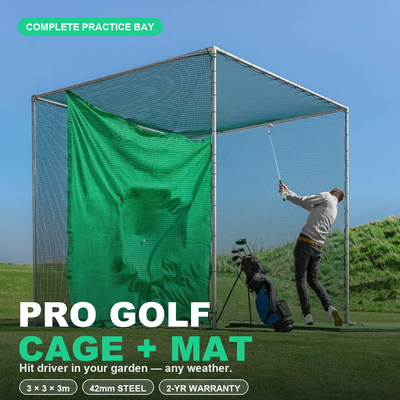
The Pro Golf Cage & Hitting Mat Bundle pairs a galvanised 42mm steel cage with a driver-rated double net and a tour-density mat — a buy-once, all-weather practice station for the UK garden. Best seller, includes the free 90-day practice programme.
See the Pro Golf Cage & Mat Bundle →The two jobs: containment netting vs impact netting
Containment netting is the knotless green mesh over the frame. On our cages it’s UV-stabilised HDPE — built to live outside all year, shrug off rain and sun, and stop mishits, toe-strikes and ricochets leaving the cage. It is not designed to take repeated full-speed strikes dead-on.
Impact netting is the sacrificial layer that absorbs your actual shots. It hangs loose behind the target (the slack is what kills ball speed), takes the abuse, and is replaceable on its own — which is exactly the point: you replace a £75–£100 panel, not a £700 cage.

Standard vs archery-grade impact panels
The choice that actually matters. A standard impact panel is fine for irons and occasional driver work — typical life is a season or two of regular use. An archery-grade panel is the tighter, denser weave developed to stop arrows; on golf duty it lasts roughly 2–3× longer under daily driver strikes. If you practise most days, or you’re working through a structured programme like our free 90-day practice programme, archery-grade is the cheaper option over three years even though it costs more on day one.
Signs your cage netting needs replacing
Look for fuzzing or powdering of the twine (UV wear), enlarged or distorted mesh directly behind your hitting line, any single broken strand (one becomes five quickly), and “bag-out” — a permanently stretched pocket where the panel no longer swings freely. A ball escaping through the side of a worn panel at 150mph is how windows and neighbourly relations get broken; replace before that point, not after.
Replacement netting: options and UK prices
If your frame is sound, you don’t need a new cage. Our Replacement Golf Cage Net (10ft × 10ft × 10ft) fits standard 3m × 3m × 3m frames — including cages you didn’t buy from us, provided the frame is that footprint. Three configurations: net only at £172.99, net + standard impact panel at £206.99, and net + archery impact panel at £275.99. Fitting is a two-person hour with cable ties: drape from the roof, work down the corners, tension last.
📏 Free tool: the Garden Golf Cage Planner
Not sure what fits? The free Garden Golf Cage Planner answers the space, base, netting and cost questions in one place — including the Will-It-Fit calculator: enter your garden size and see which cages work. No sign-up.
Buying netting as part of a new cage
Every cage in our range lets you choose the netting grade at checkout. On the FORB Frame & Net cages and the full Pro Golf Cage & Hitting Mat Bundle you pick standard or archery impact netting per bay — the 42mm heavy-duty frames with archery netting are what we spec for daily-driver households. The Garden Golf Cage Planner walks through the whole decision — space, base, netting grade and budget — in one free guide.
Not sure what fits your garden?
Send me a photo of your garden with rough measurements on WhatsApp and I’ll design your setup with you — free, no obligation. Chat with Tom on WhatsApp →
What I've learned from replacement-net orders
Replacement nets are one of the quiet workhorses of our order book, and the pattern in those orders is instructive. Most people wait too long: the typical replacement customer tells us the panel “went” months ago and they’ve been nursing it with cable ties and hope. One customer replaced a net on a frame that turned out to be seven years old — the galvanised steel was absolutely fine, which is exactly the economics the two-layer design intends: frames are decades, netting is seasons.
The second pattern: people who bought standard netting the first time overwhelmingly choose the archery-grade panel the second time. Once you’ve replaced a panel you understand where the wear actually happens — a saucer-sized zone directly behind your favourite target position — and paying £69 more for a panel that lasts two to three times longer stops feeling like an upgrade and starts feeling like arithmetic. It’s why I recommend archery-grade by default for anyone hitting more than twice a week.
And a third, smaller one: measure before you order. The 10ft × 10ft × 10ft net fits a 3m × 3m × 3m frame — but I noticed a steady trickle of enquiries from owners of 2.5m and 4m cages hoping it will stretch or gather. It won’t, not well. Measure pole-to-pole along the ground, front and side, before you click buy; if your frame isn’t 3m each way, message us on WhatsApp first and we’ll find the right net rather than the nearly-right one.
Fitting tips from the builds I've done
Fit the roof first on a calm day — netting is a sail, and even a light breeze turns a one-hour job into a wrestling match. Work the corners loosely before you tension anything, use every tie point (skipping half of them is why nets sag by spring), and leave the impact panel visibly slack. A drum-tight panel returns the ball’s energy to the ball — bad for the netting and occasionally bad for your shins. After the first week of hitting, walk the ties once and re-tension: the net settles, and that five-minute check is the difference between a panel that lasts two seasons and one that lasts four.
Frequently asked questions
What netting is used on golf cages?
Two types: UV-stabilised knotless containment mesh on the roof and walls, and a denser impact panel behind the target that absorbs full-speed strikes. The impact panel is the part that wears and the part worth upgrading to archery-grade.
How long does golf cage netting last?
Containment netting typically lasts many years outdoors. Standard impact panels last a season or two of regular use; archery-grade panels roughly 2-3x longer under daily driver practice.
Can I buy replacement netting for my golf cage?
Yes — our 10ft x 10ft x 10ft replacement net fits any sound 3m frame, from £172.99 net-only or with a standard (£206.99) or archery-grade (£275.99) impact panel included.
Is archery netting good for golf?
Very — its dense weave was designed to stop arrows, and on golf duty it takes daily driver strikes far longer than standard mesh. It is the netting we recommend for anyone practising most days.
Ready to build your garden practice space?
Configure the cage, mat and base in 60 seconds — from £734.99 with a £50 bundle saving and the free 90-day practice programme included.
Build your cage with the right netting →
Free Home Golf Cage Setup Design Consultation
Not sure on size, base or mat? Chat directly with Tom, OpenGolfer’s founder — he practises from his own garden cage most days and has designed hundreds of home setups.
- Send a photo of your garden with rough measurements — get a tailored layout and spec for your space
- Personal replies from a real golfer, not a call centre
- Honest advice on what to buy — and what not to
Usually replies within the hour, 8am–8pm · prefer to talk? 02033 768500


Leave a comment