
Golf Cage Winter Care UK: Leave It Up or Take It Down?

Every October the same question lands in my inbox: should the garden golf cage come down for winter, or can it stay up? The honest answer is that it depends on which cage you own, how exposed your garden is, and whether you actually intend to practise through the cold months — which, for what it is worth, is exactly when structured practice pays off most, because your handicap does not know it is January. This guide works through what a British winter genuinely does to netting and frames, the case for each approach, how to store a cage properly if it does come down, and how to keep hitting balls when the lawn is frozen solid.


What winter actually does to a golf cage
Let us separate the real threats from the imagined ones, because people tend to worry about the wrong things.
Frost and cold: less harmful than you think
Cold on its own does very little to a quality cage. Galvanised or powder-coated steel is indifferent to frost, and modern UV-stabilised polyethylene or nylon netting stays serviceable well below freezing. Netting does stiffen in a hard frost and its impact absorption drops slightly, so it is marginally more prone to damage from a flush driver strike at -5°C than at 15°C — but in fifteen years around this equipment I have seen precisely two nets that failed from a cold-weather strike, and both were already sun-degraded. The Met Office has a good explainer on how frost and ice actually form at metoffice.gov.uk; the takeaway for cage owners is that the freeze-thaw cycle matters more than the freeze — it heaves ground anchors loose and works water into frame joints, which is where your maintenance attention should go.
UV: the slow killer, and winter is your off-season from it
Ultraviolet light is what actually ends a net's life, making the twine brittle until it starts snapping at the impact zone. Here is the quietly useful fact: UV exposure in a UK December is a small fraction of June levels. Winter is your net's rest period. A net that stays up all winter ages far less in those four months than it does in any single summer month, which undermines the instinct that winter is when the net "needs protecting". What winter does bring is the next item.
Storms: the genuine threat
Named storms are the one thing that destroys cages, and the UK storm season runs roughly October to March. A tensioned net is a sail; a 60mph gust can fold a frame or rip anchors out of saturated ground. Everything else in this article is secondary to this: if your cage stays up for winter, you must be willing to drop the netting when an amber wind warning is issued. I have covered the full drill — anchors, guy ropes, weights, and the warning thresholds — in the setup context of our garden cage setup guide, and it applies doubly from November onwards.
Leave it up or take it down? The actual decision
Here is how I split it with customers, and it comes down to cage type and honesty about usage.

| Your situation | Verdict | Reasoning |
|---|---|---|
| Steel-framed cage, sheltered garden, will practise in winter | Leave it up | Quality frames are built for it, winter UV is minimal, and a cage you can use beats a cage in a shed |
| Steel-framed cage, exposed or coastal garden | Leave frame up, manage the net | Keep the frame anchored and guyed; slacken or drop netting whenever serious wind is forecast, or remove it entirely for the worst months |
| Pop-up cage (e.g. Forza ProFlex) | Take it down | Pop-ups are designed for quick deployment, not for riding out storms; two minutes to stow, two minutes to redeploy on a nice Saturday |
| Any cage, no intention of winter practice | Take the net down, frame optional | An unused tensioned net through storm season is all risk and no reward |
A customer in Harrogate has run his Forza Golf Practice Cage through two full winters left up, with the net dropped ahead of storms perhaps four or five times a season, and after those two winters the net shows less wear than a summer-only net I inspected the same month that had spent three Julys in full sun. Meanwhile the taller LinksCube XL carries more wind area by design, so I lean harder on the guy-ropes-and-drop-the-net routine for those on open plots.

If it comes down: storing a cage properly
Taking a cage down badly causes more damage than leaving it up. The failure I see repeatedly is netting stuffed damp into a shed in November and unpacked mouldy, stinking and weakened in March. The routine that avoids it:
Dry everything first. Pick a dry day, or hang the net in a garage for 48 hours before it is bagged. Mildew needs moisture; deny it and netting stores indefinitely.
Brush the net down, check it over. Leaves, sap and dirt hold moisture against the twine. A stiff brush and ten minutes now also finds small impact-zone holes while they are still a five-minute repair with netting twine rather than a panel replacement.
Loose coils, not tight bundles. Coil the net loosely into a breathable bag — an old duvet cover is perfect — never a sealed plastic sack. Label which edge is the top; future-you will be grateful in April.
Frame care. Wipe the poles down, touch in any coating chips with metal paint before winter damp gets at bare steel, and store sections flat so they cannot bow. Bag the fixings and tape the bag to a pole — I measured the cost of not doing this once: forty minutes on my knees on a customer's frosty lawn hunting for the last two carabiners.
Mind the ground anchors. Screw anchors can stay in the lawn all winter (mark them for the mower), or come up and get a wire-brush and a smear of grease.
Practising through the winter
If you keep the cage up, winter practice is genuinely productive — but the environment changes and it is worth knowing how.
Never hit off frozen turf. Frozen ground is concrete with grass on top. It hurts wrists and elbows, it wrecks the lawn when the surface thaws, and it will destroy club soles. A proper mat is non-negotiable in winter: something with real pile depth and a rubber base that stays put on hard ground, like the Forza driving range mat with rubber base, or any of the options in our hitting mats collection. On a frozen or sodden lawn I also recommend a walkway mat or two between the house and the cage — lawns scar fast in winter.
Cold balls behave differently. A golf ball at 2°C is measurably firmer and comes off the face with less speed — you will feel it as a harsher strike and see slightly lower flight into the net. That is physics, not a swing flaw, so do not chase it. Keep the balls you practise with indoors and take them out warm; it makes the session more pleasant and the feedback truer to your summer ball flight.
Net behaviour in cold snaps. As above, netting stiffens in hard frost. Give the impact zone a quick look before and after frosty sessions, and if your net is more than a few summers old, ease off full-bore driver work when it is well below freezing.
Light and habit. Realistically, winter practice happens in a lunch break or under lights. A cheap outdoor floodlight aimed across (not into) the cage mouth turns 5pm darkness into usable practice time. And if the weather defeats you entirely, this is exactly the gap a launch monitor fills — the same disciplined practice moves indoors, which is a different article: our net, cage and simulator setup guide covers how the pieces combine.

The spring recommissioning check
Whichever route you chose, do a proper once-over in March: re-tension the net evenly (winter works it loose), push-test every anchor after the freeze-thaw cycles, check each carabiner and bungee for corrosion or perishing, look hard at the net's impact zone in good daylight, and re-square the frame before the first serious session. Twenty minutes, once a year, is most of what "cage maintenance" amounts to. If the winter has revealed the net is past it, replacement netting and complete cages are in our golf cage collection.
FAQ
Will frost damage my golf cage netting?
Not meaningfully. Quality netting tolerates freezing temperatures fine; it stiffens slightly and absorbs impact a little less well, so go easy with the driver in a hard frost if the net is old. The real winter threats are storms and, over years, summer UV — not cold.
Can I leave a pop-up golf cage out over winter?
I would not. Pop-up cages trade permanence for convenience — that is the whole point of them. Stow it and redeploy it on decent days; it takes minutes each way and the cage will last years longer.
Is it worth practising outside in a cage in winter?
Absolutely, and the golfers who do arrive in April ahead of everyone else. The conditions are: hit off a proper mat, never frozen turf; warm balls from indoors; decent light; and skip the genuinely foul days rather than resenting them.
How do I stop my stored net going mouldy?
Dry it completely before storage — hang it indoors for a couple of days if needed — then coil it loosely in a breathable bag somewhere dry. Mould needs damp; a bone-dry net in a duvet cover comes out in spring exactly as it went in.
Our #1 garden cage, ready to play
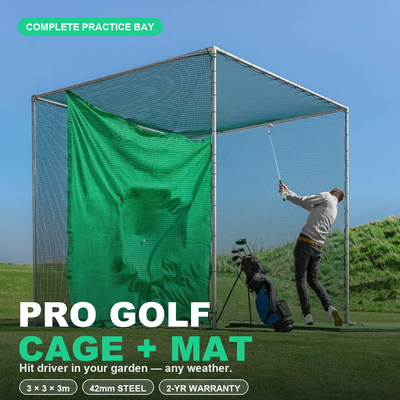
The Pro Golf Cage & Hitting Mat Bundle pairs a galvanised 42mm steel cage with a driver-rated double net and a tour-density mat — a buy-once, all-weather practice station for the UK garden. Best seller, 2-year warranty, 30-day returns.
Shop the Pro Golf Cage Bundle →⛳ Free resource: the 90-Day Golf Cage Practice Programme
A cage stops your golf balls — a plan lowers your scores. The free interactive golf cage practice programme gives you 39 structured 25-minute sessions, a 24-drill library, and progress scorecards you can track online — built around the Pro Golf Cage & Hitting Mat Bundle and open to every garden golfer.
Free email series: Dream Home Golf Cage Setup
Six short emails from Tom on the five decisions behind a brilliant garden practice space.
📏 Free tool: the Garden Golf Cage Planner
Planning a garden golf cage? The free Garden Golf Cage Planner answers the space, base, netting and cost questions in one place — including the Will-It-Fit calculator: enter your garden size and see which cages fit. No sign-up.

Free Home Golf Cage Setup Design Consultation
Not sure on size, base or mat? Chat directly with Tom, OpenGolfer’s founder — he practises from his own garden cage most days and has designed hundreds of home setups.
- Send a photo of your garden with rough measurements — get a tailored layout and spec for your space
- Personal replies from a real golfer, not a call centre
- Honest advice on what to buy — and what not to
Usually replies within the hour, 8am–8pm · prefer to talk? 02033 768500


Leave a comment