
Pro Golf Cage & Hitting Mat Bundle: The 6-Month Long-Term Review

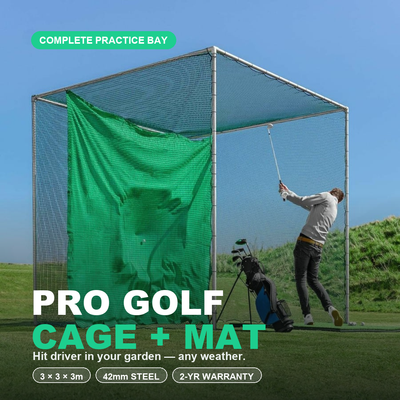
Let’s start with the obvious conflict of interest: we sell this cage. It’s our flagship product, and a glowing review from the shop that profits from it is worth roughly nothing. So this isn’t that. This is the 6-month account of the Pro Golf Cage & Hitting Mat Bundle as it actually lives: my own cage, hit almost daily through a British winter and spring, plus the wear reports and complaints (yes, there are some) that come back from customers on WhatsApp. What’s held up, what’s showing age, what genuinely surprised people, and the two groups of golfers I actively talk out of buying it.

What it is, in one paragraph
The bundle is a 3m × 3m × 3m outdoor practice cage — the standard UK footprint, with wider and longer configurations available — built on a 42mm galvanised steel frame, hung with a driver-rated double net (a weatherproof outer net plus an archery-grade impact panel where the ball strikes), anchored with U-pegs, and paired with a tour-density hitting mat. The full cage, mat and pro base configuration reviewed here is £1,284.98 — lighter configurations, down to the cage on its own, cost less on the product page — it carries a 2-year warranty, and you can spread the cost with Klarna or Clearpay at checkout, which on this configuration works out at around £110 a month. Build time is quoted at 60–90 minutes; I installed mine solo in a little over an hour, and the customer feedback clusters in exactly that window unless the instructions get read after the frame is half up, in which case add half an hour and some language.
Six months of British weather: the wear report
The honest reason this cage costs four figures when a pop-up net costs £279.99 is not the golf — it’s the weather. British conditions are the number-one killer of cheap nets: UV eats untreated netting, wind fatigues thin poles, and damp corrodes bare steel. The winter my cage stood through included several named storms — the Met Office runs its storm-naming season from early autumn precisely because this is a normal British winter, not an exceptional one — and the cage’s job was to stand there and take it. Here’s the component-by-component account after 6 months outside.
| Component | Condition at 6 months | Notes |
|---|---|---|
| 42mm galvanised frame | As new | No rust at joints or feet; galvanising is doing its job. Expected — this is the part that should outlast everything else. |
| Outer weatherproof net | Very good | No UV chalking or brittleness yet; some green algae film on the north-facing panel that brushed off. |
| Archery-grade impact panel | Good, visibly used | A dinner-plate-sized area of fuzzing where 80% of strikes land. Cosmetic so far; this is the designed sacrificial zone and the part you’d eventually replace. |
| U-peg anchors | Solid | No movement through the storms on my lawn. Customers on sandier ground have needed to re-seat pegs after the wettest weeks — see the anchoring guide below. |
| Tour-density mat | Very good | Slight flattening at the tee position, no seam lift, no elbow complaints. Rotating your stance position spreads the wear. |
The pattern is the one you’d hope for: the expensive, hard-to-replace parts (frame, outer net) are ageing at a rate suggesting many years of service, while the wear concentrates in the impact panel — which is exactly why the design uses a double net with a replaceable strike zone rather than making the whole structure the consumable. When the day comes, a replacement 3m cage net runs £172.99–£275.99, which reframes the cage as a long-term asset with a modest running cost rather than a thing you’ll bin in two summers. That’s the maths that separates it from the cheap end of the market.
What surprised customers (it surprised me too)
Three things come up unprompted in follow-up messages. First, how dead the double net is. Driver strikes don’t crack or trampoline; they thud and drop. A customer in Kent told me his abiding memory of the first session was disappointment at the sound — and that after a week he’d realised the quiet was why his neighbours hadn’t said a word. Second, how much the mat matters. People buy this as a cage with a mat thrown in and discover the mat is half the product; hitting 60 balls off tour-density turf instead of a worn doormat is the difference between practice that helps your golf and practice that hurts your elbows. Third, usage patterns. Buyers plan for weekend sessions and end up doing four short evening sessions a week instead, because the cage removes the drive to the range. That’s where the improvement actually comes from — and it’s why we built the free Practice Lab 90-day programme, so those 20-minute sessions have structure instead of becoming driver-bashing.
The honest niggles
Nothing at 6 months qualifies as a failure, but three things deserve saying. The build is genuinely a 60–90 minute job, not a 20-minute one, and the frame wants two people for the final lift if you’re not comfortable working overhead alone. Algae film on shaded panels is a fact of outdoor life in Britain; a soft brush sorts it in minutes but nobody puts that in the brochure. And on exposed or sandy sites the standard U-pegs are the minimum, not the maximum — our guide to anchoring a golf cage for wind and UK ground types is worth ten minutes before your first named storm, not after it.
Who shouldn’t buy it
Two groups, and I turn both away regularly. Projection simulator builders: this is a net cage, not an impact screen. You cannot project a course onto it, and if your actual dream is simulated golf in a garage or garden room, you want an enclosure with a proper impact screen from the simulator bundles collection instead — buying the cage first and the sim later means buying the containment twice. Light or undecided users: if you honestly expect to hit balls a couple of times a month through summer, the £1,284.98 bundle is more cage than you need, and I’d rather point you at the Standard Golf Cage & Hitting Mat Bundle, which trades some of the Pro’s heavy-duty spec for a friendlier price. The Pro earns its money through frequency and weather exposure; without those, it’s overkill, and overkill is a polite word for overspend.
What it costs to run, honestly
The purchase price is the headline, but the long-term numbers are what make or break outdoor kit, so here they are without spin. Up front: £1,284.98 for the full cage, mat and pro base configuration, or spread that cost with Klarna or Clearpay at checkout at around £110 a month. Running costs at 6 months: zero. Nothing has needed replacing, tightening beyond a seasonal peg check, or treating. Projected running costs: one impact panel replacement somewhere down the line, at £172.99–£275.99 depending on the net you choose, with the frame and outer net carrying on regardless. Set that against what a committed range-goer spends on buckets, fuel and time over the same years and the cage stops looking like an indulgence and starts looking like an amortisation exercise — with the not-small bonus that the practice happens because the cage is twenty steps from the kettle. That convenience effect, more than any spec on the page, is what we found actually changes people’s golf.
Frequently asked questions
How long does the net last on the Pro cage?
After 6 months of near-daily use the outer net shows no UV degradation and the impact panel shows cosmetic fuzzing in the strike zone only. The impact panel is the designed consumable; replacement 3m nets cost £172.99–£275.99 when the day eventually comes, and the frame and outer net are built to serve for years beyond that.
Can I leave it up all winter?
Yes — that’s the point of the galvanised frame, weatherproof netting and U-peg anchoring, and mine stood through named storms untouched. On exposed sites, check peg tension after major blows and follow the anchoring guide for your ground type.
Can I use it as a golf simulator screen?
No. It’s a net, not a projection surface. You can absolutely hit into it with a launch monitor beside the mat and read your numbers from a phone or tablet — plenty of customers do — but for projected course play you need an impact-screen enclosure, which is a different product solving a different problem.
How long does it take to build?
60–90 minutes is the honest range. One person can do it; two makes the final net-hanging stage quicker and considerably less comedic. No concrete, no tools beyond what’s sensible, and it can come down and move house with you.
Six months in, my honest verdict is that the bundle does the specific thing it promises: it turns a 3m corner of a British garden into practice you’ll actually do in February, and it’s wearing like something designed by people who understood that February was the brief. If you’ll use it three times a week, the Pro Golf Cage & Hitting Mat Bundle is the version I recommend without hedging; if you won’t, buy the Standard bundle and put the difference towards lessons.
Not sure which option fits your space or budget? Message Tom on WhatsApp for a free consultation — no obligation, real answers from someone who installs this kit weekly.

Free Home Golf Cage Setup Design Consultation
Not sure on size, base or mat? Chat directly with Tom, OpenGolfer’s founder — he practises from his own garden cage most days and has designed hundreds of home setups.
- Send a photo of your garden with rough measurements — get a tailored layout and spec for your space
- Personal replies from a real golfer, not a call centre
- Honest advice on what to buy — and what not to
Usually replies within the hour, 8am–8pm · prefer to talk? 02033 768500


Leave a comment