
How to Anchor a Golf Cage: Wind, Ground Types & Safety UK

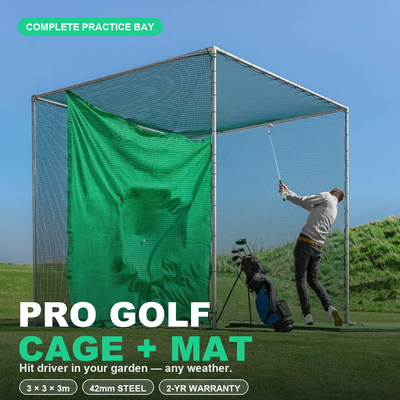
Almost every damaged golf cage I hear about comes down to the same thing: anchoring. Not the frame, not the netting — the bit of the job people rush on day one. A 3m x 3m cage with netting fitted presents several square metres of wind-catching surface, and in a British winter gust that surface can generate hundreds of kilograms of lateral load. Anchored properly, that load goes harmlessly into the ground. Anchored badly, the cage becomes a very expensive kite heading for your greenhouse or your neighbour's car. This guide covers how I anchor cages on every common garden surface, how to think about your own wind exposure, and the simple storm drill that keeps cages alive for years.


Why wind is the real enemy
Golf cage netting is designed to stop a ball travelling at 150mph+, which means it is fine mesh with a lot of surface area. When wind hits it, the net does not let the gust pass cleanly through — it loads up like a sail, and all of that force transfers into the frame and then into whatever is holding the frame down. The load is also dynamic: gusts shock-load the anchors repeatedly, working stakes loose over hours in a way a steady push never would. That is why a cage that "felt solid" in October is leaning by February.
Wind exposure varies enormously across the UK. A sheltered suburban garden in the Midlands, hemmed in by houses and fences, might see damaging gusts once or twice a year. A coastal garden in Cornwall, Pembrokeshire or the east coast of Scotland can see 50mph+ gusts a dozen times each winter, with salt in the air corroding fixings for good measure. Anchoring specs that are perfectly adequate inland are marginal on the coast. Be honest about which garden you have, and check the Met Office weather warnings page as a habit through winter — an amber wind warning is your cue to act, not to hope.
Anchoring by ground type
Grass
Grass is the easiest surface and the strongest anchor medium if you do it right. The supplied stakes with most cages are a starting point, not the finished job. For a permanent steel cage like the Forza Golf Practice Cage 3x3x3m I recommend upgrading to 30–40cm spiral or screw-in ground anchors on each upright — the kind sold for trampolines and marquees, a few pounds each. Drive them at a slight angle away from the cage so the pull works against the full length of the anchor, not straight up its axis. In soft or sandy soil, go longer. I installed a cage on a Norfolk lawn with almost pure sandy loam where standard pegs pulled out by hand; 50cm screw anchors solved it completely.
Patio and paving
You cannot stake a patio, so you are choosing between weight and permanent fixings. Weights are the usual answer: purpose-made anchor bags or sandbags on every upright base plate, and I mean genuinely heavy — aim for 20–25kg per corner minimum on a 3m cage, doubled in exposed positions. Water-fillable weights are convenient but check them in a freeze; ice expansion splits the cheap ones. The permanent alternative is to drill and fix base plates to the slabs with sleeve anchors, which is far stronger but commits the cage's position and puts holes in your patio. For a cage that will never move, it is the better engineering answer.
Decking
Decking is deceptively good news: you can screw straight down into the joists (not just the boards) with coach screws through the base plates, which gives a fixing stronger than any stake. Find the joists first — fixing into a 28mm board alone will strip out under storm load. The caveat is that decking flexes, so check the fixings each season. And think about ball bounce: hard decking underfoot means low mishits come back at you faster, so a cage with a ground-level skirt, or extra netting from our golf nets collection around the mouth, is worth adding.
Artificial turf
Artificial grass usually sits on compacted stone or sand, which takes screw anchors well — you can part the turf pile, drive the anchor through a small cut or between seams, and it disappears. If the turf is laid over concrete you are back to weights, as with a patio. One customer in Cheshire ran his LinksCube on artificial turf over type 1 hardcore with screw anchors through the turf, and after eighteen months of exposure on an open plot it had not moved a millimetre.

Guy ropes: cheap insurance most people skip
Base anchoring resists sliding and uplift at ground level, but a 3m frame in a gust also wants to fold and rock at height. Guy ropes fix that. Two or four guys from the top corners, run at roughly 45 degrees to screw anchors a metre or so out from the cage, transform its storm behaviour — the load path goes straight from the top of the frame into the ground instead of levering against the base fixings. Use proper guy line or 6mm braided polypropylene with a tensioner, not bungee cord, which stretches exactly when you need it not to. Mark the lines with hi-vis tape or line flags at head height; a taut guy rope across a lawn is a genuine trip and eye hazard for children, and this is the one safety point I would call non-negotiable.

We tested this the accidental way: of the cages we have supplied to exposed coastal gardens, the ones that have come through named storms untouched are, almost without exception, the ones with guys fitted. The frame-only failures — bent top rails, folded corners — cluster in the no-guys group.
The storm drill: when to drop the netting
Here is the single most effective thing you can do, and it costs nothing: when a serious blow is forecast, take the load off the net. The frame on its own has tiny wind area; it is the netting that does the damage. My drill, and what I tell every cage customer at handover, is:
Yellow wind warning or forecast gusts 40–50mph: check all anchors and guys, re-tension, clear loose objects from around the cage.
Amber warning or gusts above 50mph: drop the netting. On most cages this means unhooking the carabiners or ball bungees down two sides and letting the net hang slack against one wall, or bundling it entirely and tying it to a bottom rail. Ten minutes of work removes 90% of the wind load.
Red warning: netting off and indoors, and if the cage is a pop-up like the Forza ProFlex, the whole thing comes in. Pop-ups are brilliant precisely because this takes two minutes — they should never ride out a storm assembled.
A customer in Swansea learned this the hard way in the winter before last: he left the net tensioned through a named storm, and the gusts folded a top corner of the frame and tore two panels. The repair bill was around £150 and a month of waiting on parts. His neighbour's identical cage, netting dropped the evening before, needed nothing but re-hanging. Same street, same storm. Insurers, for what it is worth, treat garden structures inconsistently — some home policies cover storm damage to "items in the open", many exclude it — so assume the cage is self-insured and act accordingly.

Anchoring requirements at a glance
| Surface | Primary anchor | Minimum spec (3m cage, sheltered) | Exposed / coastal upgrade |
|---|---|---|---|
| Grass | Screw-in ground anchors | 30cm anchors, all uprights | 40–50cm anchors plus 4 guy ropes |
| Patio / paving | Weights on base plates | 20–25kg per corner | 40kg+ per corner or drilled sleeve anchors, plus guys to weighted points |
| Decking | Coach screws into joists | 2 screws per base plate, into joists | Add guys; inspect fixings monthly in winter |
| Artificial turf | Screw anchors through turf | 30cm into sub-base | 50cm anchors plus guys; weights if laid on concrete |
Seasonal checks
Anchoring is not fit-and-forget. Freeze-thaw cycles heave stakes, UV slackens guy lines, and vibration backs off bolts. My routine is a five-minute check on the first of each month through winter: push-test each upright, re-tension guys, check carabiners for corrosion, and confirm the net has not sagged into contact with the frame anywhere (chafe kills netting quietly). Twice a year, spring and autumn, do the full once-over including every bolt. If you are setting a cage up from scratch, the step-by-step garden setup guide builds these anchor points in from the start, and if you are still choosing a cage, taller premium frames like the LinksCube XL come with beefier base plates that make all of the above easier — browse the full golf cage collection with your surface in mind.
FAQ
How much wind can a golf cage take?
A properly anchored steel cage with netting fitted is comfortable to around 40mph gusts. Between 40 and 50mph you are relying on the quality of your anchoring; above 50mph the netting should be dropped regardless of how well anchored the frame is. Pop-up cages should come down well before any of those numbers.
Can I anchor a golf cage on a patio without drilling?
Yes — weighted base plates or anchor bags at 20–25kg per corner will hold a 3m cage in normal conditions, doubled for exposed sites, ideally with guy ropes run to additional weighted points. Drilling sleeve anchors into the slabs is stronger, but weights avoid committing the position permanently.
Do I really need guy ropes?
In a sheltered garden with good ground anchors, you can get away without them. On any open, elevated or coastal site, fit them — they are a few pounds of hardware and they change how the frame carries storm load. Mark them clearly so nobody walks into them.
Should I take the netting off every winter?
Not necessarily off for the season — a quality UV-stabilised net is built to live outside — but you should drop or slacken it ahead of every amber-or-worse wind warning. If you would rather not manage that, removing the net from November to February and practising into a freestanding net is a legitimate low-stress option.
Our #1 garden cage, ready to play
The Pro Golf Cage & Hitting Mat Bundle pairs a galvanised 42mm steel cage with a driver-rated double net and a tour-density mat — a buy-once, all-weather practice station for the UK garden. Best seller, 2-year warranty, 30-day returns.
Shop the Pro Golf Cage Bundle →⛳ Free resource: the 90-Day Golf Cage Practice Programme
A cage stops your golf balls — a plan lowers your scores. The free interactive golf cage practice programme gives you 39 structured 25-minute sessions, a 24-drill library, and progress scorecards you can track online — built around the Pro Golf Cage & Hitting Mat Bundle and open to every garden golfer.
Free email series: Dream Home Golf Cage Setup
Six short emails from Tom on the five decisions behind a brilliant garden practice space.
📏 Free tool: the Garden Golf Cage Planner
Planning a garden golf cage? The free Garden Golf Cage Planner answers the space, base, netting and cost questions in one place — including the Will-It-Fit calculator: enter your garden size and see which cages fit. No sign-up.

Free Home Golf Cage Setup Design Consultation
Not sure on size, base or mat? Chat directly with Tom, OpenGolfer’s founder — he practises from his own garden cage most days and has designed hundreds of home setups.
- Send a photo of your garden with rough measurements — get a tailored layout and spec for your space
- Personal replies from a real golfer, not a call centre
- Honest advice on what to buy — and what not to
Usually replies within the hour, 8am–8pm · prefer to talk? 02033 768500


Leave a comment