
Best Practice Golf Balls for Nets & Cages (UK): Real vs Foam vs Limited-Flight

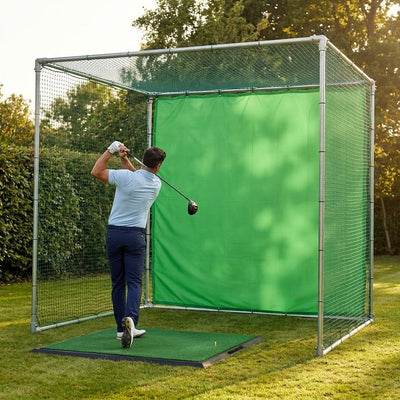
The cage arrives, you bolt it together, and within a day you are standing on the mat with a driver and a bucket of whatever balls were already in the garage — some range picks, a few foam ones from the kids, maybe a lonely wiffle ball the dog half-chewed. That first bucket is almost always wrong. I hit balls in my own cage most days and I have put every one of these categories in front of a launch monitor in the kind of cages we sell, so here is the honest sorting of real vs foam vs limited-flight vs airflow: what each one is actually for, what it does to your feedback and your data, and what you should spend.

The one-line answer
In a proper contained cage, hit real golf balls. That is the whole reason a cage beats an open net: full containment means ball flight is irrelevant to safety, so you can practise with the same ball you play with and get feedback that actually transfers to the first tee. Foam earns its place indoors and with young kids. Limited-flight balls solve a problem the cage has already solved for you. Airflow balls are a garden toy. Everything below is the reasoning, because the exceptions are where people trip up.
Real balls: the default, and the only choice for data
Strike feel, turf interaction, the sound of a flush one, the sting through your hands on a thin one — every scrap of feedback your body gives you is calibrated to a real ball. Practise with anything lighter and you are rehearsing a slightly different swing than the one you take to the course. That alone settles it for most people.
The moment a launch monitor enters the picture it stops being a preference and becomes physics. Radar and camera units both read ball speed and spin off the actual ball. A foam or hollow ball compresses differently, spins differently and leaves the face at a fraction of real speed, so the numbers a monitor hands back are fiction — not slightly off, fiction. Every unit in our launch monitor collection assumes a real ball for accurate spin and speed, and that is not a brand quirk, it is baked into how the tracking works.

Here is the money-saving part: you do not need premium balls for cage work. My own practice stock is a mix of mid-price two-piece balls and good-condition lake balls, and it does the job perfectly. Save the tour balls for the wedge sessions where spin feedback genuinely matters, and hammer the cheap ones with the driver. Nobody's numbers ever got worse for hitting a £1 lake ball instead of a £4 tour ball into a net.
Foam: for indoors, and for small kids
Foam has two honest jobs and no others. The first is indoor swing work where a real ball is out of the question — a living room, a garage without a proper net, a hotel room the night before a trip. A dense foam ball gives you a target and a rough sense of contact, which is enough to rehearse positions and tempo. The second is young children. For under-eights swinging in and around a garden setup, foam strips almost all the risk out while they learn that a golf swing is a big, committed move rather than a gentle tap. In family setups, foam gets the kids started and the real balls come out the moment they can reliably find the mat — usually inside a season.
Just be clear-eyed about the ceiling. Foam will not tell you whether that drive was flushed or caught off the heel, it is wildly wrong in any wind, and no launch monitor on the market will read it as usable data. It is a starter ball and a bad-weather ball, not a practice ball.
Limited-flight: solving a problem the cage already solved
Limited-flight, or reduced-distance, balls exist to make open-air practice safer in spaces that cannot contain a full shot. That is a real problem — in the wrong garden. Inside a contained cage it is a problem you have already spent money to eliminate: the net stops the ball at three metres whether it would have carried 50 yards or 280. Put a limited-flight ball in that cage and you are paying real-ball money for worse feedback and misleading data. The single honest exception: if you split your practice between the cage and open pitching further down the garden, keep a few limited-flight balls for the open work. For the cage itself, don't bother.
Airflow and wiffle balls: a toy, not kit
The perforated plastic balls are fine for exactly what they are — a garden game, a chipping contest with the kids, something you can lose in a hedge without a wince. But they weigh next to nothing, hand you zero strike feedback, and are completely invisible to a launch monitor. If you own a cage there is no session where a wiffle ball beats foam (indoors or kids) or a real ball (everything else). Keep them in the toy box.
What to hit, at a glance
| Ball type | Strike feedback | Launch monitor data | Best use | In a contained cage? |
|---|---|---|---|---|
| Real ball | Full — identical to the course | Accurate speed and spin | All cage practice, all data work | Yes — the default |
| Foam | Poor — positions and tempo only | None usable | Indoors; children under 8 | Only for young kids |
| Limited-flight | Reduced | Misleading | Open-garden practice, no containment | Rarely worth it |
| Airflow / wiffle | None | None | Garden games | No |
What the netting does to your balls
Balls in a cage lead a hard life — hundreds of impacts into netting, dropping onto the mat, living outdoors in a bucket. Cover scuffing is the main event: after a few weeks of daily use the paint dulls and you pick up the odd mark from the net weave, quicker if you drag them across a stone-flecked lawn between sessions. It is cosmetic long before it is functional, which is one more reason not to feed tour balls to your driver. Keep the practice stock in a covered bucket, and retire any ball that develops a visible cut or a smile — a damaged cover changes flight and, more to the point in a cage, changes how it rebounds off the net, which is the last thing you want flying back at you.
How many balls, and why you mark them
Fewer than you think. The cage returns everything to your feet, so you are not stocking a shag bag — 12 to 20 balls is the sweet spot. Enough to hit a proper unbroken set before you collect, few enough that the wear spreads evenly and you notice the moment one goes walkabout. I run 15 in my own cage and re-rack twice inside a 45-minute session, which doubles as a natural break to reset focus — the structured sessions in our free 90-day practice programme are built around exactly that rhythm.
And mark them. A dot or your initials in permanent marker does three jobs at once: you spot intruder balls that snuck in from a course round, you can keep a dedicated numbered set for launch monitor sessions so wear stays consistent across your data, and when one does escape through a gap you left in the door netting, the neighbour knows whose it is. Small thing. Saves arguments.
Cold balls fly shorter — the winter reality
A cage is the reason you can practise in January, so you should know what January does to the ball. A cold golf ball compresses less efficiently and comes off the face slower, and cold air is denser and drags harder, so carry drops noticeably in the cold. In plain terms: when your winter numbers read shorter than your August ones, the launch monitor isn't broken and neither is your swing — it's the weather. Keep your practice balls indoors between winter sessions rather than in a frozen bucket by the cage. A ball hit at room temperature behaves a lot closer to its summer self than one that has spent the night at two degrees.
The verdict
If you take one thing to your first proper session, take real balls — mid-price two-piece for the driver, a few decent ones for the wedges, all of them marked. Foam stays indoors and with the little ones, limited-flight lives out in the open garden if you pitch there at all, and the wiffle balls go back in the toy box. The cage is what makes real-ball practice safe every day of the year; the Pro Golf Cage & Hitting Mat Bundle gives you a 42mm galvanised frame, a driver-rated double net and a tour-density mat from £734.99, so the only decision left is which 15 balls earn a marker dot.

Frequently asked questions
What are the best golf balls for a practice net or cage?
In a fully contained cage, ordinary real golf balls — mid-price two-piece or good-condition lake balls. They give true strike feedback and accurate launch monitor data. Foam is only the right call indoors or for young children, and limited-flight or wiffle balls have no real place in a cage.
Can I use foam balls with a launch monitor?
No, not for real data. Foam compresses and spins nothing like a real ball, so the speed, spin and carry numbers a monitor returns are meaningless. Radar units like the Garmin R10 and FlightScope Mevo Gen2, and camera units alike, all need a real ball to read anything you can trust.
How many practice balls do I need for a garden cage?
12 to 20. The cage returns every ball to your feet, so you only need enough for an unbroken hitting set before you re-rack. Mark them with a dot so you can track wear evenly and spot the ones that escape.
Do I need to spend money on premium balls for cage practice?
No. Cheap two-piece balls and lake balls in decent condition are ideal for the bulk of your practice, especially driver work. Keep a handful of better balls for wedge sessions where spin feedback matters, and don't feed tour balls to a net that will only scuff them.
Why do my golf balls fly shorter in winter?
Cold balls compress less and leave the face slower, and cold, dense air drags harder — so winter carry is genuinely shorter, and your launch monitor is right to show it. Store your practice balls indoors between cold sessions to keep them behaving closer to their summer selves.

Free Home Golf Cage Setup Design Consultation
Not sure on size, base or mat? Chat directly with one of our experts — real golfers who practise from their own garden cage most days and has designed hundreds of home setups.
- Send a photo of your garden with rough measurements — get a tailored layout and spec for your space
- Personal replies from a real golfer, not a call centre
- Honest advice on what to buy — and what not to
Usually replies within the hour, 6am–10pm · prefer to talk? 02033 768500


Leave a comment