
Large Golf Nets: A UK Buying Guide From Someone Who Installs Them
The net that's too small doesn't fail dramatically. It fails the first time you swing a driver flat out, catch one thin off the toe, and the ball skips over the top rail into your neighbour's greenhouse. I've been called out to fix exactly that more than once. So before we talk brands and prices, understand this: a "large" golf net isn't about looking impressive in the garden. It's about having enough width, height and depth that a mishit still gets caught. Get the size right and everything else is detail. Get it wrong and you own an expensive way to lose golf balls.
I sell these nets for a living and hit off them myself, in a real UK garden, through real British weather. This is the guide I wish existed before I started.
What "large" actually means for a golf net
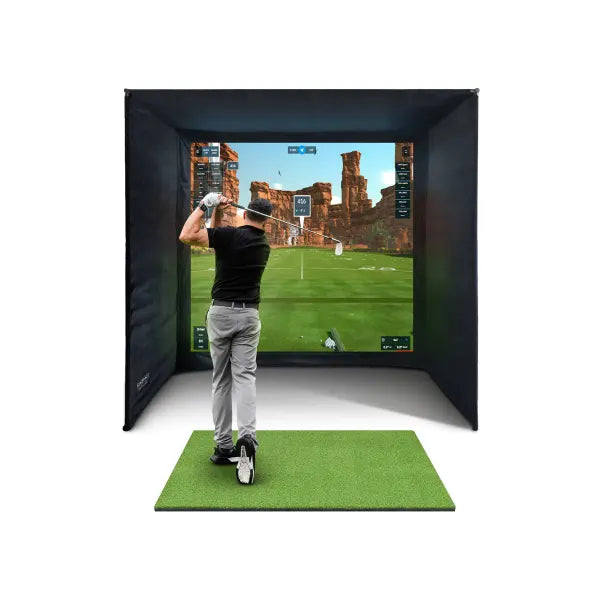
Marketing throws the word "large" at anything over about 7 feet. Ignore that. For full swings with real clubhead speed you want a genuine enclosure, and the number that keeps coming up for a reason is 3m × 3m × 3m, roughly 10ft in every direction. That's the size most of the cages I sell come in, and it's the sweet spot for a UK garden: big enough to swing a driver without ducking, small enough to fit down the side return or at the bottom of a normal lawn.
Here's how the three dimensions actually behave:
- Height is the one people underestimate. You need clearance for your hands at the top of the backswing plus a margin for a thinned strike climbing off the face. Under about 9ft and tall players start feeling boxed in. 10ft is comfortable for almost everyone.
- Width decides how much sideways error you can survive. A snap hook or a shank goes sideways fast. Around 10ft gives you room to miss and still hit netting rather than the frame or the fence behind it.
- Depth matters more than buyers think. The net needs to absorb ball speed, and it does that by giving. A shallow net with no room to travel takes the full hit on the frame anchors and on your rebound risk. A proper cage has a baffle or a double-net back panel that kills the ball dead and drops it at your feet.
That last point is why I steer people toward a full cage rather than a single flat panel once they're swinging a driver. A flat net stops the ball. A cage stops the ball and stops the ricochet.
Frame and netting: what survives a British winter
This is where cheap and proper part company, and it's mostly invisible in the photos.
Netting. You'll see two materials. Polyethylene is cheaper and lighter and it's what most bargain nets use, but UV degrades it and after a couple of summers outdoors it goes brittle and starts letting go at the seams. Knotted nylon is the grown-up choice for a net that lives outside, better abrasion resistance and it takes repeated driver impacts without fraying. If a listing won't tell you the material, assume it's the cheap one.
Frame. The gauge of the steel is the tell. A 34mm powder-coated steel frame is a solid, honest garden cage. Step up to 42mm and you've got noticeably more rigidity, less flex in wind, and a structure that isn't going to shuffle across the patio when you lean into a shot. Aluminium is lighter and won't rust but flexes more; PVC poles are fine for a pop-up you pack away, not for something left standing through a winter of gales.
Whatever you buy for outdoors, it has to be galvanised or powder-coated. Bare steel in the British climate is a rust timeline, not a purchase.
Pop-up versus fixed frame
The honest trade-off is time against toughness.
A pop-up net is up in a few minutes and packs into a bag, which is genuinely brilliant if you rent, if you share the lawn with kids and a trampoline, or if you just want to hit for twenty minutes and clear it away. The compromise is that it's a lighter structure with a shorter hard-use life, and you wouldn't leave it standing outside all year.
A fixed steel cage takes 30 to 60 minutes to build the first time, and then it stays. It shrugs off daily driver sessions, it doesn't move in the wind once it's anchored, and it's the setup I'd choose for anyone who's serious about practising more than they play. Most people who start with a pop-up and get the bug end up buying a fixed cage within a year, so if you already know you're committed, skip a step.
The net ladder: what I'd actually buy
Five setups, entry to serious. Prices are what they are on the site as I write this, and I've named them so you can go and check.
Pop-up: FORZA ProFlex — from £279.99

If you want to be hitting balls this week without drilling anything or committing your weekend to an assembly, this is where I point you. The ProFlex pops up in a few minutes and drops back into its bag when the kids need the garden. It's a driving net rather than a fortress, so treat it as portable practice, not a permanent installation. For a first taste of home practice on a budget it's the honest entry point.
Frame & net cage: FORZA Golf Practice Cage 3m × 3m × 3m — from £459.99

This is the full 10ft cube in frame-and-net form, no mat included. It's for the buyer who already owns a good hitting mat, or who wants to source their own, and just needs the enclosure. You get the real footprint and the full catch, at the lightest possible price for a proper fixed cage. Add a mat later and you've built the same thing as the bundles below.
Standard cage & mat bundle — from £459.99

Here's the one most first-time buyers should look at hardest. A 34mm powder-coated steel frame, the full 3m cube, plus a hitting mat in one box. It's the point where you stop assembling a setup out of parts and just buy a garden practice bay. For the money it's the most complete honest starting point I sell, and it's what I'd put in most gardens.
Pro cage & mat bundle — from £734.99

Step up to the 42mm frame and you feel the difference the first time you lean into a driver: the whole structure stays put and dead quiet where a lighter frame would rattle. It's the double-net, tour-density-mat setup, and it's the one I'd buy for daily use and for anyone planning to add a launch monitor down the line. This is the cage I recommend most often to people who already know they're going to practise properly.
Socketed pro cage — from £734.99

Same 42mm build as the Pro, but the uprights drop into ground sockets so the cage is anchored into the earth rather than standing on it. If you get exposed wind, or you want the most permanent, most rigid version of a garden cage, this is it. You commit to a spot in the garden, but in return you get a structure that isn't going anywhere in a storm.
Quick comparison
| Net | Type | Frame | Mat included | Best for | From |
|---|---|---|---|---|---|
| FORZA ProFlex | Pop-up | Portable poles | No | Renters, quick sessions, packing away | £279.99 |
| FORZA Practice Cage | Fixed frame & net | Steel | No | Already own a mat | £459.99 |
| Standard Cage & Mat | Fixed bundle | 34mm steel | Yes | Most first-time buyers | £459.99 |
| Pro Cage & Mat | Fixed bundle | 42mm steel | Yes | Daily use, adding a monitor | £734.99 |
| Socketed Pro Cage | In-ground fixed | 42mm steel | Yes | Exposed sites, maximum rigidity | £734.99 |
Anchoring, siting and the boring stuff that matters
A large net catches a lot of wind whether or not there's a ball in it. On grass, ground stakes and guy lines do the job for a standing cage; on a patio, weight the base corners or use the socketed version. Don't skip this. A gust that shifts an un-anchored 10ft cage is how frames get bent and fence panels get broken.
For siting, leave a swinging margin behind the mat and clearance to the sides, and point the open face away from the house and any neighbour's window. And if the net lives outside all year, the netting is a consumable: a fresh replacement net is a cheap way to get another few seasons out of a good frame rather than binning the whole thing.
Will a launch monitor work behind a net?
A lot of net buyers add a launch monitor within a year, so size for it now if there's any chance. The rule that trips people up is space, and it depends on the technology. Radar units, like the budget-friendly FlightScope Mevo, sit behind the ball and need roughly 2.4m of clearance behind your strike to read the flight, which is tight in a 3m cage but workable if you set up near the front. Camera-based units, like a Foresight GC3 or a Uneekor Eye Mini, sit about 0.6m to the side of or just in front of the ball and don't need that runway at all, which makes them far easier to live with in a compact garden cage. If a monitor is on your horizon, the 42mm Pro cage is the one I'd build around, because it gives you the rigidity and the room to grow into a full setup.
FAQ
What size net do I need to hit a driver at home?
A genuine 3m × 3m × 3m cage, roughly 10ft in each direction, is the size I recommend most often for full driver swings. The height clears your hands and gives margin for a thinned strike, the width survives a hook or a shank, and the depth lets the netting absorb ball speed and drop the ball dead instead of firing it back.
Are pop-up golf nets any good?
For quick sessions and for anyone who needs to clear the garden afterwards, yes. Something like the FORZA ProFlex is up in minutes and packs into a bag. Just don't expect a lightweight pop-up to survive being left outside all year or to take the same daily hammering as a fixed steel cage. It's portable practice, not a permanent installation.
Nylon or polyethylene netting for outdoors?
Knotted nylon, every time, if the net lives outside. Polyethylene is cheaper but UV degrades it and it turns brittle after a couple of summers. Nylon handles repeated driver impacts and British weather far better. If a listing won't tell you which it is, assume it's the cheaper one.
How do I stop my golf cage blowing over?
Anchor it. On grass, use ground stakes and guy lines; on a hard surface, weight the base corners or choose a socketed cage that drops into the ground. A 10ft frame catches serious wind, and an un-anchored one shifting in a gust is how frames bend and fences break.
Can I add a launch monitor to my net later?
Yes, and it's the most common upgrade. Radar monitors like the FlightScope Mevo need about 2.4m behind the ball, tight but workable in a 3m cage. Camera units like the GC3 or Eye Mini sit to the side and need no runway. If a monitor is likely, build around the 42mm Pro cage now.

Free Home Golf Cage Setup Design Consultation
Not sure on size, base or mat? Chat directly with one of our experts — real golfers who practise from their own garden cage most days and has designed hundreds of home setups.
- Send a photo of your garden with rough measurements — get a tailored layout and spec for your space
- Personal replies from a real golfer, not a call centre
- Honest advice on what to buy — and what not to
Usually replies within the hour, 6am–10pm · prefer to talk? 02033 768500


Leave a comment