
Big Golf Nets for the Garden: Full-Size Options UK

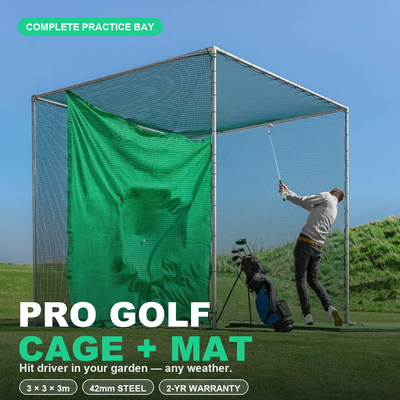
If you want to hit driver at home — properly, at full speed, without flinching — a big golf net is not a luxury, it is the entry requirement. Small pop-up nets are brilliant for wedge work, but a driver leaving the face at 100 mph or more with a toe-strike spraying it 20 degrees offline needs serious width, serious height and serious anchoring. I have installed full-size nets and cages in gardens across the UK, from wide-open plots in Yorkshire to squeezed suburban strips in Surrey, and the pattern is always the same: people underestimate how big the net needs to be and overestimate how much garden the whole setup swallows. This guide covers the real dimensions a driver demands, how to plan the space, what wind does to a three-metre-tall structure, and the full-size options I actually rate.

Why Driver Practice Demands a Big Golf Net
A well-struck driver is easy to contain — it flies low-ish, straight-ish, and hits the middle of almost any net. The problem is the other 30% of shots. Standing 3m back from the net, a strike that starts just 10 degrees offline is already more than half a metre wide of your aim point by the time it arrives; a proper heel-shank can be two metres wide. Skied shots off the crown climb steeply and clear low nets entirely. In other words, the net is not there for your good shots — it is there for your bad ones, and bad driver shots need a face at least 3m wide and around 3m tall to catch reliably.
Height matters more than most people think. A skyed drive can leave the face at 30 degrees or more. From 3m away, that shot is roughly 1.7m above strike height at the net — add your tee height and the arc of a bounced deflection and a 2m net simply is not tall enough. This is exactly why full-size cages are built at 3m and beyond.
The Dimensions That Actually Work

From the installs I have done, here is what I consider the workable minimums and the comfortable targets for full-out driver practice:
| Dimension | Bare minimum | Comfortable | Why |
|---|---|---|---|
| Net/cage width | 3m | 3.5m+ | Catches heel and toe strikes 3m back |
| Net/cage height | 2.5m | 3m–3.8m | Contains skied and thinned-then-bounced shots |
| Ball-to-net distance | 2.5m | 3m | Lets netting absorb rather than rebound |
| Space behind the golfer | 1.5m | 2m | Full driver swing arc plus follow-through |
| Total garden run | ~4m | 5m+ | You hit from inside the cage — its 3m depth contains most of the geometry |
That last row is the one to check first — and it is smaller than most guides claim, because you hit from inside the cage, not behind it. The mat sits at the cage mouth with the ball around 3m from the impact panel, so the cage's own 3m depth does most of the work; add roughly a metre of standing room behind and a ~4m run is genuinely workable. I hit driver most days from about 3m off the panel in exactly that footprint, and 5m+ simply makes everything feel more relaxed. If your garden is tighter than that, my guide on what size golf cage you need walks through the compromises in detail.
Planning the Space in a UK Garden
Before you order anything, spend ten minutes with a tape measure and a mate:
Orientation. Hit away from the house, away from greenhouses, and ideally along the longest axis of the garden. Aim the net so the worst possible miss — for right-handers, usually a big block right or a shank — still lands in your own garden. I always stand where the ball will be and physically look at what a 45-degree miss line passes over.
Ground. Big nets and cages want level, firm ground. Lawns are fine; decking is not, unless you can bolt into the joists. Leave enough flat area in front of the net for a proper hitting mat — hitting driver off a thin doormat-style mat on bare lawn ruins both the lawn and your wrists.
Overhead. Check for washing lines, cables and overhanging branches, both where the structure stands and along the ball's first metre of flight. A 3.8m-tall cage is taller than most single-storey extensions; make sure nothing crosses the space above it.
Neighbours and boundaries. A freestanding garden cage does not normally need planning permission, but a permanent 3m+ structure hard against a fence line can generate friction. The government's planning permission guidance is worth a skim if you are building anything with a roof near a boundary, and a friendly conversation over the fence before the cage goes up costs nothing.
Wind Loading: The Thing That Actually Destroys Big Nets

Golf balls do not kill big nets. British weather does. A 3×3m net face presents nine square metres of sail area, and even though netting is porous, a winter gust hits it with a genuinely large force — more than enough to lift ground pegs, bend cheap tube steel and cartwheel an unanchored frame across the garden. The Met Office strong wind guidance treats anything above gale force as a risk to garden structures, and a golf cage is exactly the kind of structure they mean.
What I have learned from installs that survived — and a couple that did not:
Anchor properly on day one. Screw-in ground anchors at every corner as a minimum, guy ropes on the windward side if the cage sits in an exposed spot. One customer in Cornwall ran a Forza cage through two coastal winters on doubled ground anchors and heavy rubber base weights without a single failure — while a neighbour's pegged-only gazebo left the county twice.
Slacken or strip the netting for storms. Most quality cages let you unclip the back and roof panels in ten minutes. Dropping the netting before a named storm removes almost all the sail area and is the single best thing you can do for the frame's lifespan.
Steel over fibreglass, always at this scale. Flexible poles that are charming in a pop-up are a liability at 3m tall. Full-size structures need rigid steel with proper corner joints.
Full-Size Options Worth Buying
FORB Heavy-Duty Steel Cage + Pro Mat Bundle (3m × 3m × 3m) — the one to buy
My default recommendation for a garden driver bay is the FORB heavy-duty steel cage and hitting mat bundle. It is the full professional spec — 42mm galvanised steel tube (112kg of frame), a complete 2.3mm knotless weatherproof enclosure, and a separate archery-grade impact panel that hangs loose inside the cage to kill driver-speed shots dead. Because it is a true cage rather than a flat net, a shank simply thumps into the side panel instead of visiting next door. It arrives with a 5ft × 5ft pro hitting mat, anti-skid base and ball tray, so you are hitting balls the day it goes up. We installed one for a customer in Kent who has run it through two winters uncovered; the frame is unmarked and only the impact-zone netting shows wear.
See The Complete Cage & Mat Bundle →
Budget alternative: lightweight 3m cages
Lighter 3×3×3m cages with thinner tube exist at lower prices, and they are fine for slower swing speeds or occasional use. But at full driver speed the difference is real: thinner frames flex in wind, the single-net designs bounce balls back harder, and the netting wears faster at the impact zone. If you are practising several times a week — which is the whole point of a garden bay — the heavy-duty frame is the buy-once option.
Large frame nets
If a full cage is more than you need, 3m+ wide frame nets with angled side wings occupy the middle ground — browse the golf nets collection for current options. They contain driver well when you hit from directly in front, but they give up the shank protection of a cage, so I only recommend them for gardens with generous space either side of the target line.
Making It Last
A big net is a five-to-ten-year purchase if you treat it right. Rotate your aim point across the face so one square metre does not take every impact. Check anchor tension monthly — ground anchors work loose through wet-dry cycles. Hose bird mess off netting before it dries, because the acids degrade polyester. And if the cage will one day host a launch monitor and screen, plan cable routes and power now; my net and cage simulator setup guide covers turning a garden cage into a full outdoor sim bay.
Frequently Asked Questions
How big does a golf net need to be for a driver?
At least 3m wide and 2.5m tall, hitting from about 3m away — and I would call 3m tall the sensible standard. Anything smaller relies on you never mishitting, which is not a plan. Fully enclosed cages remove the risk entirely because the sides and roof catch what the face misses.
How much garden do I need for a full-size golf cage?
Budget roughly 6m of length as an absolute minimum and 7–8m for comfort: 3m of cage depth, 2.5–3m from ball to net, and 1.5–2m of swing room behind you. Width-wise, allow the cage's 3m plus half a metre each side for access and guy ropes.
Will a big golf net survive UK winters outdoors?
The steel frame will; the netting is the consumable. Left up year-round, expect to replace impact netting every two to three years from UV and weather. Dropping the net panels for winter, or at least before named storms, extends that dramatically. Proper ground anchors are non-negotiable in any season.
Do I need planning permission for a garden golf cage?
Freestanding cages are almost always fine as temporary garden structures, but height limits near boundaries can apply to anything more permanent — a 3.8m cage tight against a fence is worth checking. See the government planning guidance linked above, and if in doubt, a quick call to your local authority settles it.
⛳ Free resource: the 90-Day Golf Cage Practice Programme
A cage stops your golf balls — a plan lowers your scores. The free interactive golf cage practice programme gives you 39 structured 25-minute sessions, a 24-drill library, and progress scorecards you can track online — built around the Pro Golf Cage & Hitting Mat Bundle and open to every garden golfer.
Free email series: Dream Home Golf Cage Setup
Six short emails from Tom on the five decisions behind a brilliant garden practice space.
📏 Free tool: the Garden Golf Cage Planner
Planning a garden golf cage? The free Garden Golf Cage Planner answers the space, base, netting and cost questions in one place — including the Will-It-Fit calculator: enter your garden size and see which cages fit. No sign-up.

Free Home Golf Cage Setup Design Consultation
Not sure on size, base or mat? Chat directly with Tom, OpenGolfer’s founder — he practises from his own garden cage most days and has designed hundreds of home setups.
- Send a photo of your garden with rough measurements — get a tailored layout and spec for your space
- Personal replies from a real golfer, not a call centre
- Honest advice on what to buy — and what not to
Usually replies within the hour, 8am–8pm · prefer to talk? 02033 768500


Leave a comment