
Why Your Range Sessions Aren't Making You Better: What the Science Says About Golf Practice

Here is the uncomfortable finding buried in thirty years of motor learning research: the practice that feels most productive is often the practice that teaches you least. Hitting fifty balls in a row with the same club at the same target — the standard range session — produces rapid, visible improvement within the session and remarkably little of it survives to Saturday’s medal. Sports scientists have a name for the fix, they have tested it on golfers specifically, and it is something you can apply tonight without buying anything. This is the first article in our practice science series, where every claim comes with a citation you can check — the full reference list is at the bottom.
A note on sources: I sell practice equipment; the researchers below do not. Everything here is drawn from peer-reviewed journals — motor learning is a mature field with findings that have been replicated for decades, and where the evidence is mixed I say so.
OUR #1 GARDEN CAGE, READY TO PLAY
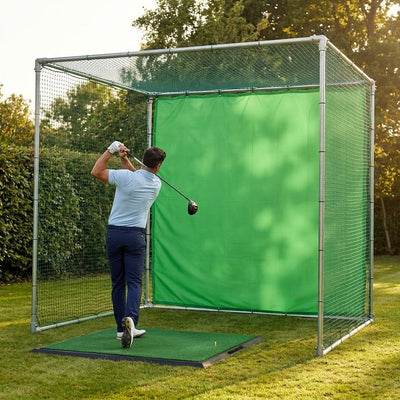
The Pro Golf Cage & Hitting Mat Bundle pairs a galvanised 42mm steel cage with a driver-rated double net and a tour-density mat — a buy-once, all-weather practice station for the UK garden. Best seller, includes the free 90-day practice programme built on the research below.
See the Heavy-Duty Garden Golf Cage →Performing is not learning
The foundational distinction in this field is between performance — how well you hit it during practice — and learning — how much of that skill is still there days later, on the course, under pressure. They are not the same thing, and they are often inversely related. Practice conditions that make you look good today frequently produce weak retention, while conditions that feel scrappy and difficult produce durable skill (Guadagnoli & Lee, 2004; Magill & Anderson, 2007).
The classic demonstration is the contextual interference effect, reviewed comprehensively by Magill and Hall (1990). Practise several skill variations in a blocked order (AAAA BBBB CCCC) and you outperform during the session; practise the same variations in a random order (ACBA BCAB…) and you look worse during the session — but come back for a retention test and the random group wins. The leading explanation is cognitive effort: switching tasks forces you to re-plan every shot rather than running on autopilot, and that effort is what gets encoded (Lee, Swinnen & Serrien, 1994). Fifty 7-irons in a row means you solved the shot once and then repeated the answer forty-nine times. On the course you never hit the same shot twice — every hole hands you a new club, lie and target — which is precisely the condition you never rehearsed.
The golf evidence
This is not just a laboratory curiosity — it has been tested on golf. Porter and Magill (2010) had sixty novices practise putting to three different distances for 81 trials, following either a blocked schedule, a random schedule, or an increasing schedule that started blocked, moved to a fixed rotation, and finished fully random. On the retention and transfer tests that followed, the increasing group generally beat both of the others. That result matters twice over: it confirms that pure block practice is the weakest way to convert range balls into skill, and it shows you do not have to jump straight into chaos — the winning schedule ramped up the difficulty.
Guadagnoli and Lindquist (2007) turned the same thinking into prescriptions golfers can actually use, applying the challenge point framework to golf practice. Their guidance: a novice might hit the same putt three to five times before changing distance and direction, while an experienced player should switch after one or two repetitions. The better you get, the more variety your practice must contain to keep teaching you anything.
The challenge point: practice difficulty is a dial, not a virtue
The framework behind that advice is worth knowing on its own. Guadagnoli and Lee (2004) proposed that learning is driven by the information available in practice, and that information peaks at an optimal challenge point that depends on your skill level. Too easy, and there is nothing new to learn — the fortieth identical 7-iron carries almost no information. Too hard, and you are overwhelmed — a beginner hitting driver at a 20-yard window learns nothing either. The practical rule I give customers: aim for a success rate around 60–80% on whatever drill you are running. If you are succeeding almost every time, make it harder — smaller target, longer club, random order. If you are failing most attempts, make it easier. Improvement lives at the edge of your ability, not in the middle of it.
An honest caveat before you reorganise your life
Science-backed means reporting the misses too. In one of the golf studies in this literature, Porter, Landin, Hebert and Baum (2007) compared three levels of contextual interference on golf skills and found no significant outcome differences between groups. And two recent meta-analyses complicate the picture: a 2023 review argued the effect in real sport settings is far less consistent than the lab classics suggest (Ammar et al., 2023), while a 2024 meta-analysis across 54 studies found a medium retention benefit overall — strong in laboratory tasks, much weaker in applied settings (Czyż et al., 2024). A fair reading of the whole literature: the advantage of varied, effortful practice over mindless block repetition is real but not magic — it shows up most strongly in retention and transfer, it can take weeks rather than days, and its size varies. What is not in dispute anywhere in the literature is the core warning: in-session performance is a poor guide to learning. If your only evidence that practice is working is how good the last twenty balls felt, you are measuring the wrong thing.
⛳ Free resource: the 90-Day Golf Cage Practice Programme
A cage stops your golf balls — a plan lowers your scores. The free interactive golf cage practice programme gives you 39 structured 25-minute sessions, a 24-drill library, and progress scorecards you can track online — built around the Pro Golf Cage & Hitting Mat Bundle and structured on the increasing-interference schedule described above.
Why this is an argument for practising at home
Notice what the research asks of you: short, frequent, varied, effortful sessions. Now notice what a range session actually offers: a 40-minute round trip, a £10 basket that punishes “wasting” balls on experiments, bays that encourage one club at one target, and a social incentive to look good rather than learn. The economics of the range push you towards exactly the practice structure the evidence rates worst.
This is the real case for a garden setup, and it is why I built mine. A cage in the garden makes the evidence-based structure the easy option: twenty minutes after work counts, switching clubs every ball costs nothing, and nobody is watching your scrappy random-order wedge session. After two seasons with mine, I noticed the biggest change was not volume — it was that variety stopped feeling expensive. Swapping ninety minutes at the range once a week for twenty-five minutes in the cage four evenings a week is precisely the frequency-plus-variety pattern what the skill acquisition literature would predict pays off (Farrow & Robertson, 2017). If you are weighing up whether your garden can take a cage, our step-by-step setup guide covers space, bases and anchoring.
The 25-minute evidence-based session
Here is the structure I recommend, translated directly from Porter and Magill’s (2010) increasing schedule — it is the template the 90-day programme is built on:
Minutes 0–8, blocked warm-up: one club, one target, deliberate tempo. You are calibrating, not learning yet. Minutes 8–18, serial rotation: a fixed loop — wedge, 8-iron, driver, repeat — same order each time, new shot plan every ball. Minutes 18–25, random with consequence: never the same club twice in a row, pick a specific target in the net for every ball, and score yourself out of ten. The scoring matters: it adds the pressure and feedback that make practice representative of play rather than rehearsal of comfort (Pinder et al., 2011). It will feel worse than finishing on twenty pured 7-irons. That feeling is the point.
Not sure what fits your garden?
Send me a photo of your garden with rough measurements on WhatsApp and I’ll design your setup with you — free, no obligation. Chat with Tom on WhatsApp →
Frequently asked questions
Is hitting balls at the driving range a waste of time?
No — but how you use the balls matters more than how many you hit. The research consistently shows that varying clubs, targets and shots produces better retention than repeating one shot in a block, even though block practice feels better during the session (Magill & Hall, 1990; Porter & Magill, 2010).
What is the contextual interference effect in golf?
It is the finding that practising skill variations in a mixed or random order tends to hurt performance during practice but improve learning measured later. In golf putting, a schedule that gradually increased from blocked to random practice beat both pure blocked and pure random schedules on retention and transfer tests (Porter & Magill, 2010).
Is random practice better for beginners too?
Beginners should ramp into it. The challenge point framework suggests novices benefit from more repetition — roughly three to five repeats of a shot before changing — while skilled players should change after one or two (Guadagnoli & Lindquist, 2007). Matching difficulty to your level beats copying a tour player’s practice.
How long should a golf practice session be?
Short and frequent beats long and rare. The mechanisms behind the practice benefits above are about cognitive effort per shot, not shot volume — four 25-minute varied sessions spread across a week ask more of your brain, and give it more consolidation time, than one 90-minute block session (Lee, Swinnen & Serrien, 1994).
Does practising into a net actually improve your golf?
A net removes ball-flight feedback, so pure net-bashing has limits — but structured practice (varied clubs, specific targets, scored shots) trains the movement patterns and decision-making the research identifies as what actually transfers, and adding a launch monitor restores the feedback loop. Make the practice representative of play and the venue matters far less than the structure (Pinder et al., 2011).
References
Ammar, A. et al. (2023) The Myth of Contextual Interference Learning Benefit in Sports Practice: A Systematic Review and Meta-Analysis, Educational Research Review, 39, 100537.
Czyż, S.; Wójcik, A.; Solarská, P. & Kiper, P. (2024) High Contextual Interference Improves Retention in Motor Learning: Systematic Review and Meta-Analysis, Scientific Reports, 14.
Farrow, D. & Robertson, S. (2017) Development of a Skill Acquisition Periodization Framework for High-Performance Sport, Sports Medicine, 47 (6), 1043–1054.
Guadagnoli, M. & Lee, T. (2004) Challenge Point: A Framework for Conceptualizing the Effects of Various Practice Conditions in Motor Learning, Journal of Motor Behavior, 36 (2), 212–224.
Guadagnoli, M. & Lindquist, K. (2007) Challenge Point Framework and Efficient Learning of Golf, International Journal of Sports Science & Coaching, 2 (1 Suppl.), 185–197.
Lee, T.; Swinnen, S. & Serrien, D. (1994) Cognitive Effort and Motor Learning, Quest, 46 (3), 328–344.
Magill, R. & Anderson, D. (2007) Motor Learning and Control: Concepts and Applications, New York: McGraw-Hill.
Magill, R. & Hall, K. (1990) A Review of the Contextual Interference Effect in Motor Skill Acquisition, Human Movement Science, 9 (3), 241–289.
Pinder, R.; Davids, K.; Renshaw, I. & Araújo, D. (2011) Representative Learning Design and Functionality of Research and Practice in Sport, Journal of Sport and Exercise Psychology, 33 (1), 146–155.
Porter, J.; Landin, D.; Hebert, E. & Baum, B. (2007) The Effects of Three Levels of Contextual Interference on Performance Outcomes and Movement Patterns in Golf Skills, International Journal of Sports Science & Coaching, 2 (3), 243–255.
Porter, J. & Magill, R. (2010) Systematically Increasing Contextual Interference Is Beneficial for Learning Sport Skills, Journal of Sports Sciences, 28 (12), 1277–1285.
Ready to build a practice space the science approves of?
Configure the cage, mat and base in 60 seconds — from £734.99 with a £50 bundle saving and the free 90-day practice programme included.
Shop the Pro Golf Cage Bundle →
Free Home Golf Cage Setup Design Consultation
Not sure on size, base or mat? Chat directly with one of our experts — real golfers who practise from their own garden cage most days and has designed hundreds of home setups.
- Send a photo of your garden with rough measurements — get a tailored layout and spec for your space
- Personal replies from a real golfer, not a call centre
- Honest advice on what to buy — and what not to
Usually replies within the hour, 6am–10pm · prefer to talk? 02033 768500


Leave a comment