
Golf Practice Cage: How to Choose the Right One (UK Guide)

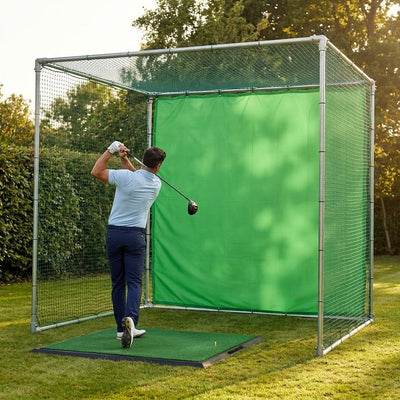
A familiar story: the pop-up net bought the year before is folded up in the shed with a driver-shaped hole in the back panel. That's the story behind a lot of cage enquiries: someone buys the cheapest thing that says "golf net," hits a few drivers into it, and learns the hard way that a practice cage and a driving net are not the same product. So before you spend anything, let me walk you through how I actually choose one — because the frame is the easy bit, and it's the three or four decisions around it that decide whether you're still using it next January.

The one question that decides it: how often will you really hit?
Be honest with yourself here, because it changes everything downstream. If you're going to knock a few balls about on a summer evening once a fortnight, you do not need three metres of galvanised steel sunk into your lawn. If you're a genuine every-week practiser who wants to grind through a British winter, a pop-up net will not survive you and it will drive you mad.
The FORZA ProFlex pop-up (£279.99) is the honest budget answer for the occasional hitter. It springs up in a couple of minutes, packs into a bag, and lives in the shed between sessions. I recommend it to renters, to people who can't leave anything up permanently, and to anyone who mostly wants to warm up before a round. What it isn't is a driver cage you leave outside all year. Treat it as a folding net with a bit of side and top protection, not as a permanent range.

If you'll be out there most weeks, buy a permanent steel cage and stop reading the pop-up section. A proper 3m frame with a double-layer net is a different category of product, and the rest of this guide is really about how to spec that.
Can it take a driver? Height and depth come first
This is the spec people skip and then regret. Driver practice needs height and it needs a bit of run-out behind the ball. A cage that's tall enough for a wedge is not tall enough for a full driver launch — you want the full 3m of height so a thinned drive or a high launch doesn't clip the top rail on the way through.
Depth is the sneaky one. A 3m-deep cage isn't 3m of usable hitting room, because you stand a good half-metre inside the front edge and the ball needs space to fly, hit the back net and drop. In practice I tell people to plan for around 4m of clear ground front-to-back once you account for where you stand and where the mat sits. Measure your garden for that before you fall in love with a frame. If you genuinely can't clear a driver, an iron-and-wedge setup is still hugely worthwhile — just go in knowing that, rather than discovering it after the concrete's set.
34mm or 42mm steel: what the gauge actually buys you
Frame poles come in two thicknesses that matter in the UK, and the difference is really about wind and frequency of use rather than looks.

34mm galvanised steel is the sensible choice for a sheltered garden and moderate use. It's rigid, it takes a driver, and it's what I recommend for most people who practise a couple of times a week in a spot that isn't a wind tunnel. That's the Standard Golf Cage & Hitting Mat Bundle (£459.99), and for a lot of gardens it's all the cage you'll ever need.
42mm heavy-duty steel is what I recommend for daily hitters and for exposed, windy plots — coastal gardens, open fields, anywhere that catches the weather. The extra wall thickness means less flex and less rattle when a gust hits the netting, and it simply feels more planted when you're leaning into a driver. That's the Pro Golf Cage & Hitting Mat Bundle (£734.99), which is our best-seller for a reason: it's the one that still looks and feels new two winters in.

Freestanding or socketed: do you want to move it?
A freestanding cage sits on feet and can go on grass, patio or artificial turf. It's the right call if you rent, if you might reposition it, or if you just don't want to dig holes. Both the Standard and the Pro bundles above are freestanding, and they're perfectly stable once weighted and tensioned properly.
Socketed is the permanent, tidy option. The frame legs drop into ground sockets set in concrete, so the cage sits flush, doesn't shift, and has the cleanest look when it's a fixed feature of the garden. The Socketed Pro Golf Cage, Net & Mat (£734.99) is the same 42mm heavy-duty spec as the Pro bundle, just bolted into the ground rather than standing on feet. If you own the house, you know exactly where it's going, and you never want to think about it moving in a gale, socket it.

The net and the mat matter more than the frame
Here's the bit nobody tells you: the frame almost never fails. What fails is a thin single-layer net that a fresh driver eventually punches through, and a cheap mat that wrecks your wrists and your enjoyment. Spend your attention here.
For the back panel you want a proper driver-rated net — ideally a double layer, so the outer net slows the ball and the inner net stops it, rather than one skin taking the full hit every time. All of our cage bundles ship with that double-net setup because it's the single biggest reason a cage lasts. If you ever do wear a net out, a replacement 3m cage net is £172.99, which is a lot cheaper than replacing the whole thing — another reason buying a decent frame once beats buying a pop-up twice.
The mat is the difference between practice you look forward to and practice that hurts. A tour-density hitting surface on a proper cushioned base lets you take a real divot-style strike without the club juddering back through your hands, and it's what makes winter sessions bearable when the ground's frozen. Every one of our cage bundles includes a 1.5m tour-density mat rather than a thin off-cut, and if you want to compare surfaces there's a full range on the hitting mats collection.
The range at a glance
| Cage | Frame | Fixing | Includes mat? | Price | Best for |
|---|---|---|---|---|---|
| FORZA ProFlex Pop-Up | Folding poles | Portable | No | £279.99 | Occasional / renters / warm-ups |
| Standard Cage & Mat Bundle | 34mm steel | Freestanding | Yes (1.5m) | £459.99 | Sheltered garden, regular use |
| Pro Cage & Mat Bundle | 42mm heavy-duty | Freestanding | Yes (1.5m) | £734.99 | Daily hitters, exposed/windy plots |
| Socketed Pro Cage, Net & Mat | 42mm heavy-duty | Ground-socketed | Yes (1.5m) | £734.99 | Permanent fixture, cleanest look |
What I'd actually buy
Strip away the options and my advice is simple. If you only hit occasionally or you can't leave anything up, buy the ProFlex pop-up and don't overthink it. If you practise regularly in a normal, reasonably sheltered garden, the Standard 34mm bundle is the value sweet spot and it'll take a driver happily. And if you're an every-week golfer, or your garden catches the wind, spend the extra and get the Pro 42mm bundle — it's the one I recommend most often and the one I'd put in my own garden. Socket it if it's staying put forever. That's genuinely the whole decision.
Frequently asked questions
Do I need planning permission for a golf cage in my garden?
For a standard 3m domestic cage, almost never. It's treated like any garden structure, and at that height in a normal back garden you're typically well inside permitted limits. The usual exceptions are listed buildings, conservation areas, and putting a tall structure right on a boundary — if any of those apply to you, have a quick word with your local planning office first. For the vast majority of UK gardens it's a non-issue.
Can I really hit a driver into a garden cage?
Yes, into a properly specced one. You need the full 3m height, a rigid frame, and a driver-rated double net at the back — all of our steel bundles are built for full swings. What you should not do is drive full-out into a thin single-layer net or a lightweight pop-up long-term; that's how back panels get holes. Match the cage to the club and you're fine.
How much does a decent golf practice cage cost in the UK?
Realistically you're looking at £279.99 for the ProFlex pop-up, £459.99 for a freestanding 34mm steel bundle with a mat, and £734.99 for the 42mm heavy-duty or socketed setup. The jump in price is mostly steel thickness, net quality and the mat — the things that decide how long it lasts — rather than anything cosmetic.
How much garden space do I actually need?
Plan for roughly 3m of width, the full 3m of height, and around 4m front-to-back once you allow for where you stand and where the ball flies before it hits the back net. Measure the run-out behind your hitting position, not just the footprint of the frame — that's the dimension people get caught out on.
Can I add a launch monitor to a garden cage later?
Absolutely, and plenty of owners do. Radar-based units need around 2.4m of clear space behind the ball to read the shot, so they suit a slightly deeper setup; camera-based units sit roughly 0.6m in front of or beside the ball, so they fit tighter footprints. If you're weighing that up, I wrote a full launch monitor budget ladder for garden cages that walks through what fits and what each rung buys you.

Free Home Golf Cage Setup Design Consultation
Not sure on size, base or mat? Chat directly with one of our experts — real golfers who practise from their own garden cage most days and has designed hundreds of home setups.
- Send a photo of your garden with rough measurements — get a tailored layout and spec for your space
- Personal replies from a real golfer, not a call centre
- Honest advice on what to buy — and what not to
Usually replies within the hour, 6am–10pm · prefer to talk? 02033 768500


Leave a comment