
Golf Cage for the Garden: The UK Buyer's Guide 2026

Searches for a golf cage for the garden have climbed steadily over the past year, and I understand why. A cage in the garden means full-swing practice with real balls, whenever you like, without a drive to the range. But buying a cage for a British garden is a different decision to buying one for a garage or a barn. Your garden has weather, a lawn that gets soft in October, neighbours who can see over the fence, and a footprint that probably is not as generous as you think. This guide is about that decision: matching the right cage to the garden you actually have. If you want the full market rundown of every cage we rate, that lives in our complete golf net & cage buying guide — here I am focusing purely on the garden side of the choice.


Why a garden cage is a different buying decision
Indoors, a cage lives in a controlled environment. In the garden it lives outside all year, on ground that moves with the seasons, in a country that averages over 150 days of rain a year in many regions. That changes the priorities. Frame corrosion resistance matters more than it ever does indoors. Netting UV stability matters, because British summer sun degrades cheap polyethylene netting surprisingly fast. Anchoring matters, because a 3m tall cage is effectively a sail in a January storm. And the way the cage looks matters, because you and your neighbours will see it every single day.
I have installed cages in gardens from Cornwall to Cheshire, and the pattern I see is consistent: people who buy on price alone for a garden setting end up replacing netting or bent poles within eighteen months. People who buy for outdoor durability are still hitting into the same cage five years later.
Step one: assess the garden honestly
Before you look at a single product page, get a tape measure out. You need three numbers.
Footprint
A proper full-swing cage needs a minimum footprint of around 3m x 3m for the cage itself, plus standing room behind it. You hit from outside or at the mouth of the cage, so allow at least 1.5m of clear space behind the opening for your swing and your mat. Realistically you want a level area of about 3m x 5m. Measure it, and measure it where the cage will actually go, not the widest part of the lawn.
Height and overhangs
Most garden cages are 3m tall. Check for overhanging branches, washing lines, telephone wires and the eaves of sheds. I measured a garden in Bristol last spring where the owner was convinced he had space, and a single sycamore branch took 40cm off his usable height — worth knowing before delivery day, not after. Trees also drop sap and leaves onto netting, which shortens its life, so a spot clear of the canopy is worth a slightly longer walk from the back door.
Slope and drainage
British lawns are rarely flat. A cage will tolerate a gentle slope, but anything beyond a few degrees makes the frame rack and puts uneven load on the anchors. Also look at where water sits after heavy rain. A cage standing in a winter puddle means muddy footings, faster corrosion at the base, and a swamp where you stand to hit. The Royal Horticultural Society has good practical advice on assessing and improving lawn drainage at rhs.org.uk/lawns if your chosen spot holds water.

Grass, patio or a dedicated base?
Where the cage stands changes both the anchoring and the experience.
Grass is the default and it works well. Ground stakes bite properly, the cage sits naturally in the garden, and mishit balls that squirt low are caught by turf rather than ricocheting. The downside is wear: the strip where you stand and the line where you walk to collect balls will turn to mud between November and March. A customer in Kent solved this with two cheap rubber walkway mats and a proper hitting mat, and his lawn recovered every spring.
Patio or paving gives you a clean, level, all-weather standing area, but you cannot stake into it. You will be relying on weighted anchors — sandbags or purpose-made weight plates on each upright — and you should be more conservative in wind (more on that in our setup guidance). Hard standing also means bouncing balls, so a cage with a skirt or return netting at ground level earns its keep.
A dedicated base — artificial turf over compacted hardcore, or a timber-framed pad — is the premium route. It drains, it stays level, it looks intentional rather than temporary, and you can set ground anchors into the sub-base before the turf goes down. If you are planning to keep the cage up year-round for years, this is what I recommend. It typically costs £300–£600 in materials for a 3m x 5m pad if you do the labour yourself.
Weather resistance: what actually matters in the UK
Three things separate a cage that survives British weather from one that does not.
Frame material and coating. Powder-coated or galvanised steel is what you want for a permanent garden cage. Thin uncoated tube rusts at the joints within a couple of seasons. Fibreglass-poled pop-ups avoid rust entirely but trade away rigidity.
Netting specification. Look for UV-stabilised netting of at least 2mm twine thickness. Archery-grade or golf-specific impact netting takes thousands of full-speed driver strikes; the bargain netting on unbranded cages goes brittle in sunlight and starts failing at the impact zone first — exactly where you least want a hole.
Fixings. Stainless or galvanised bolts, decent carabiners or ball bungees for the net, and proper ground anchors. Cheap zinc-passivated fixings streak rust down the frame within a year.
We tested netting offcuts left on a south-facing fence through a full summer and the difference was stark: the UV-stabilised sample was visibly unaffected, while the budget sample tore by hand in September. That is the gap you are paying for.
Aesthetics and neighbours
A 3m black cube changes how a garden looks, and it is 3m of visual presence your neighbours will also see. A few things genuinely help. Black netting all but disappears against hedging and fencing from more than a few metres away — green netting, counterintuitively, tends to stand out more because it never quite matches real foliage. Positioning the cage side-on to the neighbouring boundary rather than face-on softens the sightline. And planting — a trellis, bamboo screening or a couple of pleached trees — breaks up the outline quickly.
It is also worth a friendly word over the fence before it goes up. Cages under 4m generally sit fine within permitted development for garden structures, but a neighbour who hears about it from you takes it very differently to one who wakes up to scaffolding. In the several hundred cages we have supplied, I can count actual neighbour disputes on one hand, and every one involved a cage that appeared without warning.

Which cage suits which garden?
Here is how I match cages to gardens when customers ask. Sizes are the cage footprint; add standing room to all of them.

| Garden type | Typical usable space | Best fit | Why |
|---|---|---|---|
| Small / terraced garden | Under 3m x 5m level area | Forza ProFlex pop-up cage | Compact, genuinely quick to put up and take down, so it does not have to dominate a small garden permanently |
| Medium suburban garden | 3m x 5m–6m level area | Forza Golf Practice Cage 3x3x3m | Heavy-duty steel frame built to stay outside year-round; the workhorse choice for most gardens |
| Large garden | 4m x 6m+ with clear height | LinksCube XL 3m x 3m x 3.8m | The extra 0.8m of depth gives a more enclosed strike environment and more forgiveness on toe-strikes and shanks |
| No permanent space at all | Any lawn, cleared per session | A freestanding net from our golf nets collection | Not a cage, but five minutes to deploy and nothing left in the garden between sessions |
If you are unsure which size camp you fall into, our dedicated what size golf cage do I need guide works through the measurements in much more detail, including swing-arc clearances for taller players.
Budget: what garden cages actually cost
Loosely, the garden cage market breaks into three bands. Pop-up cages like the ProFlex sit around the entry level — a few hundred pounds — and are ideal if the cage needs to disappear between sessions. Steel-framed permanent cages such as the Forza 3x3x3m sit in the mid hundreds to around a thousand depending on netting spec. Premium cages like the LinksCube XL sit above that, and you are paying for frame gauge, netting quality and the deeper enclosure. Add a proper hitting mat to any of these — hitting off bare turf ruins the lawn and your wrists — and budget for anchoring upgrades if you are on a patio.
Browse the current line-up in our golf cage collection for what each option costs today.
Once you have chosen
Delivery day to first shot is usually an afternoon for a steel cage with two people. I will not repeat the whole process here because we have a full walkthrough in the step-by-step garden cage setup guide — but the short version is: build the frame flat on the lawn, walk it upright, square it before you tension the net, and do the anchoring properly on day one rather than "when I get round to it". The get-round-to-it anchors are the ones I hear about after the first named storm.
FAQ
Do I need planning permission for a golf cage in my garden?
Generally no. A standard 3m garden cage is a temporary structure and sits comfortably within permitted development rules for most houses. Exceptions are listed buildings, conservation areas and flats, where it is worth a quick call to your local planning office before ordering.
Can I put a golf cage on an ordinary lawn?
Yes — grass is the most common surface and the easiest to anchor into. Protect the standing and walking areas with mats through winter, and pick the most level, best-drained part of the lawn rather than the most convenient one.
Will a garden golf cage survive UK winters outside?
A galvanised or powder-coated steel cage with UV-stabilised netting will, provided it is anchored properly and you drop or slacken the netting ahead of severe storms. Pop-up cages should come in over winter. One customer in Yorkshire has run his Forza cage through two winters on an exposed plot with nothing worse than a re-tension each spring.
How close to a fence or house can I place the cage?
Leave at least 0.5m all round for airflow and net deflection — netting bulges on impact, and you do not want it slapping a fence panel or window on every drive. Side-on to the boundary also reads far less imposing from next door.
Our #1 garden cage, ready to play
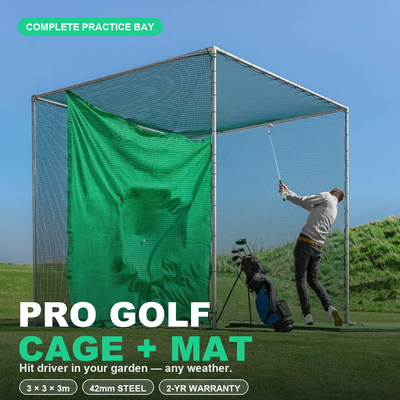
The Pro Golf Cage & Hitting Mat Bundle pairs a galvanised 42mm steel cage with a driver-rated double net and a tour-density mat — a buy-once, all-weather practice station for the UK garden. Best seller, 2-year warranty, 30-day returns.
Shop the Pro Golf Cage Bundle →⛳ Free resource: the 90-Day Golf Cage Practice Programme
A cage stops your golf balls — a plan lowers your scores. The free interactive golf cage practice programme gives you 39 structured 25-minute sessions, a 24-drill library, and progress scorecards you can track online — built around the Pro Golf Cage & Hitting Mat Bundle and open to every garden golfer.
Free email series: Dream Home Golf Cage Setup
Six short emails from Tom on the five decisions behind a brilliant garden practice space.
📏 Free tool: the Garden Golf Cage Planner
Planning a garden golf cage? The free Garden Golf Cage Planner answers the space, base, netting and cost questions in one place — including the Will-It-Fit calculator: enter your garden size and see which cages fit. No sign-up.

Free Home Golf Cage Setup Design Consultation
Not sure on size, base or mat? Chat directly with Tom, OpenGolfer’s founder — he practises from his own garden cage most days and has designed hundreds of home setups.
- Send a photo of your garden with rough measurements — get a tailored layout and spec for your space
- Personal replies from a real golfer, not a call centre
- Honest advice on what to buy — and what not to
Usually replies within the hour, 8am–8pm · prefer to talk? 02033 768500


Leave a comment