
A Garden Golf Cage for the Whole Family: Kids, Juniors & Safe Setups (UK)

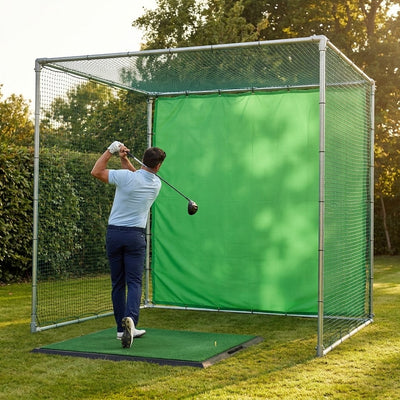
Most people buy a garden golf cage for themselves and discover within a fortnight that they have actually bought it for the household. The eight-year-old wants a go, the teenager gets quietly competitive, and suddenly the cage is doing more rounds per week than the family telly. That is the best version of this purchase — a £1,300 setup that four people use beats a £1,300 setup that one person uses — but golf clubs are heavy, fast-moving objects and a garden full of children is not a driving range. This guide covers the safety rules that actually matter, the junior kit basics, and the games that turn “can I have a go” into a golfer.
Why a cage is a genuine family investment
Getting a child to a golf course or range involves a car, a booking, daylight and an attention span. A cage in the garden involves opening the back door. Ten swings after school beats one range trip a month for building a swing, and it is how junior golf actually sticks — little and often, with a parent pottering nearby rather than a formal lesson. The R&A has invested heavily in getting more families into golf for exactly this reason: the game grows through low-pressure, accessible practice, and nothing is more accessible than the garden. Run your garden through our Garden Golf Cage Planner first — the 3m × 3m footprint fits far more family gardens than people assume.
The safety rules that actually matter
You do not need twenty laminated rules. You need four, enforced every single time, until they are automatic. These are the ones I give every family who buys from us, and the ones I run in my own garden.
1. One hitter, ever
One person in the hitting position, one club out of the bag. The most dangerous object in the setup is not the ball — the net stops that — it is the clubhead on the backswing and follow-through, moving at speed exactly where a queue-jumping sibling stands. Everyone else waits behind an agreed line a good three metres back. No exceptions, including adults.
2. Enter from behind, announce yourself
All approaches to the cage happen from behind the hitter, loudly. Teach children to shout “coming in!” and wait for the club to go down before crossing the line. A golfer mid-swing has tunnel vision; the rule puts the responsibility on the approacher, which is the only version that works with excited kids.
3. No dogs, no spectating siblings inside the cage
Nobody stands inside the cage or collects balls while anyone is holding a club. Balls come back naturally in a contained cage anyway, so there is rarely a reason to be in there mid-session. Dogs are the hard one — a bouncing golf ball is irresistible — so the dog goes inside the house during hitting time, not just “over there”. Most dogs learn the routine quickly; the kitchen window is the correct place for them.
4. Foam balls for under-8s
Small children swinging real balls near patios, windows and each other is unnecessary risk for zero benefit — at that age it is all about the movement, not ball flight. Foam until they can reliably strike the mat and follow the rules above, which for most kids is somewhere around 8. Then graduate them to real balls in the cage, which is a genuinely exciting rite of passage if you frame it that way.
Junior clubs and tee heights: keep it simple
Do not hand a seven-year-old a cut-down adult 7-iron — it is too heavy and too flat, and it teaches a scoopy compensation swing. Proper junior sets are sized by height, flexible, light, and second-hand ones are everywhere for £30–£60 because children outgrow them like shoes. One or two clubs is plenty to start: something lofted like a pitching wedge or 9-iron, and later a fairway wood or driver for the fun of it.
Tee everything up generously at first. A ball sitting up on a 30–40mm tee is dramatically easier to strike than one on the mat, and early success is the entire game at this age — a child who makes contact three swings in a row wants a fourth swing. Lower the tee as the strike improves, then introduce hitting off the mat with the lofted club. Resist coaching positions; rhythm and contact first, everything else later.
Games that get kids hooked
Children do not practise, they play. The trick is dressing practice as a game with a score:
Target zones: clip or tie coloured markers onto the back net — a high one, a low one, a corner one — and award points per hit. Three balls each, keep score, rotate. This is secretly trajectory and face control practice.
Closest-to-the-marker: pick one marker, everyone hits one ball, nearest wins the round. Works from age six to adult, and parents lose more often than they expect once a junior finds rhythm.
Ladders: hit the low target, then the middle, then the high one in order; miss and you restart. First to complete the ladder wins. Older kids will grind at this for half an hour without noticing they are doing structured practice.
When they are ready for actual structure, our free Practice Lab programme has session formats that adapt well to juniors — short blocks, clear targets, a score at the end. Ten focused minutes beats forty aimless ones at any age, but especially at nine.
Can the cage double as a football rebound net?
Honest answer: sort of. The netting on a golf cage is golf-spec — a dense weave designed to absorb a small, hard ball at high speed — not a sprung football rebounder. Kicking a football about into it is absolutely fine and the frame will not care. What it will not do is ping the ball back like a purpose-built rebound goal, and repeated full-power shots with a muddy football will grubby the net and stress the tie points faster than golf ever will. So: casual kickabout, yes; do not promise a football-mad child a rebound goal, and do not take goalposts-and-shooting-practice sessions into it. It is a golf cage that tolerates football, not a two-sport system.
Why containment beats an open net with children around
This is the single biggest family-specific buying decision. An open-fronted practice net relies on every shot being struck roughly at the net — and children produce shanks, tops, tee-height wallops and full-blooded mishits in directions physics students would find interesting. A contained cage with side and roof netting means those shots hit netting instead of a window, a sibling on the trampoline, or next door's greenhouse. The Pro Golf Cage & Hitting Mat Bundle is built exactly for this: 42mm galvanised steel, a driver-rated double net with a weatherproof outer and an archery-grade impact panel, U-peg anchored with no concrete, and a 60–90 minute build. We found that families are consistently the customers who most appreciate the double-net design — not for the adult's driver, but for the eleven-year-old's gloriously unpredictable 5-wood.
A family setup that works: quick reference
| Age | Ball | Clubs | Supervision | Best format |
|---|---|---|---|---|
| Under 8 | Foam | 1 lofted junior club, teed up | Adult alongside, always | Contact games, 10 minutes |
| 8–11 | Real, in the cage | 2–3 club junior set | Adult present in garden | Target zones, ladders |
| 12–15 | Real | Junior/teen set | Rules embedded; adult nearby | Closest-to-marker, Practice Lab blocks |
| Adults | Real | Full bag | — | Structured 90-day programme |
If you want to compare sizes and budgets side by side before deciding, our full golf cage collection shows every option we sell, from portable pop-ups to permanent steel builds.
Frequently asked questions
Is a golf net safe for kids in the garden?
A fully contained cage is, with four rules enforced: one hitter at a time, approach from behind and announce yourself, nobody (including dogs) inside the cage during hitting, and foam balls for under-8s. Open-fronted nets are much less forgiving of children's mishits.
What age can a child start using a garden golf cage?
Swinging foam balls alongside a parent: as young as 4 or 5. Hitting real balls in the cage: usually around 8, once they can reliably strike the mat and follow the safety rules every time.
Can a golf cage be used for football too?
For a casual kickabout, yes — the frame and netting will take it. But golf netting isn't a sprung rebounder, so it won't return the ball like a purpose-built football goal, and heavy repeated shooting practice will wear the net faster.
Do juniors need their own golf clubs?
Yes — height-sized junior clubs, not cut-down adult ones, which are too heavy and teach bad habits. One lofted club is enough to start, and second-hand junior sets are cheap because kids outgrow them quickly.
If you are weighing up whether your garden and your family suit a cage, the Will-It-Fit calculator answers the space question in a minute — and if you tell me the ages of your crew on WhatsApp, I will happily suggest the setup and the house rules to go with it.

Free Home Golf Cage Setup Design Consultation
Not sure on size, base or mat? Chat directly with one of our experts — real golfers who practise from their own garden cage most days and has designed hundreds of home setups.
- Send a photo of your garden with rough measurements — get a tailored layout and spec for your space
- Your design pack: your room drawn six ways, plus a walkthrough call
- Honest advice on what to buy — and what not to
Usually replies within the hour, 6am–10pm · prefer to talk? 02033 768500


Leave a comment