
Golf Cage on a Sloped or Uneven Garden: What Actually Works (UK)

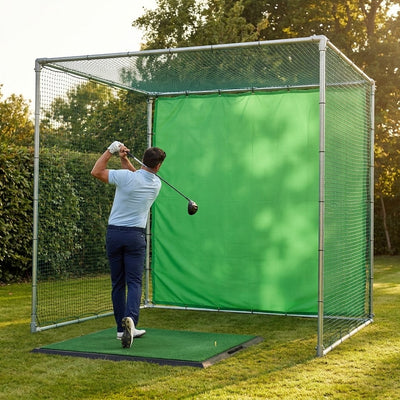
The question I get more than almost any other on WhatsApp is some version of “my garden slopes — can I still have a cage?” And the honest answer is: almost certainly yes, because almost no UK garden is level. Victorian terraces fall towards the house, new-builds fall away from it, and half the country is built on a hillside. A golf cage is a 3m × 3m footprint of freestanding steel, not a snooker table, and it tolerates far more ground movement than people assume. What matters is knowing how much fall you actually have, which of the five fixes matches it, and the one part of the setup that genuinely must be dead level: the mat.
First, measure the fall properly
Eyeballing a lawn is useless — grass hides 100mm of fall easily. The five-minute method: lay a straight 3m plank (or a taut string line between two pegs) across the spot where the cage will sit, put a spirit level on it, lift the low end until the bubble centres, and measure the gap under the raised end. That gap is your fall across the footprint. Do it twice, once front-to-back and once side-to-side, because gardens rarely slope in just one direction. If you have a laser level, even better, but the plank method is all you need and it is hard to get wrong.
Write both numbers down before you go any further, because they decide everything below. A garden that looks like it “slopes badly” can measure 40mm across 3m, which is nothing; a lawn that looks “basically flat” can measure 140mm. You cannot pick the right fix without the number.
How much slope can a cage actually tolerate?
A freestanding steel cage is a braced box, not a precision instrument. As a working rule: up to about 50mm of fall across the 3m footprint, put the cage up and stop worrying. The frame will sit solidly, the net hangs true enough, and once the grass grows back around the base plates you will never see the lean. Between 50mm and 100mm you are into “fix the ground, not the cage” territory. Beyond 100–150mm you need a platform or a re-grade, because packing one corner of a steel frame that high stops being an adjustment and starts being a wobble.
Ground anchoring still works on a slope, by the way. The U-peg anchors supplied with our Pro Golf Cage & Hitting Mat Bundle drive vertically into the ground regardless of the surface angle, so a modest slope does not compromise the hold at all. If your garden is exposed as well as sloped, read our full guide on anchoring a golf cage for wind and different ground types before you build.
The five fixes, in cost order
1. Move or rotate the cage (free)
The cheapest levelling tool is a tape measure. Gardens rarely slope evenly, and rotating the cage 90 degrees so it runs along the contour rather than down it often halves the fall across the footprint. Shifting the whole thing 2m towards the flatter end of the lawn does the same. Before you touch a spade, spend ten minutes with the plank in three or four candidate positions. Our Garden Golf Cage Planner and its Will-It-Fit calculator will tell you which orientations your garden allows, which is exactly the freedom you need here.
2. Localised levelling: cut and fill (a weekend and a spade)
For 50–100mm of fall, the classic fix is turf cut-and-fill on the four base-plate positions only. Skim the turf off the high spots, dig out or build up a firm, flat pad roughly 400mm square under each upright, compact it with your heel or a tamper, and relay the turf. You are levelling four dinner-tray-sized patches, not the whole lawn. Fill with compacted soil or sharp sand, never loose topsoil on its own — it settles and your careful levelling sinks with it over the first wet month.
3. Packers or adjustable feet under the low uprights (under £20)
Solid packers — paving riven offcuts, thick rubber pads, treated timber — under the downhill base plates work fine for modest corrections. Be honest with yourself about the limit though: above roughly 75mm of packing this becomes a bodge. A tall stack of packers concentrates the load, can rock, and creates a gap under the frame edge that a shanked ball will find. If you are stacking three bricks under one corner, the ground needs fixing, not the frame.
4. A raised timber platform (roughly £150–£400 in materials)
For genuinely sloped gardens — 100mm to 300mm of fall — a timber deck platform is the answer that actually works long-term. Build a sub-frame from treated sleepers or 100mm posts set level (the downhill side sits proud of the ground, the uphill side is trenched in or sat on pads), deck it with treated boards, and you have a dead-level 3.5m × 3.5m stage for the cage and mat. It drains, it will not settle, the mat sits perfectly flat on it, and honestly it looks smart. It works on cross-falls of 250mm or more and is a realistic two-weekend DIY job.
5. Full re-grade (£500–£2,000+ with a landscaper)
Digging out and re-levelling a section of garden with a retaining edge is the nuclear option. It is the right call only if you wanted a level terrace anyway, or the slope is severe enough that a platform would stand awkwardly high on one side. Get a landscaper to quote the terrace as a garden improvement in its own right; the cage then just sits on it.
Which fix for which slope?
| Fall across 3m | What to do | Rough cost | DIY? |
|---|---|---|---|
| Under 50mm | Nothing — build the cage | £0 | — |
| 50–75mm | Rotate/relocate, or packers under low uprights | £0–£20 | Yes, an hour |
| 75–100mm | Cut-and-fill pads under the four base plates | £0–£50 | Yes, a weekend |
| 100–300mm | Raised timber platform on a sleeper sub-frame | £150–£400 | Confident DIYer, two weekends |
| 300mm+ | Full re-grade / terrace | £500–£2,000+ | Usually a landscaper |
The mat must be dead level, even if the cage isn't
Here is the distinction that saves people money: the cage tolerates slope; your stance does not. Hitting off a mat that leans even 20mm across its width quietly changes your ball position, your weight distribution and your strike — you are grooving a ball-above-feet lie without knowing it. So whatever you do with the frame, level the metre-and-a-half where the mat sits properly. Skim the turf, screed a sharp-sand pad, check it with the spirit level in both directions, and set the mat on that. I installed my own cage on a lawn with about 40mm of fall and did nothing to the frame at all, but I spent a careful hour getting the mat pad flat — that is the right ratio of effort.
Sloped usually means drainage too — especially on clay
Water runs downhill, and if your cage sits at the bottom of the slope on heavy clay, the hitting area becomes a bog from November to March. Parts of the UK average well over 1,000mm of rain a year — the Met Office UK climate averages are worth a look for your region — and clay simply will not soak it away. Cheap fixes that work: site the mat on the uphill half of the footprint; cut a shallow gravel-filled channel across the slope above the cage to intercept run-off; and put the mat on a rubber base or the timber platform from option 4 so it sits clear of standing water. The pattern through winter is consistent: the setups that stay usable year-round are the ones raised even 50mm off saturated ground.
BUILT FOR REAL UK GARDENS
The Pro Golf Cage & Hitting Mat Bundle is freestanding 42mm galvanised steel with U-peg anchors — no concrete, and happy on the modest slopes most UK gardens actually have. From £1,284.98 for the 3m × 3m × 3m cage and mat, with a 2-year warranty.
See the Pro Cage bundle →Frequently asked questions
Can you put a golf cage on a sloped garden?
Yes. A freestanding steel cage handles up to about 50mm of fall across its 3m footprint with no work at all. Beyond that, level the four base-plate positions or build a timber platform — only severe slopes need a re-grade.
How do I level the ground for a golf net or cage?
Measure the fall first with a 3m plank and spirit level. Then level only what needs it: firm 400mm pads under each upright for the frame, and a properly flat sand-screeded area under the hitting mat. You almost never need to level the whole lawn.
Do U-peg anchors work on a slope?
Yes — they drive vertically into the ground whatever the surface angle, so a modest slope doesn't reduce the hold. On exposed sloped sites, follow our anchoring guide and check the pegs after storms.
Do I need a concrete base for a golf cage?
No. Lawn, compacted ground or a timber platform are all fine for a freestanding cage. A dead-level surface only matters under the mat, where your stance is — not under the whole frame.
If you are still not sure which route your garden needs, run your dimensions through the Garden Golf Cage Planner, or send me a photo of the slope on WhatsApp with the plank measurement — it usually takes me two minutes to tell you which of the five fixes you actually need, and most of the time the answer is the free one.

Free Home Golf Cage Setup Design Consultation
Not sure on size, base or mat? Chat directly with one of our experts — real golfers who practise from their own garden cage most days and has designed hundreds of home setups.
- Send a photo of your garden with rough measurements — get a tailored layout and spec for your space
- Personal replies from a real golfer, not a call centre
- Honest advice on what to buy — and what not to
Usually replies within the hour, 6am–10pm · prefer to talk? 02033 768500


Leave a comment