
Golf Nets for Small Gardens: Compact Practice Setups UK

Most of the golf net content online is written for people with American-sized back yards. The reality in the UK is rather different: terraced and semi-detached gardens are commonly 5–8m long, and plenty of newer builds offer less than that. The good news is that a small garden absolutely does not rule out useful practice — compact hitting stations in gardens under 6m long often get used far more than big cages, precisely because they are so easy to live with. The trick is choosing the right kit for the space, being honest about which shots are safe, and setting things up so your neighbours never have a reason to mention it. Here is how I approach golf nets for small gardens, based on the setups that have actually worked.


How Small Is Small? Measuring What You Actually Have
Before choosing anything, measure your usable hitting run: the straight-line distance from where your feet would be to the furthest point you could place a net, avoiding flower beds, sheds and washing lines. According to the Office for National Statistics, the median garden in Great Britain is around 188 square metres — but that average hides huge variation, and in London the typical garden is roughly half that. In practice, the gardens I get asked about most are 4–7m of usable length.
A full swing setup needs three zones: room behind you for the club (about 1.5m), the ball-to-net gap (2.5–3m for full shots), and the net itself (0.5–1.5m deep depending on type). That is why 6m is the rough dividing line: above it, full shots into a proper net are comfortable; below it, you start trading either the safe hitting distance or the club you use.
What Shots Are Realistic in a Small Garden

This is the honest bit that sales pages skip. In a garden under 6m:
Chipping and pitching — unlimited. A chipping net needs 2–4m of carry and almost no height. This is also, frankly, the practice that saves most amateurs the most shots. Twenty minutes of landing-spot work three evenings a week will do more for your handicap than an hour of driver.
Wedges to mid-irons — yes, with the right net. Full swings with a wedge through 7-iron are fine at 2.5m from a decent net. The ball arrives at moderate speed and predictable height, and a good pop-up gathers it easily.
Long irons and woods — conditionally. The ball comes off faster and lower, rebound energy is higher, and an offline strike covers the width of a small garden instantly. I only recommend these in tight spaces inside a net with side wings or a compact cage.
Driver — usually not worth it. In under 4m of usable depth it gets tight: the ball sits closer to the net than the design distance, so you want a cage with a proper archery-grade impact panel — it exists precisely to absorb 100+ mph strikes at close range — rather than a bare net with no margin for the mishit. If driver practice is the goal, that is a full-size cage conversation — see my guide to what size golf cage you need — or a trip to the range.
The Kit That Works in Tight Spaces
Pop-up net cages
For small gardens the Forza ProFlex pop-up net cage is the setup I recommend more than anything else, for one simple reason: it goes away. A permanent structure in a small garden dominates it; the ProFlex is up in a couple of minutes, folds flat afterwards, and its side wings catch the off-centre strikes that a flat pop-up would let past — which matters enormously when the fence is three metres from your target line. After testing it through a summer of evening sessions in my own garden, the fold-and-stash routine took under three minutes door to door, which is the difference between a net that gets used and one that rots in the shed.
Chipping nets
A basket-style chipping net costs £20–£40, sits anywhere, and turns a 4m lawn into a genuine short-game station. Pair it with towels or hoops as landing targets at different carries. If I could only put one practice aid in a small garden, it would be this plus a decent mat.
Compact cages
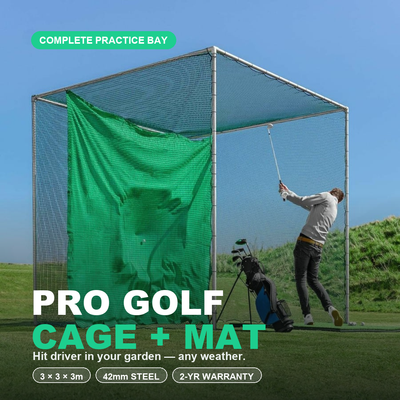
If you have 6m+ and want something semi-permanent that safely takes longer clubs, a compact steel golf cage is the step up — the enclosed sides and roof mean an ugly strike stays in your garden, full stop. My cage vs net guide covers when that upgrade is genuinely worth it; for smaller plots, the honest answer is often "not yet".
A proper mat
Small-garden practice means hundreds of swings from the same spot, which destroys lawn in a fortnight. A quality hitting mat protects the grass, your wrists and your consistency. Something around 1.5m square gives you a stable stance without swamping the garden, and it can live in the shed with the net.
Safety Margins: The Non-Negotiables

In a big garden a mistake is embarrassing. In a small one it is next door's greenhouse. The margins I insist on:
| Rule | Minimum | Why |
|---|---|---|
| Ball-to-net distance | 2.5m (full shots) | Closer, and mishits deflect around the face; also reduces rebound risk |
| Net face for irons | 2.2m wide, with wings preferred | Covers typical iron dispersion at close range |
| Lateral clearance to boundaries | 1m+ either side of target line | An 8-iron shank travels sideways faster than you would believe |
| Aim line | Down the garden's long axis, away from the house | Worst-case miss lands on your own property |
| People and pets | Behind the hitting position, always | Rebounds and deflections are unpredictable |
Two extra habits worth stealing. First, do a "worst shot audit": stand at your hitting position and imagine the most horrific shank and the most violent pull. If either clears a boundary, shorten the club or reposition until it cannot. Second, start every new setup with twenty soft half-swings before going to full speed — it shows you the rebound behaviour and any gaps around the net edges while the stakes are low. If your natural miss points at a neighbour's window, rotating the whole setup — even 30 degrees — can put a solid wall behind it instead.
Keeping the Neighbours Onside
A practice net in a small garden sits close to other people's lives, so the social side is as important as the technical one:
Noise. The impact of ball on net is quiet; ball on mat is a dull thud; but a mishit rattling a steel frame carries. Small gardens amplify everything off fences and brick. I would keep full-speed sessions to sociable hours — the same courtesy you would apply to a lawnmower — and switch to chipping in the evening, which is near-silent.
Sightlines. A 2m pop-up that disappears after each session generates zero comment. A permanent 3m structure overlooking a neighbour's patio can, even when it is perfectly legal. Freestanding temporary nets need no permission, but if you move to anything permanent near a boundary, skim the government planning guidance first.
The stray ball conversation. Have it before it happens, not after. Telling a neighbour "I've set it up so the worst miss stays on my side, but tell me instantly if a ball ever comes over" buys enormous goodwill — and holds you to a proper safety standard.
A Sample Under-6m Setup
For a typical 5.5m terraced garden, here is the setup I would actually build: ProFlex pop-up at the far end angled down the long diagonal, 1.5m hitting mat 2.5m back, chipping net stored by the door for evening sessions, and practice limited to 8-iron and shorter at full speed. Total outlay is in the low hundreds, everything stows in a shed, and it covers the 60% of the game played from 130 yards in. When the golf bug bites harder, the same mat and habits transfer straight into a bigger cage or an indoor simulator — the golf nets collection has the full range when you are ready to compare options.
Frequently Asked Questions
Can I use a golf net in a garden under 5 metres?
Yes, but scope it honestly: chipping without limits, and full swings only with wedges and short irons at a minimum 2.5m from the net. Below about 4m of usable run, I would make it a dedicated short-game station rather than forcing full shots into inadequate margins.
What is the best golf net for a small UK garden?
A pop-up net cage with side wings — the Forza ProFlex is my standard recommendation — because it combines genuine mishit protection with a two-minute takedown. In a small garden, the ability to put the net away is worth more than any spec-sheet advantage of a bigger fixed frame.
Will my neighbours object to a garden golf net?
Rarely, if you use a temporary net, keep sessions to reasonable hours and make sure balls physically cannot leave your garden. Objections almost always stem from permanent structures on boundaries or from stray balls — both of which are avoidable with the setup choices covered above.
Is it worth getting a launch monitor for a small garden setup?
Once your swing practice is regular, yes — even a basic unit adds carry numbers and strike feedback that a net alone cannot give, and portable radar units work happily in net setups. It turns repetition into measurable practice, which is exactly what short-range work needs.
⛳ Free resource: the 90-Day Golf Cage Practice Programme
A cage stops your golf balls — a plan lowers your scores. The free interactive golf cage practice programme gives you 39 structured 25-minute sessions, a 24-drill library, and progress scorecards you can track online — built around the Pro Golf Cage & Hitting Mat Bundle and open to every garden golfer.
Free email series: Dream Home Golf Cage Setup
Six short emails from Tom on the five decisions behind a brilliant garden practice space.
📏 Free tool: the Garden Golf Cage Planner
Planning a garden golf cage? The free Garden Golf Cage Planner answers the space, base, netting and cost questions in one place — including the Will-It-Fit calculator: enter your garden size and see which cages fit. No sign-up.

Free Home Golf Cage Setup Design Consultation
Not sure on size, base or mat? Chat directly with Tom, OpenGolfer’s founder — he practises from his own garden cage most days and has designed hundreds of home setups.
- Send a photo of your garden with rough measurements — get a tailored layout and spec for your space
- Personal replies from a real golfer, not a call centre
- Honest advice on what to buy — and what not to
Usually replies within the hour, 8am–8pm · prefer to talk? 02033 768500


Leave a comment