
Golf Simulator in a Conservatory? The Honest UK Verdict

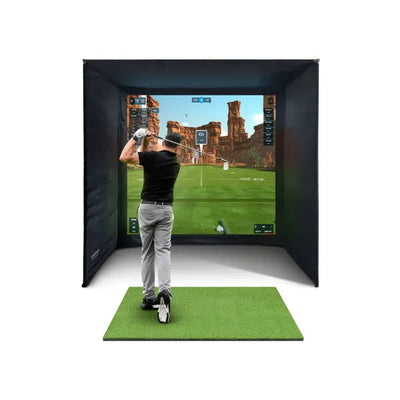
The conservatory question comes up on WhatsApp at least once a fortnight, and I understand why: it is often the one room in a British house with genuine spare floor space, a lofty apex ceiling and nobody watching television in it. So can you put a golf simulator in a conservatory? My honest verdict, having talked at least four customers out of it this year (one customer in Kent went ahead with the limited version below and loves it) and helped two do a limited version safely: usually no — but not always, and the exceptions are worth understanding properly. Here are the problems in order of severity, the setups that genuinely can work, and a risk checklist to run before anyone hits a ball.

Problem one: you are surrounded by glass
Start with the disqualifier. A conservatory is a room made of the one material a golf ball is best at destroying. And the shot that breaks a pane is not the pure drive into the screen — it is the topped ball that rockets off at shin height, the hosel strike that goes forty degrees right, the thin one that climbs. Every golfer hits these; indoors, the only question is what they hit. In a normal room the answer is a wall you can patch. In a conservatory it is glass, and a full-speed mishit into a pane is not a maybe.
That makes a full enclosure with side barriers non-negotiable — not a flat net hung across one end, but a proper bay with a back screen, roof net and side protection so the offline miss is caught, the sort of coverage a purpose-built enclosure provides as standard. And I will be straight: even with a full enclosure, glass directly behind the screen is a risk I would design out rather than manage. Screens and nets attenuate a ball’s energy; the worst-case combination of a seam, a worn panel and a flush drive is not something to park in front of your neighbour-facing elevation. Modern conservatories should be glazed with safety glass in critical locations — the Glass and Glazing Federation publishes the standards — but safety glass is designed to break safely, not to be a backstop for golf balls. Toughened panes still break; they just break into granules rather than shards.
Problem two: light floods in, and simulators hate it
A conservatory is designed to capture daylight; a projected simulator image is designed for the opposite. Project onto an impact screen in a glass room on a bright day and the image washes out to a ghost — there is no projector on a sensible budget that outguns the sun through three glazed walls and a glass roof. Camera-based launch monitors bring their own complaint: direct sunlight on the hitting area can interfere with the cameras that read the ball, so a bright conservatory can degrade the measurement as well as the picture. Radar units generally cope with sunlight far better. Blinds transform all of this — a fully blinded conservatory in the evening is effectively a normal room — but blinds for three walls and a roof are a real cost line, and without them daytime projection is simply not happening.
Problem three: the climate swings are brutal
Conservatories run hotter and colder than any other room in the house: roasting under June sun, down near outdoor temperature on a January morning. Both ends hurt. Summer heat is unpleasant to swing in and unkind to electronics left baking; winter cold brings the cold-room condensation problem — warm moist air meeting cold-soaked kit — that plagues garages, plus lens fogging the moment you blast the heating before a session. The practical consequence: a conservatory is a poor place to store a projector or PC year-round even if you only sometimes play there. Kit that lives elsewhere and visits for sessions fares much better.
Problem four (and one genuine plus): floor and ceiling
Most conservatories have tiled floors, which raise two smaller issues: a hitting mat on hard tile needs a proper rubber base under it to protect your joints and stop it creeping, and a hard-floored glass room is an echo chamber — impact sounds crack around it, which matters with a house attached and neighbours near. Both are solvable with a decent mat-and-base setup and accepting the acoustics.
The genuine plus is height. A conservatory’s apex roof often peaks higher than a standard 2.4m ceiling, and in the middle of the room you may find the 2.8m-plus that lets a taller golfer swing driver freely — the very thing that rules out many spare rooms. Measure at the point your hands actually travel, not at the eaves; our room size guide covers the full set of dimensions that matter and how to check them honestly.
When a conservatory setup CAN work
Now the fair hearing, because “usually no” is not “never”. There are two setups I am comfortable recommending.
Launch-monitor practice into a quality net
Skip projection entirely: a launch monitor, a phone or tablet for numbers, and a quality practice net with proper side protection. Blinds fitted and drawn for camera units. Most importantly, orient the bay so the miss-line — the low topped shot and the wide shank — faces the solid house wall, not glass. One of the two conservatory setups I helped spec this year runs exactly this: net against the house wall, hitting out of the room’s glazed end towards brick, blinds down for the camera, projector money saved. After several months it works precisely because it respects what the room is.
The short-game room, with the full swing outside
The second honest answer: use the conservatory for what it is actually good at — a bright, pleasant putting and chipping zone the whole family drifts through — and put the full swing in the garden where it belongs. A putting mat plus soft foam balls for chipping carries near-zero risk, and a garden cage takes the driver safely outdoors. That pairing costs less than conservatory-proofing a full sim and gets used more. Our Pro Golf Cage & Hitting Mat Bundle (42mm galvanised steel, driver-rated double net, from £1,284.98 with the mat) is the buy-once version of the garden half, up in an evening with no concrete.
The verdict, factor by factor
| Factor | Conservatory reality | Verdict |
|---|---|---|
| Glass surroundings | Mishits fly at shin height and forty degrees offline | Full enclosure with side barriers non-negotiable; no glass on the miss-line |
| Daylight | Washes out projection; can upset camera launch monitors | Projection needs full blinds; radar units cope best |
| Temperature | Roasting June, freezing January, condensation at both transitions | Never store electronics there year-round |
| Floor | Hard tile, echoey | Mat with rubber base required; accept the noise |
| Ceiling | Apex often generous in the middle | The one honest advantage — measure where your hands travel |
The risk checklist before you hit a ball
If you do go ahead with the launch-monitor-and-net version, run this list — all of it — before the first full swing:
- Miss-line audit: stand at the hitting position and trace where a topped ball and a 40-degree shank would go. If either line ends in glass, reposition until it ends in house wall or netting.
- Side barriers up: a flat net alone does not catch the offline miss. Side protection on both sides, no exceptions.
- Net condition check: inspect for worn panels and gaps at seams and floor before every block of sessions — a net is only as good as its most tired panel.
- Soft-ball first session: hit the first sessions with foam or restricted-flight balls to prove the geometry before real balls fly.
- Blinds drawn for any camera-based launch monitor, and no direct sun across the hitting zone.
- Kit stored elsewhere: electronics sleep in the house, not in the glass room, summer and winter.
- House rules: one swinger at a time, everyone else behind the hitting line, always — family rooms need family rules.
If the checklist feels like too much friction, listen to that instinct: it is the room telling you the full swing belongs elsewhere. A proper indoor bay in a garage or garden room — something like the FlightScope Mevo Gen 2 sim bundle (enclosure, impact screen and mat included, from £2,498) — gives you the projection, the climate and the peace of mind the conservatory cannot.
THE SAFER PLACE FOR THE FULL SWING
Keep the conservatory for putting and chipping, and give the driver a proper home: the Pro Golf Cage & Hitting Mat Bundle — 42mm galvanised steel, driver-rated double net, tour-density mat — from £1,284.98, built in an evening.
See the Pro Cage bundle →Frequently asked questions
Can you put a golf simulator in a conservatory?
Usually it is the wrong room: glass on every side, daylight that washes out projection, and brutal temperature swings. It can work for launch-monitor practice into a quality net with side barriers, blinds drawn and the miss-line facing the house wall — but a full projected simulator belongs in a garage, garden room or spare room.
Will a golf net protect conservatory glass?
A good net with side barriers catches the overwhelming majority of shots, but nets attenuate energy rather than guarantee it, and panels wear. Treat glass directly behind or beside the hitting line as something to design out by repositioning, not something to defend with netting alone.
Do launch monitors work in bright conservatories?
Radar-based units generally cope well with daylight. Camera-based units can struggle with direct sunlight across the ball, so a bright glass room needs blinds drawn for reliable readings. Evening sessions with blinds down behave like any normal room.
What golf setup actually suits a conservatory?
Putting and chipping. A putting mat and foam-ball chipping make it a brilliant bright short-game zone with near-zero risk, while the full swing goes outdoors into a garden cage or indoors into a proper enclosed simulator bay.

Free Home Golf Simulator Design Consultation
Not sure on space, screen or launch monitor? Chat directly with Tom, OpenGolfer’s founder — he has designed hundreds of home setups and will tell you exactly what fits your room and budget.
- Send your room size (or a photo) — get a tailored layout and spec for your space, ceiling height included
- Personal replies from a real golfer, not a call centre
- Honest advice on what to buy — and what not to
Usually replies within the hour, 8am–8pm · prefer to talk? 02033 768500


Leave a comment