
Golf Simulator Pros and Cons UK: A Brutally Honest List

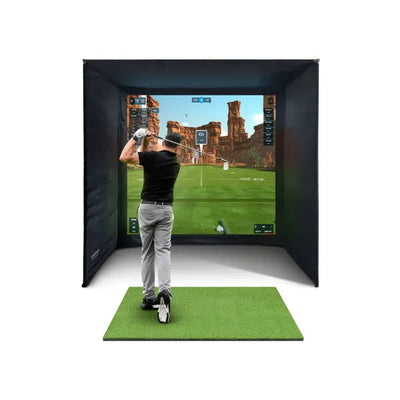
I sell golf simulators for a living, so you would expect this article to be nine parts pros and one grudging con about tidying cables. It is not going to be that. I have installed enough simulators across the UK — and taken enough follow-up calls six months later — to know exactly where they delight people and exactly where they disappoint. Some buyers get life-changing value from day one; a smaller number discover that the reality did not match the Instagram fantasy. The difference is almost never the equipment. It is whether the buyer went in with honest expectations. So here is the genuinely balanced list I wish every customer read before spending a penny.
The pros: why simulators earn their keep
1. Practice volume you simply cannot get any other way
This is the big one. The average UK club golfer hits perhaps 50–100 range balls a week in summer and close to zero from November to February. A simulator owner can hit 300 balls a week, every week, twelve months a year, without leaving the house. Nothing else in golf — not lessons, not new clubs, not training aids — comes close to the improvement effect of simply hitting ten times more balls with instant feedback on every one. Customers who were 18 handicaps at install regularly report being down to 12 or 13 within eighteen months, and the common thread is volume, not talent.
2. The British winter stops mattering
From October to March, UK golf is a lottery of frost delays, temporary greens, waterlogged fairways and 3:50pm sunsets. A simulator turns those five months from dead time into your most productive practice block of the year. One customer in Harrogate told me his simulator "bought back a third of his golfing life" — and having played January golf in Yorkshire, I do not think he was exaggerating.
3. Feedback that transforms practice quality
A launch monitor tells you your club speed, ball speed, launch angle, spin and carry distance on every single shot. Most golfers have never seen this data in their lives and are guessing at their own carry numbers — usually optimistically. After a few weeks with real numbers, you stop coming up short on approach shots because you finally know your 7-iron carries 148 metres, not the 160 you told yourself. This is the same reason every tour professional now travels with a launch monitor.
4. It becomes family entertainment, not just your practice cave
This one surprises buyers most. Modern software includes closest-to-the-pin contests, mini-games, and playable versions of famous courses, and we found that in family households the simulator quickly stops being one person's toy. Kids who would never stand on a cold range will happily play simulator skills challenges for an hour. Several customers have told me the sim gets more combined family use than their television. It also quietly becomes the best wet-birthday-party solution in the street.
5. It can pay for itself against real-world golf costs
Range balls at £6–£10 a bucket, simulator bay hire at £30–£50 an hour in most UK cities, winter green fees wasted on abandoned rounds — it adds up. A golfer using a commercial sim bay twice a week is spending £3,000+ a year. A mid-range home setup like the FlightScope Mevo Gen 2 bundle costs around that once, and then it is yours for a decade. My full UK cost breakdown runs the numbers properly.
The cons: what the glossy videos do not show
1. The space sacrifice is real and permanent
A full-swing simulator realistically needs about 3 metres of ceiling height, 4 metres of width and 5 metres of depth to be comfortable and safe. In most UK homes that means surrendering the garage, and surrendering it properly — the car lives outside now, the bikes hang on the wall, and that room is a golf room. Plenty of couples have had franker conversations about this than about the price. Before anything else, measure honestly using my room size guide; ceiling height is the number that kills more UK simulator dreams than any other, because standard British ceilings sit at 2.4 metres and most golfers need more to swing a driver.
2. The real cost is more than the sticker price
The bundle price is not the finished price. Add a projector if you want a screen rather than hitting into a net with a tablet, a PC or gaming laptop for the premium software titles, software subscriptions at £100–£250 a year for the good stuff, and possibly heating, lighting or electrics for a garage conversion. A "£3,000 simulator" commonly lands at £4,500–£5,000 fully realised. It is still good value against commercial bay hire — but go in with the full number, not the headline one.
3. It is not identical to real golf, and feel is the gap
Let me be straight about this: hitting off a mat is not hitting off turf. A mat is more forgiving of slightly heavy strikes — the club skids where turf would dig — so fat shots get flattered. There is no wind in your face, no uneven lies on most setups, no rough grabbing the hosel, and no consequence anxiety standing over a shot with water left. Simulator golf sharpens your swing mechanics and your distance control brilliantly; it does not fully train the judgment and nerve of real golf. The R&A and USGA's own Rules of Golf do not even attempt to govern it — it is a different, adjacent game, and the golfers who improve fastest treat it as a complement to real rounds, not a substitute.
4. Putting and chipping are the weak spots
No consumer simulator does putting truly well. Reading a break on a flat mat aimed at a projected green is nothing like reading a real sloping surface, and most owners end up using auto-putt or gimmes inside a set distance. Short chips are similarly compromised because the ball meets the screen before its flight has really developed. If the short game is what you want to train, a dedicated tool like the ExPutt RG putting simulator does that one job far better than a full sim does — but be honest that your 30-yard pitch and your putting will still need real-world practice.
5. Projectors and bright rooms do not mix
Simulator marketing photos are always taken in darkened rooms, and there is a reason. In a garden room with big glass doors or a conservatory-adjacent space, a standard 3,000-lumen projector image looks washed out and grey in daylight hours. The fixes — blackout blinds, a brighter projector, or accepting evening-only play — all work, but they are decisions you should make before buying, not after. My projector guide covers brightness for UK rooms honestly.
6. Some people simply stop using them
The uncomfortable one. Like exercise bikes, a minority of simulators become expensive coat hangers. The pattern I have seen in follow-up conversations: buyers who had a specific habit in mind ("Tuesday and Thursday nights, plus Sunday with the kids") still use theirs heavily years later; buyers who bought on impulse without a routine drift off after the novelty fades, usually around month four. Know which buyer you are — I recommend writing down the two or three weekly sessions you will actually do before you place an order, and being suspicious of yourself if you cannot.
The balance sheet at a glance
| Factor | The honest verdict |
|---|---|
| Practice volume | Huge pro — 10x more balls than range-only golfers, year-round |
| UK winter | Huge pro — turns 5 dead months into your best practice block |
| Shot data | Pro — real carry numbers change how you play |
| Family use | Pro — consistently underestimated by buyers |
| Space | Con — a full room, permanently; 2.4m ceilings are a genuine blocker |
| Total cost | Con — expect 30–50% above the headline bundle price |
| Feel vs real turf | Con — mats flatter heavy strikes; no substitute for turf entirely |
| Putting/chipping | Con — the short game still needs real-world practice |
| Daylight rooms | Con — projectors need light control to look good |
So who should actually buy one?
Buy with confidence if: you play or want to practise at least twice a week; you have (or will build) a space with 2.8m+ ceilings; you accept the total cost including software and projector; and you see it as a practice-plus-entertainment tool rather than a replacement for golf. In my experience these owners are the most satisfied customers in our business, and many say it is the best money they have spent on golf.
Think harder if: your ceiling is 2.4m and you are hoping to "make it work"; the budget only stretches by ignoring the extras; or the main appeal is novelty. In the first case, consider whether a garden building solves it — my garden room guide covers that route. In the last case, a £200 swing-stick option like the PhiGolf 2 is a far cheaper way to find out whether the habit sticks before committing thousands.
If you have read the cons and you are still in, that is exactly the buyer who ends up delighted. Start with the complete UK buyers guide to pick the right system for your space and budget, or browse the current simulator bundles to see what a complete setup includes.
FAQ
Are golf simulators worth it in the UK?
For golfers who practise regularly, yes — the UK's five-month winter makes the case stronger here than almost anywhere. The maths works if you use it twice a week or more; against £30–£50/hour commercial bay hire, a home setup typically pays for itself within one to two years.
Do golf simulators actually improve your game?
Yes, with a caveat. The combination of massively increased practice volume and accurate carry/spin data reliably improves ball-striking and distance control. Putting, chipping and course judgment improve far less, so real rounds remain essential.
What is the biggest downside of a golf simulator?
Space. A comfortable full-swing setup needs roughly 3m ceilings and a 5m-deep room, which rules out most standard UK living spaces and pushes buyers to garages, extensions or garden rooms. Cost overruns beyond the headline price come a close second.
Can you use a golf simulator in a bright room?
Only with planning. Standard projectors wash out in daylight, so you need blackout blinds, a high-brightness (4,000+ lumen) projector, or a screen-free setup where you hit into a net and read your numbers from a tablet or TV to the side.


Free Home Golf Simulator Design Consultation
Not sure on space, screen or launch monitor? Chat directly with Tom, OpenGolfer’s founder — he has designed hundreds of home setups and will tell you exactly what fits your room and budget.
- Send your room size (or a photo) — get a tailored layout and spec for your space, ceiling height included
- Personal replies from a real golfer, not a call centre
- Honest advice on what to buy — and what not to
Usually replies within the hour, 8am–8pm · prefer to talk? 02033 768500


Leave a comment