
A Golf Simulator for the Whole Family: Kids, Games & Getting Non-Golfers Playing

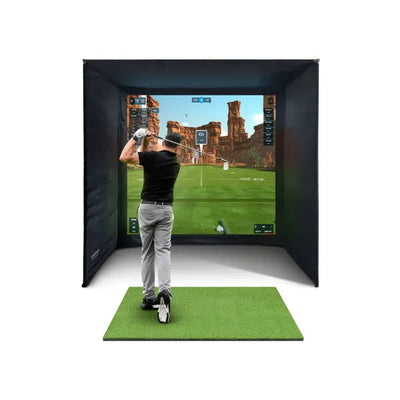
The best family-tech purchase I know is not a console, a trampoline or a hot tub. It is a golf simulator — and I say that having set several up for households where only one person actually played golf on the day it arrived. Six months later, the picture is usually different: kids running closest-to-the-pin ladders after school, a partner who “doesn’t play golf” quietly grooving a nine-iron, grandparents taking on grandchildren at par-3 courses in the rain. This guide covers what actually matters when the simulator is for the whole family: kids’ setup practicalities, the safety rules that make it work, the games that hook non-golfers, and the one buying check mixed-handed households must make.
Why a simulator beats a console for family money
A games console and a golf simulator compete for the same corner of the family budget and the same evening hours, so it is a fair comparison. The console wins on price. The simulator wins on almost everything else: every hour on it is physical — a kid who plays nine holes swings a club well over a hundred times including practice swings — it is genuinely multigenerational in a way few games are, and it builds a real-world skill that transfers straight to the course, the range and PE lessons. Screen time is the modern parenting battleground; a simulator is the rare screen the whole household feels good about. And unlike the console, it never gets outgrown — the same bay serves a seven-year-old’s first swings and a parent’s serious practice. The Golf Foundation, the charity that gets juniors into golf in the UK, is built on exactly this insight: make golf accessible and playful early, and it sticks for life.
Setting the bay up for kids: the practicalities
A few adjustments make the difference between kids who love the sim and kids who try it twice.
Lighter clubs, always
Junior clubs are shorter and much lighter, and they matter more indoors than at the range because the temptation is to hand a child a cut-down adult club that happens to be nearby. Proper junior clubs let kids actually swing rather than heave, and a heaved club in an indoor bay is a control problem. A basic junior set covers years of growth.
Tee everything up
At the range you would teach ball-first contact off the turf. On a simulator mat, tee everything up for kids — irons included. Mats are firm, and a fatted iron shot that the mat refuses to absorb sends a jolt up small arms and wrists. Teed-up strikes keep contact fun, and the technique refinement can come later. For the same reason, keep young kids’ sessions short: twenty to thirty minutes of swinging is plenty before quality and enthusiasm both dip.
One swinger, one line
The single non-negotiable rule in any family bay: one swinger at a time, and everyone else behind a marked waiting line. Put a strip of bright gaffer tape on the floor a couple of metres behind the hitting position and make it law from day one — nobody crosses it while a club is moving, and the club gets put down between turns. We found with our own customers that the families who tape the line on day one never have a scare, and the ones who rely on “stand back a bit” eventually do. A swinging club is the one genuine hazard in the room; a piece of tape and a house rule removes it.
The games that hook non-golfers
Nobody ever converted a reluctant ten-year-old with a driving-range session. Games did. Almost every simulator package ships with game modes beyond the serious golf, and they are the family gateway.
| Game format | Best for | Why it hooks |
|---|---|---|
| Closest-to-the-pin ladder | Any age, 2–6 players | One shot each, instant ranking, infinitely repeatable — the family leaderboard writes itself |
| Demolition-style mini-games | Kids especially | Smashing on-screen targets is pure arcade fun; they are grooving a swing without noticing |
| Longest drive (with handicap multipliers) | Mixed abilities | Give juniors a distance multiplier and dad’s driver advantage evaporates — genuine jeopardy for everyone |
| Team scramble, 9 holes | Family v family, guests | Weak shots do not count, so beginners contribute without pressure |
| Par-3 course night | School-night golf | Nine short holes fits inside an hour, everyone holes out |
The pattern behind all of these: short turns, visible scores, and formats where a beginner can beat a golfer. Closest-to-the-pin is the one I recommend every family starts with — a customer in Kent told me their weeknight ladder had become such an institution that the kids’ friends were coming round to play it, and the golf-club member of the house was no longer the family number one. That is the sign it has worked.
The mixed-handedness check before you buy
Here is the buying detail families discover too late: if your household has both left- and right-handed players, check how the launch monitor you are considering handles handedness switching before you buy. Some units switch between a righty and a lefty essentially instantly; others need a settings change, a repositioning, or a moment of recalibration between players. None of that matters to a solo golfer. It matters enormously on family game night, when players alternate shot by shot and a clunky switch turns a fast ladder game into a queue. I will not pin behaviours on specific models here because software updates change them — ask us on WhatsApp about the current state of whichever unit you are eyeing, or compare options in our launch monitor collection. It is the single most common regret I hear from mixed-handed households, and the easiest to avoid.
Screen time that is actually physical
It is worth dwelling on the health angle, because it is the argument that wins over the sceptical parent. An hour on a simulator is an hour of repeated athletic movement — rotation, balance, coordination — dressed up as a video game. For kids it builds swing speed and movement skills at the age they are most trainable; for adults it is a genuine reason to move on a dark January evening. Compare the physical content of an hour of console play and an hour of sim play and there is no contest. The trick, as with all of this, is that nobody in the room experiences it as exercise.
When a garden cage is the better family buy
Honesty section: a simulator is not always the right first purchase for a family, and I talk people from one to the other every week. If the primary goal is kids burning energy hitting balls — rather than scores, courses and games on a screen — a garden practice cage delivers that for a fraction of the money, outdoors, with zero setup per session and no handedness question at all. Our Pro Golf Cage & Hitting Mat Bundle (from £1,284.98 for the 3m cage-and-mat setup) is the buy-once version: 42mm galvanised steel, a driver-rated double net, tour-density mat, built in an evening and left up all year. Plenty of families run the two in sequence — cage first while the kids are small, simulator later when scores start to matter. And if the budget stretches to the full indoor setup now, the FlightScope Mevo Gen 2 sim bundle (from £2,498, enclosure, screen and mat included) is where I point most families first: proven kit, game modes included, and a bay the whole household can share safely.
ONE BAY, THE WHOLE FAMILY
The Mevo Gen 2 home simulator bundle — launch monitor, enclosure, impact screen and mat from £2,498 — is the family setup we recommend most: game modes for the kids, serious practice for the golfer, one safe bay for everyone.
See the Mevo Gen 2 sim bundle →Frequently asked questions
Is a golf simulator suitable for kids?
Very — with three adjustments: proper junior clubs rather than cut-down adult ones, everything teed up so firm mats never jar small wrists, and sessions kept to twenty or thirty minutes. Add a one-swinger-at-a-time rule with a taped waiting line and it is one of the safest ways a child can hit full shots.
What are the best golf simulator games for non-golfers?
Closest-to-the-pin ladders, demolition-style target games and team scrambles. The common thread is short turns, visible scores and formats where beginners can genuinely beat experienced golfers — longest-drive with handicap multipliers is the great leveller.
Do golf simulators work for left- and right-handed players together?
Yes, but how smoothly varies by launch monitor: some switch handedness near-instantly, others need settings changes between players. If your household has both, make switching speed a buying criterion — it is what keeps alternating family games flowing.
Should a family buy a golf simulator or a garden golf cage?
If the goal is screen golf — courses, games, scores — buy the simulator. If it is mainly kids hitting balls and burning energy, a garden cage does the job outdoors for far less money, and a simulator can follow later when scores start to matter.

Free Home Golf Simulator Design Consultation
Not sure on space, screen or launch monitor? Chat directly with Tom, OpenGolfer’s founder — he has designed hundreds of home setups and will tell you exactly what fits your room and budget.
- Send your room size (or a photo) — get a tailored layout and spec for your space, ceiling height included
- Personal replies from a real golfer, not a call centre
- Honest advice on what to buy — and what not to
Usually replies within the hour, 8am–8pm · prefer to talk? 02033 768500


Leave a comment