
Garden Golf Practice Without Annoying the Neighbours: UK Guide

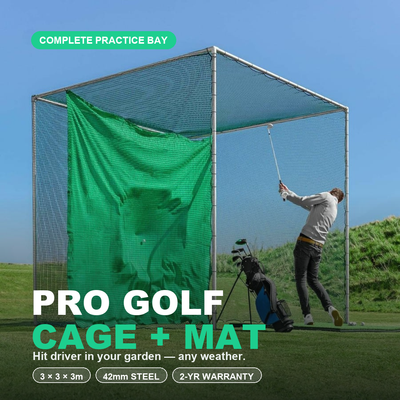
A golf net in the garden is one of the best purchases a UK golfer can make, and it is also one of the quickest ways to fall out with the people next door if you get it wrong. I sell and install garden practice equipment for a living, and the pattern is always the same: the golfers who think about noise, stray balls and sightlines before they start swinging never hear a word of complaint. The ones who drag a cheap net onto the lawn and start hammering drivers at 7am on a Sunday tend to get a knock on the door within a fortnight. This guide covers everything I have learned about practising in a British garden without becoming the neighbourhood problem: what actually annoys people, how to contain every ball you hit, and where you stand legally if a dispute does flare up.
What actually annoys neighbours about garden golf
Looking for a ready-made setup? Our Pro Golf Cage & Hitting Mat Bundle (3m × 3m × 3m) covers exactly this — available cage-only or with a professional hitting mat.
It is rarely the golf itself. In my experience there are three specific triggers, and if you deal with all three you can practise daily for years without friction.
First, impact noise. The strike of a driver on a golf ball is a sharp, percussive crack that carries much further than conversation or a lawnmower. It is the repetitiveness that grates: one crack every forty seconds, for an hour, is exactly the sort of intermittent noise that human brains refuse to tune out.
Second, stray balls. A single ball over the fence is an apology and a laugh. A second one is a pattern. A ball that hits a greenhouse, a car or a child's trampoline is a genuine incident, and you will not get the benefit of the doubt afterwards. This is the one trigger that can turn a friendly relationship sour permanently, because it is about safety rather than annoyance.
Third, visual intrusion. A three-metre-tall black cage looming over a shared fence changes the feel of next door's garden, particularly in small terraced plots. People are often too polite to mention it, but it feeds resentment that surfaces the first time a ball thuds into the netting near their patio.
The noise problem: impact sound and timing
A driver strike into a net is loud at the point of impact but drops away quickly with distance, so a single shot heard from a neighbour's patio is not intrusive. The problem is repetition and timing.
When you practise matters more than how loud you are
Councils and mediation services consistently treat early morning and late evening noise as the most serious category, and your neighbours will too. My rule of thumb, which I give to every customer who buys a garden golf cage, is simple: full-speed sessions between 9am and 8pm on weekdays, 10am to 8pm on weekends and bank holidays. Outside those windows, stick to chipping with foam balls, which is close to silent.
Making each shot quieter
You cannot silence a driver strike, but you can take the edge off it in three ways:
- Use a quality mat with a rubber base. Thin mats laid on patio slabs produce a secondary slap that adds to the strike noise. A dense mat like the Forza driving range mat with rubber base absorbs the club-to-ground contact almost completely. We tested this side by side and the difference on iron shots was obvious even standing next to the mat.
- Keep the net taut. A slack net lets the ball snap the netting like a whip. Properly tensioned netting catches the ball with a dull thud instead. This is one reason I steer people towards framed cages rather than loose nets pegged to bamboo canes.
- Mix in foam and airflow balls. For short-game work and for any session outside sociable hours, foam balls remove the strike crack entirely. You lose ball-flight feedback, but for tempo and contact drills they are excellent.

Stray balls: containment that actually works
This is the part I refuse to let customers compromise on. A mishit driver leaves the face at well over 100mph, and a garden fence will not stop it. Toe strikes and shanks come off the club at angles that surprise every golfer the first time they see them measured: a shank can travel almost 45 degrees right of your target line. Whatever containment you choose has to account for your worst strike, not your average one.
Your three containment options
There is a full breakdown in my golf cage vs golf net guide, but here is the short version as it relates to neighbourly practice:
| Option | Rough cost | Stray-ball protection | Best for |
|---|---|---|---|
| Pop-up net (e.g. Forza ProFlex) | Around £150 to £300 | Good in front, poor to the sides | Occasional practice, packed away between sessions |
| Framed cage (e.g. Forza 3m x 3m x 3m cage) | Around £500 to £900 | Excellent: enclosed top and sides | Daily practice with every club in the bag |
| Cage plus baffle netting | Cage cost plus £50 to £150 | Near total | Small gardens with close neighbours, driver practice |
A pop-up net is fine if you position it well and stick to controlled swings, but the open sides mean a genuine shank can still escape. A fully enclosed cage with a roof panel and side walls catches essentially everything, which is why I consider a proper cage the default choice for anyone practising within ball-flight distance of another property. The setup process is straightforward and I have covered it step by step in my guide to setting up a golf cage in your garden.
Baffle netting: the cheap insurance nobody regrets
Baffle netting is a secondary curtain of netting hung loosely inside or beside the cage opening. Because it hangs slack, it kills ball speed instantly rather than trampolining the ball back out. In a narrow garden with a neighbour's conservatory close by, a baffle panel down the fence side is what keeps stray balls in the cage. For the cost involved, it is the best value safety upgrade in this whole category. Browse the golf nets collection for panel netting you can repurpose as baffles.
Sightlines, fences and the looming-cage problem
A 3m cage is taller than nearly every garden fence in Britain, so it will be visible from next door. You cannot hide it, but you can soften it considerably:
- Position it against your own house or garage wall rather than along the shared boundary. The building becomes the backdrop and the cage barely registers.
- Choose black netting. Black reads as transparent against sky and foliage; green and white netting are far more visible than people expect.
- Leave a planting gap. Even 60cm between the cage and the fence, with a couple of climbers or bamboo in between, changes it from an industrial structure to part of the garden.
- Take pop-ups down between sessions. If you have gone the ProFlex route, the fold-away design is the whole point: five minutes and the garden is a garden again.
The single thing that keeps most neighbours on side is mentioning the cage before it goes up and inviting them round to see the first session. Fifteen minutes of conversation buys years of goodwill. I recommend that conversation to everyone.
Where you stand legally: UK nuisance law basics
Garden golf practice is entirely legal, and there are no specific laws restricting it. The two areas that can bite you are noise nuisance and property damage.
On noise, councils have a duty to investigate complaints about noise that could be a statutory nuisance under the Environmental Protection Act 1990. For noise to qualify it generally has to be a persistent, unreasonable interference with the enjoyment of a neighbour's home, judged on timing, frequency and duration. An hour of afternoon practice will never come close; daily 6.30am driver sessions conceivably could. In practice, councils resolve the overwhelming majority of these cases with an informal letter long before any abatement notice, and golfers who follow sociable hours simply never appear in the system.
On stray balls, you are responsible for damage your practice causes. If your ball breaks a greenhouse pane, that is on you, and repeated escapes despite complaints could in principle amount to a private nuisance claim. The practical answer is containment good enough that the question never arises. If a dispute does develop, Citizens Advice's guidance on neighbour disputes sets out the sensible escalation path: talk first, write second, mediate third, and treat the council or courts as a last resort.
My courteous-practice checklist
This is the checklist I share with customers. It has kept the peace in gardens far smaller than most people would think workable:
- Mention the setup to adjoining neighbours before it goes up, not after.
- Keep full-speed sessions between 9am and 8pm, and later starts on weekends.
- Use an enclosed cage, not an open net, if another property is within 30 metres of your hitting position.
- Add baffle netting on any side facing a neighbour's garden.
- Hit off a rubber-based mat to cut secondary noise.
- Switch to foam balls for early, late or marathon sessions.
- Aim away from the shared boundary wherever the garden allows.
- Inspect netting monthly; worn netting is how escapes happen.
- If a ball ever does escape, knock on the door the same day.
Frequently asked questions
Can my neighbour stop me practising golf in my garden?
Not in normal circumstances. There is no law against garden golf practice, and a neighbour would need to establish a statutory or private nuisance, which requires persistent, unreasonable interference. Reasonable daytime practice with proper containment does not come close to that threshold. Persistent stray balls causing damage are a different matter, which is why containment is the priority.
What time is it acceptable to start hitting balls in the morning?
There is no legal cut-off for daytime noise, but 9am on weekdays and 10am on weekends is the convention I recommend, and it mirrors the guidance most councils give for DIY and garden machinery. Before that, chip foam balls if you must practise.
Is a net or a cage better if I have close neighbours?
A cage, without question. An open-fronted net relies on you never hitting a bad shank, which is optimistic. A fully enclosed cage with roof and side panels contains your worst strike, not just your best one, and that is the standard that keeps neighbour relationships intact.
Do I need planning permission for a garden golf cage?
Almost never. A free-standing cage is a temporary structure rather than a building, so planning rules on outbuildings do not apply in the way they would to a shed or garden room. The exceptions are listed properties and some covenanted estates, so check your deeds if you are unsure.
⛳ Free resource: the 90-Day Golf Cage Practice Programme
A cage stops your golf balls — a plan lowers your scores. The free interactive golf cage practice programme gives you 39 structured 25-minute sessions, a 24-drill library, and progress scorecards you can track online — built around the Pro Golf Cage & Hitting Mat Bundle and open to every garden golfer.
Free email series: Dream Home Golf Cage Setup
Six short emails from Tom on the five decisions behind a brilliant garden practice space.
📏 Free tool: the Garden Golf Cage Planner
Planning a garden golf cage? The free Garden Golf Cage Planner answers the space, base, netting and cost questions in one place — including the Will-It-Fit calculator: enter your garden size and see which cages fit. No sign-up.

Free Home Golf Cage Setup Design Consultation
Not sure on size, base or mat? Chat directly with Tom, OpenGolfer’s founder — he practises from his own garden cage most days and has designed hundreds of home setups.
- Send a photo of your garden with rough measurements — get a tailored layout and spec for your space
- Personal replies from a real golfer, not a call centre
- Honest advice on what to buy — and what not to
Usually replies within the hour, 8am–8pm · prefer to talk? 02033 768500


Leave a comment