
Home Driving Range vs Driving Range Membership: The True 3-Year Cost (UK)

Every week someone asks me some version of the same question on WhatsApp: “Is a garden cage actually worth it, or should I just keep going to the range?” It’s a fair question, because a home driving range is a four-figure purchase and a bucket of balls is less than a tenner. But the tenner keeps happening, and the cage doesn’t. This article does the maths properly — per session, per year, over three years — and then covers the things money doesn’t measure, because they matter just as much.

What a driving range trip really costs
The ball price is the visible bit. At most UK ranges you’ll pay somewhere between £6 and £10 for 50–100 balls, with premium tech-bay venues charging more per hour. But the bucket is rarely the whole bill:
- Fuel and parking. Most golfers I speak to drive 10–25 minutes each way. Call it £2–£4 in fuel per trip for a typical round trip, more if your nearest range is a proper drive.
- The second bucket. Nobody warms up, finds a swing feel on ball 40, and stops. The £7 session quietly becomes £12.
- Time. A “quick range session” is realistically 75–90 minutes door to door once you’ve driven, queued for a bay and driven home. For a working parent, that’s the whole evening window.
Put together, a realistic all-in figure is £9–£14 per visit. Go twice a week and you’re spending roughly £1,000–£1,500 a year on practice — and that’s before a coffee, a bacon roll or the range’s membership scheme, which reduces the per-ball price but adds a standing charge. Golf participation in the UK has stayed strong since the post-2020 boom — England Golf, the governing body for amateur golf in England, tracks participation and club membership trends — so ranges are busy, and busy ranges have little pressure to get cheaper.
What a home driving range costs
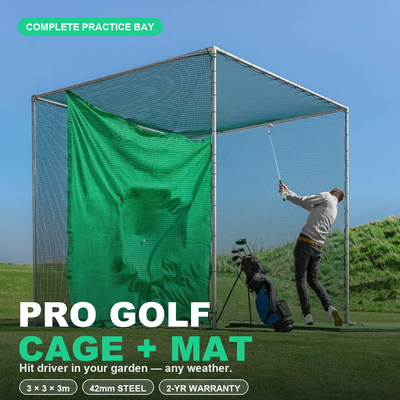
The setup I install and recommend most is the Pro Golf Cage & Hitting Mat Bundle: a 42mm galvanised steel cage with a driver-rated double net (weatherproof outer plus an archery-grade impact panel), a tour-density mat, and U-peg anchors so there’s no concrete involved. The 3m × 3m × 3m cage-and-mat configuration starts at £1,284.98, finance from around £110 a month, and it goes up in 60–90 minutes with two people. It carries a 2-year warranty and 30-day returns.
Running costs after that are close to zero. A dozen decent practice balls last months because the cage catches everything. There’s no fuel, no bay queue, no closing time. The one genuinely optional extra is a launch monitor — something like the FlightScope Mevo Gen 2 gives you carry numbers and clubhead data inside the cage — but you don’t need it on day one, and most of our customers add one later once the hitting habit is established.
The 3-year table: casual, regular, obsessive
Here’s the comparison I talk people through, using honest mid-range numbers: £11 all-in per range trip (balls plus fuel), 48 practice weeks a year, and the £1,284.98 cage-and-mat bundle with effectively nil running costs.
| Practice habit | Range: per year | Range: 3 years | Home cage: 3 years | Cage breakeven |
|---|---|---|---|---|
| Casual — 1 session/week | ~£530 | ~£1,590 | £1,284.98 | ~29 months |
| Regular — 2–3 sessions/week | £1,000–£1,500 | £3,000–£4,500 | £1,284.98 | 12–18 months |
| Obsessive — 4+ sessions/week | £2,000+ | £6,000+ | £1,284.98 | Under 12 months |
Three honest observations about that table. First, the casual golfer’s breakeven is long enough that the range is a perfectly rational choice on money alone — if once a week is genuinely your ceiling, keep buying buckets. Second, the regular golfer — the person this article is really for — breaks even in 12–18 months and then practises free for as long as the cage stands, which for a galvanised steel frame with UV-treated netting is many years of British weather. Third, the table understates the cage’s case in one important way: home practice sessions multiply. When the cage is ten steps from the back door, two planned sessions a week quietly become five short ones, because a 15-minute session is suddenly a thing that exists.
What the range gives you that a cage can’t
I sell cages, so let me argue the other side properly, because it’s real:
- Full ball flight. The range shows you the entire arc of the shot — the start line, the curve, the apex. A cage catches the ball three metres after impact. A launch monitor recovers the numbers, but watching a ball fall out of the sky is its own feedback and its own pleasure.
- Long targets. Distance control to a flag at 140 yards is easier to train when you can see a flag at 140 yards.
- The social bit. Range trips with a mate, a lesson bay with a pro next door, the low-stakes chat. Golf is a social game and a garden cage is a solitary one unless you make it otherwise.
What the cage gives you that the range can’t
- Zero friction. No drive, no bay queue, no closing time, no rain-check. The distance between “I should practise” and hitting a ball is about 40 seconds.
- The 15-minute session. This is the one that changes handicaps. Nobody drives 20 minutes each way for a 15-minute session, so range practice only happens in big, infrequent blocks. Cage practice happens in small, frequent ones — before work, after the school run, while dinner’s in the oven — and frequency is what builds a motor skill.
- The kids join in. I hear this constantly. A customer in Harrogate told me after six weeks that his two boys had claimed more cage time than he had — he counted it as the best part of the purchase, not a downside.
- Your ball, your mat, your pace. No worn range mats, no limited-flight range balls, no bloke in the next bay filming his driver swing over your shoulder.
The real answer: volume beats venue
Here’s the thing the cost table can’t show. The golfers who improve are not the ones who practise in the best facility; they’re the ones who practise the most, with some structure. Venue is secondary to volume and quality. What we found across our own customers is that the cage’s biggest effect isn’t saving money — it’s that practice actually happens. The sessions that were always going to get rained off, or lost to traffic, or skipped because the evening got away from you, happen anyway.
That’s also why every Pro Cage ships with access to our free 90-day practice programme in the Practice Lab. A cage without a plan becomes a place to slap drivers; the programme structures short, frequent sessions so the convenience turns into lower scores rather than just more ball-striking. If you keep your range habit for ball-flight days and use the cage for the frequent technical work, you’ve got the best of both — and you’ll notice the range buckets you do buy start going further.
Before you decide: will it fit?
The standard cage footprint is 3m wide × 3m tall × 3m deep, and you need roughly 4m of usable garden depth once you account for where you actually stand. That fits far more UK gardens than people assume — but check yours properly before you spend anything. Our free Garden Golf Cage Planner has a Will-It-Fit calculator: put in your garden dimensions and it tells you honestly, in seconds, which cage formats work in your space. If the answer is none, that’s your answer — keep the range membership and spend nothing.
Frequently asked questions
How much does a driving range cost in the UK?
Typically £6–£10 for 50–100 balls, with tech-bay venues charging more per hour. Add fuel and the habitual second bucket and a realistic all-in figure is £9–£14 per visit — roughly £1,000–£1,500 a year for a golfer going two to three times a week.
How much does a home driving range cost?
Our Pro Golf Cage & Hitting Mat Bundle — 42mm galvanised steel cage, driver-rated double net and tour-density mat — starts at £1,284.98 for the 3m × 3m × 3m configuration, with finance from about £110 a month. Running costs after that are near zero.
How long until a home cage pays for itself?
For a golfer practising two to three times a week, typically 12–18 months against range spending. Once-a-week golfers take closer to two and a half years; four-plus sessions a week breaks even inside a year.
Do I still need the range if I have a garden cage?
You don’t need it, but it stays useful. The cage can’t show you full ball flight or long-range distance control, so an occasional range or course session for ball-flight checking pairs well with frequent short cage sessions at home. A launch monitor in the cage narrows that gap considerably.
Ready to stop paying per bucket?
The Pro Golf Cage & Hitting Mat Bundle: 42mm galvanised steel, driver-rated double net, tour-density mat — from £1,284.98 with the free 90-day practice programme included.
Build your home driving range →
Free Home Golf Cage Setup Design Consultation
Not sure on size, base or mat? Chat directly with Tom, OpenGolfer’s founder — he practises from his own garden cage most days and has designed hundreds of home setups.
- Send a photo of your garden with rough measurements — get a tailored layout and spec for your space
- Personal replies from a real golfer, not a call centre
- Honest advice on what to buy — and what not to
Usually replies within the hour, 8am–8pm · prefer to talk? 02033 768500


Leave a comment