
Why Are Golf Cages 3m Tall? (And Can You Get a Lower One?)

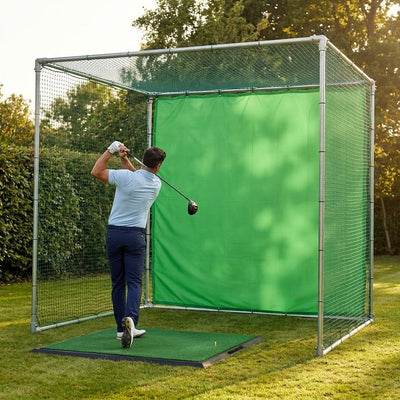
A few weeks ago a customer messaged me on WhatsApp with a very reasonable-sounding request: “Can I get the cage in 2.5m instead of 3m? Then the neighbours won’t see it over the hedge.” I understood exactly what he was after — and I told him straight: no, and I would not sell him one if I could. A 2.5m cage is a cage you cannot safely swing a driver in, which defeats the point of buying a cage at all. But his underlying problem — what the neighbours see — is real and solvable, and the solution is not a shorter cage. Here is the honest version of the conversation we had.

OUR #1 GARDEN CAGE, READY TO PLAY
The Pro Golf Cage & Hitting Mat Bundle pairs a galvanised 42mm steel cage with a driver-rated archery-grade impact panel and a tour-density mat — a buy-once, all-weather practice station for the UK garden. Best seller, includes the free 90-day practice programme.
See the 3m Pro Golf Cage Bundle →Why every serious golf cage is 3m tall
It comes down to the geometry of a driver swing. Under the R&A’s equipment rules, drivers can legally run to 46 inches (nearly 1.2m) of shaft, and most off-the-shelf drivers are around 45.5 inches. Put that club in the hands of an average-height adult and the clubhead passes well above head height twice every swing — at the top of the backswing and again through the follow-through. For a six-footer that arc peaks comfortably above 2.5m. Add the fact that a roof net is not a rigid ceiling — it sags slightly between the poles, especially when it is wet or carrying leaves — and the effective clearance of a 2.5m cage is lower than 2.5m on paper.
3m is not a marketing number. It is the height at which a tall golfer can swing a full-length driver flat out, in the middle of the bay, without ever thinking about the roof. That last part matters more than people realise.
So can you get a 2.5m golf cage? The honest answer
Not from us, and I would be wary of anyone selling one for full swings. Three things go wrong at 2.5m. First, the obvious one: catch the roof net with your driver mid-swing and you can damage the net, deflect the clubhead, or hurt yourself — a wet, sagging net makes this more likely, not less. Second, the sneaky one: even if you never actually touch the roof, you know it is there. I have watched golfers in low-ceilinged bays start shortening and steering their swings within ten balls. A practice cage that quietly teaches you a defensive swing is worse than no cage. Third, it does not even solve the sightline problem well — 2.5m still shows over a standard 1.8m fence.
If you only ever chip and pitch, a low net is fine and cheaper — our cage vs net guide covers that honestly. But if driver is part of the plan, the answer is 3m, full stop.
What your neighbours actually see — and how to change it
Here is the part of the WhatsApp conversation that actually helped. You cannot change the cage’s height, but you absolutely can change its effective height — the height the ridge sits at relative to your hedge line — because the base you put it on moves the whole structure up or down.
| Base option | Effective ridge height | Sightline verdict |
|---|---|---|
| Raised timber platform | ~3.2–3.3m (platform adds 20–30cm) | Worst for sightlines — lifts the whole cage above the hedge you were trying to hide behind |
| Grass + U-pegs | True 3m | Neutral — the honest baseline |
| Sunken base (dug-out MOT + turf) | Slightly under 3m — the dig-out drops the whole cage below lawn level | Best — the lowest possible ridge line, and it looks designed-in |
That difference is bigger than it reads. Platform versus sunken is up to 40cm of ridge height — the difference between a cage that peeks over a 3m hedge and one that does not. This exact trade-off came up in that WhatsApp thread: a platform against sightlines. If you are choosing a base anyway, choose it with the hedge in mind.
Three more sightline tricks that cost nothing
Position the cage behind the tallest run of hedge, not the thinnest — ten minutes with a ladder and a phone camera from next door’s side of the fence (ask first, obviously) tells you exactly what they will see. Pull the cage further from the boundary if you can: sight angles mean every metre away from the fence hides more of it behind the hedge from a neighbour’s ground-floor window. And the black knotless netting itself disappears against foliage surprisingly well — it is the frame poles that catch the eye, and they are slim. The wider etiquette side — noise, timing, the friendly conversation before the cage goes up — is covered in our practising without annoying the neighbours guide.
The one siting mistake nobody warns you about: trees
While we are on height — look up before you site the cage. An overhanging tree drops everything it has onto your roof net: leaves, twigs, seed pods, sap, and the occasional dead branch. Wet leaves add real weight, make the roof sag, and stain the netting; a winter’s worth left up there shortens the net’s life. A cage under a neighbour’s overhanging tree is workable if you brush the roof net with a soft broom every couple of weeks in autumn — but shifting it 2m along the fence line, clear of the canopy, removes the chore entirely. If you have a choice, site clear of the canopy. If you do not, budget for the fortnightly brush and check the roof after storms. Full siting checks — ground, levels, access — are in the step-by-step setup guide.
Does height affect planning permission?
A quick word on the other reason people ask for a lower cage: planning nerves. In the vast majority of UK gardens a netted practice cage is treated as a temporary, removable garden structure rather than a building — there is no concrete, no roof in the planning sense, and it lifts out the way it went in. I did not need permission for mine. The usual caveats apply: this is general guidance rather than legal advice, and if you live in a conservation area, a listed property or a flat with shared grounds, check with your local authority first. What I would say firmly is this: do not buy a dangerous 2.5m cage as planning insurance — height is not the thing that decides the question.
What I told him in the end
My advice was the full-height cage on a sunken base, tucked behind the tallest section of the hedge. The neighbours then see a few centimetres of black netting ridge, which against the sky reads as nothing at all — and you can swing a driver flat out without a thought for the roof. That is the trade you want: solve the sightline with the base and the siting, never with the height. Before you order, check the footprint works for your garden too — the honest space numbers are in our cage size guide — and if you are unsure, send me a photo of your hedge line on WhatsApp and I will tell you exactly how it will sit.
Frequently asked questions
Can I buy a 2.5m golf cage for my garden?
Not for full swings, and I would avoid any that claim it. A 45.5-inch driver in adult hands arcs above 2.5m at the top of the backswing and through the follow-through, and roof nets sag below their nominal height. 2.5m is fine for chipping nets only.
Is a 3m golf cage tall enough for a driver?
Yes — 3m clears a full-length driver swing for tall golfers with margin to spare, which is exactly why it is the standard. You swing freely in the middle of the bay without adjusting anything.
How do I stop neighbours seeing my golf cage over the hedge?
Change its effective height, not its actual height: a sunken base drops the ridge below 3m while a raised platform lifts it 20–30cm higher. Then site it behind the tallest hedge run and as far off the boundary as your space allows.
Can I put a golf cage under a tree?
You can, but the roof net becomes a debris tray — leaves, twigs and sap add weight, sag and staining. Site clear of the canopy if possible; otherwise brush the roof net fortnightly in autumn and check it after storms.
Full height, full swing, no compromises
The heavy-duty 3×3×3m garden golf cage bundle — galvanised 42mm steel, archery-grade impact panel, weatherproof knotless netting — from around £735. Pair it with a sunken base and it sits as low as a 3m cage possibly can.
Shop the Pro Golf Cage Bundle →
Free Home Golf Cage Setup Design Consultation
Not sure on size, base or mat? Chat directly with one of our experts — real golfers who practise from their own garden cage most days and has designed hundreds of home setups.
- Send a photo of your garden with rough measurements — get a tailored layout and spec for your space
- Personal replies from a real golfer, not a call centre
- Honest advice on what to buy — and what not to
Usually replies within the hour, 6am–10pm · prefer to talk? 02033 768500


Leave a comment