
Best Launch Monitor for a Home Simulator: R50 vs Mevo Gen 2 vs GC3S

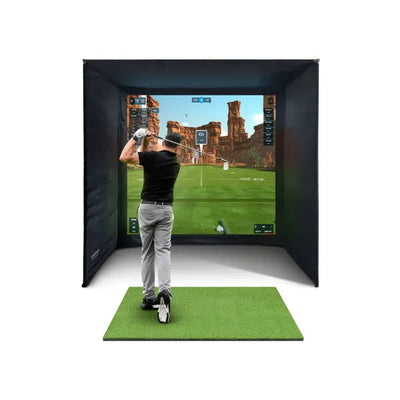
When someone asks me for the best launch monitor for a home simulator, my first answer is always a question: how much room have you got behind the ball? Because in 2026 the UK market has settled into three genuinely excellent options at three price points, the FlightScope Mevo Gen 2 at £1,199, the Foresight GC3S at £3,990 and the Garmin R50 at £4,299, and the right one for you is decided less by spec-sheet bravado than by your room dimensions, your software plans and whether you want a computer in your life. I sell and install all three, so this comparison has no horse in the race beyond you not messaging me in six months to swap one.

The fundamental split: radar behind you, cameras in front
The Mevo Gen 2 is radar. It sits about 2.4m behind the ball, watches the flight and computes your numbers from what it tracks. FlightScope has been building radar for professional golf for decades, and the Gen 2 is that pedigree at a consumer price. Radar’s strength is tracking real flight, which makes it superb outdoors; its cost is space, because the unit-behind-ball requirement adds ~2.4m to your room length, and that is precisely the length many UK garages do not have.
The GC3S and R50 are photometric: cameras photographing the ball at impact from in front of or beside it. The Foresight GC3S sits roughly 60cm in front of the ball; the R50 uses a triple camera array from a floor position in front of the ball too. Cameras measure launch directly rather than modelling from flight, which is exactly the advantage you want indoors, where the ball flies three metres into a screen and radar has the least to work with. Cameras also shrink the room requirement, which for a lot of readers quietly ends the comparison before the data debate starts.
What each one is actually like to live with
FlightScope Mevo Gen 2, £1,199
The value pick, and not grudgingly: the Mevo Gen 2 produces simulator-credible data at less than a third of the price of the other two, and it is the unit I recommend most often to golfers building their first proper sim on a sensible budget. It wants its space behind the ball, it wants decent alignment, and as a single-sided radar it needs repositioning when a left-hander steps in, so mixed-handedness households should think twice. One FlightScope-specific warning I give every buyer: the simulation software is non-refundable once activated, so choose your software package deliberately before you activate anything. As a complete room, the Mevo Gen 2 Full Package from £4,099 is the cheapest route to a genuine enclosure-screen-projector simulator that we sell.
Foresight GC3S, £3,990
The measurement benchmark of this trio. Foresight’s camera technology is what a large share of professional fitting studios run, and the GC3S brings that photometric approach to a home price. It is compact in front of the ball, unbothered by short rooms, and the natural heart of a PC-based build running serious software. Its honest catch is that it is a data device, not a self-contained simulator: you will need a computer to get the experience the unit deserves, so budget for one (our sim-spec laptop at £1,595 is the known-good pairing) or choose the GC3S Full Package from £6,799, which delivers the complete camera-based room as one matched order and still comes in £300 under the equivalent R50 package.
Garmin R50, £4,299
The all-in-one. Triple camera measurement plus a built-in 10” touchscreen running Garmin’s Home Tee Hero simulation on the device itself, so it is the only unit here that is a complete simulator with no computer, no phone and no projector. It handles left- and right-handers without repositioning, fits short rooms like the GC3S does, and for third-party software such as GSPro or E6 it connects to a PC like the others. After 8 weeks of running one alongside the GC3S, my summary is that you are paying the extra for integration rather than for a measurement leap: the R50’s numbers earn their place in this class, and the touchscreen is what separates the ownership experience. The R50 Full Package from £7,099 is the top-end complete room of the three.
The three-way table
| Mevo Gen 2 | GC3S | Garmin R50 | |
|---|---|---|---|
| Price | £1,199 | £3,990 | £4,299 |
| Technology | Radar | Camera | Camera (triple array) |
| Position | ~2.4m behind ball | ~60cm in front of ball | In front of ball |
| Short-room friendly | No | Yes | Yes |
| Sim with no PC | No | No | Yes, built-in touchscreen |
| Left + right handers | Reposition | Handles both | No repositioning |
| Full package price | from £4,099 | from £6,799 | from £7,099 |
| Buy it for | Value, outdoor + sim mix | Measurement pedigree per pound | One-box convenience |
Software ecosystems: the decision hiding inside the decision
Hardware gets the headlines, but the software ecosystem is what you interact with every session. FlightScope runs its own simulation packages, with the non-refundable-once-activated caveat above. Foresight pairs with its own software and is a first-class citizen in the third-party world serious sim golfers gravitate to. Garmin gives you Home Tee Hero on the device, which is the only zero-extra-cost, zero-extra-hardware simulation in this comparison, plus PC connectivity for the third-party route. My practical advice: decide what a normal Tuesday-night session looks like for you. If it is “walk in, hit balls, see a course, walk out”, the R50’s on-device sim wins the Tuesday test. If it is a full GSPro round on a projector with mates, all three end up PC-connected and the hardware differences (space, handedness, measurement approach) should drive the choice instead. Our wider launch monitor comparison guide covers the field beyond these three if none of them lands.
My recommendations by buyer
For the value-first builder with a room long enough for radar: the Mevo Gen 2, and it is not close at the price. The £2,791 you keep versus a GC3S buys the entire rest of a simulator. For the data purist with a PC or PC budget, or anyone building a fitting-grade practice room: the GC3S. It is the most measurement per pound in our range, and a GC3S with our sim-spec laptop still costs less than the R50 bare unit paired with that same laptop. For the golfer who wants a simulator rather than a technology project, for short rooms, and for mixed left- and right-handed households: the R50. A customer in Guildford who agonised between the GC3S and R50 for a fortnight put it well after choosing the Garmin: the GC3S was the better spreadsheet decision, the R50 was the one his family actually uses.
Whichever way you lean, the complete packages exist because a launch monitor alone is not a simulator: the enclosure, screen, projector and mat around it decide the experience as much as the unit does, and you can spread the cost of any of them at checkout with Klarna or Clearpay. The full lineup lives in our simulator bundles collection.
Two buying questions that outrank the spec sheet
Before you commit to any of the three, answer these honestly. First, who else will use it? A unit that suits you but frustrates your left-handed daughter or your mates on a Friday night gets used less than the spreadsheet predicted, and the repositioning question alone reshuffles this comparison for shared setups. Second, where will it live in two years? If the answer is a dedicated room, buy the unit that anchors that room and stage the rest; if the answer is honestly still the garden and the range, weight portability and battery life in your thinking and be suspicious of paying for room-based strengths you will rarely exercise. We found that buyers who answer these two questions first almost always land on a different unit than the one they walked in asking about, and they are the buyers who never come back to swap.
Frequently asked questions
What is the best launch monitor for a home simulator overall?
There is no single winner, which is why all three exist. The Mevo Gen 2 wins on value if your room has ~2.4m behind the ball, the GC3S wins on measurement pedigree per pound for PC-based builds, and the R50 wins on convenience as the only self-contained simulator of the three.
Is radar or camera better for indoor simulator use?
Cameras have the structural advantage indoors: they measure the ball at impact rather than modelling from a few metres of flight, and they sit in front of the ball so they fit shorter rooms. Radar remains excellent where flight and space exist, particularly outdoors.
Do any of these work without a computer?
Only the R50, which runs simulation on its built-in 10” touchscreen. The Mevo Gen 2 and GC3S both need a phone, tablet or PC for simulation, and all three want a proper PC for third-party software such as GSPro or E6 on a projector.
Which full package is the best value?
The Mevo Gen 2 package from £4,099 is the cheapest real simulator; the GC3S package from £6,799 brings Foresight’s camera measurement to a complete matched room; the R50 package from £7,099 is the premium all-in-one. All three pair the launch monitor with an enclosure, projector and hitting mat as one matched build.
The verdict
Measure your room, decide how much technology you want in your life, then let the price points sort themselves: £1,199 for the best value radar in the class, £3,990 for the strongest measurement per pound, £4,299 for the one that needs nothing else. All three are units I would happily own; only one of them fits your room, your household and your Tuesday night, and that is the best launch monitor for your home simulator.
Not sure which option fits your space or budget? Message Tom on WhatsApp for a free consultation — no obligation, real answers from someone who installs this kit weekly.

Free Home Golf Simulator Design Consultation
Not sure on space, screen or launch monitor? Chat directly with Tom, OpenGolfer’s founder — he has designed hundreds of home setups and will tell you exactly what fits your room and budget.
- Send your room size (or a photo) — get a tailored layout and spec for your space, ceiling height included
- Personal replies from a real golfer, not a call centre
- Honest advice on what to buy — and what not to
Usually replies within the hour, 8am–8pm · prefer to talk? 02033 768500


Leave a comment