
Garden Golf Cage Lighting: Practise on Winter Evenings (UK Guide)

In December, most of the UK loses daylight by around 4pm. If you work normal hours, that wipes out every weekday practice session from November to February — unless you light the cage. This is one of the highest-value upgrades a garden practice setup can get: for well under £100 in lights, you roughly double your usable practice hours across the year. I run floodlights on my own cage and hit balls happily at 9pm in January, and this guide covers everything I’ve learned: what you actually need to see, the LED specs translated into plain English, where to mount lights so you don’t stand in your own shadow, keeping the neighbours on side, the honest verdict on solar, and the safety rules that are not optional.
What you actually need to see (it’s less than you think)
The instinct is that night practice needs stadium lighting, because at the driving range you watch a ball fly 200 yards. In a cage you don’t. The net catches the ball three metres after impact, so ball flight is not something lighting has to solve. What you genuinely need to see is:
- The ball at address — clearly enough to set up and see the strike line, with no harsh shadow across the hitting area.
- Impact and the first metre of flight — enough to read start direction and contact quality.
- The netting and frame — you should always be able to see that the net is intact and where the cage boundaries are. Never hit into a net you can’t see.
That’s a 3m × 3m area lit to a decent working level — a garage-workshop job, not a sports-pitch one. Which is why the answer is cheap.
LED floodlight specs, in plain English
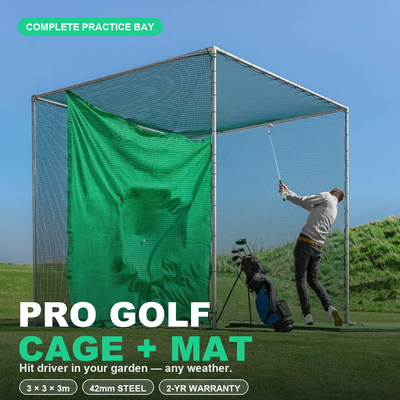
For a standard 3m × 3m × 3m cage like the Pro Golf Cage & Hitting Mat Bundle, here’s the shopping list decoded:
- Two 20–30W LED floodlights, giving roughly 4,000–6,000 lumens combined. That is genuinely plenty for a 3m cage; more just adds glare bouncing off the net. One light works but always casts a shadow somewhere; two lights from different angles cancel each other’s shadows.
- 4000K colour temperature (“neutral white”). Warmer 2700–3000K looks cosy but muddies the white ball against a dark mat; colder 6500K “daylight” feels harsh and glares more. 4000K is the comfortable middle where the ball pops.
- IP65 rating or better. The IP number is just weatherproofing: IP65 means dust-tight and protected against water jets, which is the sensible minimum for anything living outdoors in Britain year-round.
- A wide beam angle (100°+) so the light washes across the hitting area rather than spotlighting one patch.
Branded 20–30W IP65 floods cost roughly £15–£35 each, so the whole lighting project is typically £40–£80 plus mounting bits. There’s no need for anything exotic.
Your options compared
| Option | Typical cost | Install effort | Honest verdict |
|---|---|---|---|
| 2 × mains LED floods (20–30W) | £40–£80 + power run | Medium — mounting plus a safe power source | The right answer for regular winter practice. Bright, instant, permanent. |
| Rechargeable LED work lights | £30–£70 | None — charge indoors, carry out | The zero-install option. Great for renters or trying night practice before committing. You’ll be recharging after every 2–3 sessions. |
| Solar + battery floods | £20–£60 | Low | Honestly: fine for occasional short sessions only. A UK December day doesn’t deliver enough charge for long, regular evening sessions, and output drops exactly when you need it most. |
| Electrician-fitted outdoor socket + floods | £150–£300 + lights | One-off professional job | The gold standard if the cage is a permanent fixture — safest, tidiest, and adds a socket you’ll use for a launch monitor or heater anyway. |
Where to mount the lights (the shadow problem)
Position matters more than wattage. The one placement that ruins everything is a light directly behind the golfer: you cast your own shadow straight over the ball, and every address position becomes a guess. I made exactly this mistake on my first attempt — one flood on the house wall behind the hitting position — and after a week of putting my own silhouette over the ball I moved it and the problem vanished.
What works:
- Front corners, angled across the hitting area. Mount a flood on each front upright of the cage (or on posts/walls just outside them), aimed diagonally down and across the mat. The two beams cross over the ball, so neither your body nor the club casts a shadow on it.
- Mount high, aim down. Head-height or above — 2m+ on the cage uprights is ideal. Steep downward angles light the mat, not your eyes, and keep spill inside the garden.
- Keep lights out of the swing arc and the ball’s path. On a 3m-wide cage the front uprights are safely outside the strike zone, but check your alignment: no fitting should ever be somewhere a heeled or toed strike could reach.
Neighbours, glare and being a decent human
A 30W flood aimed carelessly will light up next door’s bedroom, and one grumpy conversation over the fence can end your night-practice plans faster than any technical problem. The fixes are easy: aim every light downward into your own garden and never near the horizontal; fit the slide-on glare shields or barn-door visors most floods accept; mount lights so the beam edge falls inside your boundary; and if you practise late, a light with a physical switch (rather than a PIR sensor that flicks on at every cat) keeps things civil. A quick word with the affected neighbour before winter starts goes a long way — several of our customers have done exactly that and had zero complaints since.
Getting power to the cage, safely
Three routes, in ascending order of permanence:
- Outdoor-rated extension lead from the house. Fine as a starting point if — and only if — the lead is genuinely outdoor-rated, the connections are IP-rated or kept under cover, and the socket indoors is RCD-protected. Fully unwind a reel before running floods off it, and bring the lead in after sessions rather than leaving it plugged in through storms.
- A proper outdoor socket installed by a qualified electrician. The right long-term answer for a permanent cage. Outdoor electrical installations in the UK fall under Part P of the Building Regulations, so this is a job for a registered electrician, not a weekend bodge. Expect an RCD-protected, IP-rated external socket; from there your cage lighting becomes plug-and-play.
- Battery and solar — covered above: rechargeable work lights are a genuinely good no-wiring option, solar floods are a fair-weather friend.
The safety rules that aren’t optional
Electricity outdoors in a wet UK garden deserves respect. The non-negotiables: every outdoor circuit or extension must be RCD-protected (a residual current device cuts the power in milliseconds if something goes wrong — it is the difference between a tripped switch and an electric shock); every connector that lives outside must be IP-rated or inside a proper weatherproof enclosure, never a taped-up indoor joint; and cables must be clipped up and routed completely clear of the swing, the ball’s path and the mowing line — a cable across the grass behind a golfer mid-swing is an accident on a timer. Electrical Safety First, the UK electrical-safety charity, has plain-English guidance on outdoor electrics and RCDs that’s worth ten minutes of your time before you plug anything in.
Launch monitors after dark
If your winter sessions include a launch monitor, the technology you own decides how much light you need. Radar units like the FlightScope Mevo Gen 2 track the ball by Doppler radar and don’t care about light levels at all — they work identically at midnight. Camera-based units photograph the ball, so they need the hitting area properly illuminated to pick it up reliably; the two-flood setup above generally provides enough, but keep the light even across the ball position specifically. If night practice is a big part of your plan and you haven’t bought a unit yet, that’s a point in radar’s favour.
Lighting is half the winter answer
The other half is the cage itself coping with the season — wind, sodden ground, wet netting. The Pro Cage’s galvanised 42mm steel frame and UV-treated netting are built to stand through a British winter, and I’ve covered the leave-it-up-or-take-it-down question properly in our golf cage winter care guide. And once the lights are up, use the hours well: the free 90-day practice programme in our Practice Lab is built around short, frequent sessions — exactly the 20-minute after-work windows that lighting unlocks. We found the customers who light their cages are the ones still practising in February, and the ones still practising in February are the ones who turn up in April with a swing that never went away.
Frequently asked questions
How many lumens do I need to light a golf cage?
Around 4,000–6,000 lumens total — two 20–30W LED floodlights — is plenty for a standard 3m × 3m × 3m cage. You’re lighting the ball, the strike and the net, not ball flight, so workshop-level light does the job.
Can you practise golf in the dark with a launch monitor?
With a radar unit like the FlightScope Mevo Gen 2, yes — radar doesn’t need light to track the ball. Camera-based units need the hitting area well illuminated, so pair them with proper floodlights.
Are solar floodlights good enough for a golf cage?
For occasional short sessions, yes. For regular winter evening practice, no — short, dull UK winter days don’t charge the battery enough for long sessions, precisely when you need them. Mains floods or rechargeable work lights are the dependable options.
Do I need an electrician for golf cage lighting?
Not to start — an outdoor-rated extension from an RCD-protected indoor socket, or rechargeable work lights, are both fine. For a permanent installation, an electrician-fitted outdoor socket is the safe long-term answer, and any fixed outdoor wiring in the UK should be done by a registered electrician under Part P.
Build the cage worth lighting
The Pro Golf Cage & Hitting Mat Bundle — 42mm galvanised steel, driver-rated double net, tour-density mat — stands through UK winters, from £1,284.98 with the free 90-day practice programme included.
See the Pro Cage bundle →
Free Home Golf Cage Setup Design Consultation
Not sure on size, base or mat? Chat directly with Tom, OpenGolfer’s founder — he practises from his own garden cage most days and has designed hundreds of home setups.
- Send a photo of your garden with rough measurements — get a tailored layout and spec for your space
- Personal replies from a real golfer, not a call centre
- Honest advice on what to buy — and what not to
Usually replies within the hour, 8am–8pm · prefer to talk? 02033 768500


Leave a comment