
Blocked vs Random Practice: Why Your Cage Sessions Should Feel Harder

The most satisfying practice session you can have in a garden cage is fifty 7-irons in a row. By ball 30 you’ve found the strike, by ball 40 every shot feels identical, and you pack up convinced you’ve improved. The awkward finding from motor learning research is that this kind of practice — blocked repetition of one club, one shot, over and over — is the format most likely to evaporate before the weekend. The practice that actually transfers to the course tends to feel worse while you’re doing it. This article explains why, honestly, with the actual studies — and then gives you a 25-minute cage session built on them.

Blocked practice: why it feels so good
Blocked practice means repeating the same task in a block: 50 wedges, then 50 seven-irons, then 20 drivers. Random (or interleaved) practice means switching task every ball or every few balls — wedge, driver, 8-iron, wedge again — so you never get to groove into a rhythm.
Blocked practice feels better for a simple reason: your performance during the session genuinely is better. Each swing benefits from the one before it; the solution to “how do I hit this shot” is still in short-term memory, so you just repeat it. Random practice takes that away. Every ball forces you to re-plan the shot from scratch — new club, new target, new swing feel — and your session numbers get uglier as a result.
The catch is what you’re training. On the course you never hit the same shot twice in a row. Golf is one attempt, cold, with a different club and a different target every time — which is exactly the skill random practice rehearses and blocked practice avoids. Researchers call the difficulty created by switching tasks “contextual interference”, and the classic review of the effect found a recurring pattern: higher interference tends to depress practice performance but improve retention and transfer (Magill & Hall, 1990). Lee, Swinnen and Serrien (1994) put the underlying principle plainly: the cognitive effort of re-solving the problem each time is not a bug, it’s the mechanism. Practice that feels harder is often the practice doing the work.
What the golf-specific research says — including the caveats
The most useful golf study here is Porter and Magill (2010), who had 60 novices practise golf putting to three distances over 81 trials. The group that gradually increased the interference — starting blocked, moving to serial, finishing random — outperformed both the pure-blocked group and the pure-random group on retention and transfer tests. That’s a genuinely practical result: you don’t have to go full chaos from ball one. Warm up blocked, then progressively scramble the session.
It also fits the challenge point framework of Guadagnoli and Lee (2004): learning is maximised when practice difficulty matches the learner’s current skill. Too easy and nothing is being processed; too hard and you’re just flailing. A beginner benefits from more blocked work than a 5-handicapper, and the right amount of randomness is the amount that stretches you without breaking you. Guadagnoli and Lindquist (2007) applied the same framework directly to golf practice design.
Now the honest caveats, because this topic gets oversold. An earlier golf study (Porter et al., 2007) found no significant outcome differences between interference levels, and a recent meta-analysis across 54 studies (Czyż et al., 2024) found the retention benefit of high contextual interference is solid in lab tasks but much smaller — sometimes near negligible — in applied sport settings. So no, randomising your cage session will not transform your golf in a fortnight. What the evidence supports is more modest and still worth acting on: blocked repetition flatters you during practice and tends to under-deliver afterwards, variety and re-planning cost you nothing and plausibly help retention, and the gradual blocked-to-random structure is the best-supported way to arrange a session. I’ve written a fuller review of this research in why your range sessions aren’t making you better.
A 25-minute cage session that uses the science
Here’s the structure I use in my own cage and the one we built the free 90-day programme around. It follows the Porter and Magill shape: blocked to start, scrambled by the end, with consequences attached.
| Minutes | Phase | What you do | Why |
|---|---|---|---|
| 0–5 | Blocked warm-up | 10–15 easy wedges, one club, focus on strike only | Groove the movement, warm the body, earn the right to make it harder |
| 5–15 | Serial rotation | Cycle three clubs in a fixed order (e.g. wedge → 7-iron → driver), one ball each, full routine every ball | Introduces switching while keeping it predictable — the middle step in the increasing-interference schedule |
| 15–22 | Random + variable targets | Pull clubs at random (shuffle them, or use a dice), and vary the shot: high, low, fade-feel, draw-feel, three-quarter | Full re-planning every ball — the condition with the best-supported retention benefit |
| 22–25 | Consequence game | Nine-ball challenge: score each strike out of 3, target 20+; miss the standard and the session ends on five made wedge strikes | Pressure and consequence make practice represent the game |
Two implementation notes from doing this daily. First, the random phase genuinely feels scrappy — expect worse contact than your blocked warm-up and resist the urge to “fix” it by repeating a club until it feels good again. That urge is precisely the trap. Second, a full pre-shot routine on every ball matters more than ball count. Twenty balls with routine, club changes and a target beat sixty balls raked over mindlessly.
Make it look like golf: targets and consequence
There’s a second research thread worth knowing: representative learning design. Pinder et al. (2011) argue that practice transfers best when it preserves the information and pressures of the real game — real targets, real decisions, something at stake. In a cage that means picking a specific seam or marker on the net as a start-line target rather than just “hitting into the middle”, calling the shot out loud before you swing, and playing imaginary holes: driver, then the 8-iron you’d have left, then the pitch. A customer in Chesterfield who’d had his cage about two months told me the single change that made his sessions feel different was playing his home course hole-by-hole in the net — same clubs, same order, one ball each. That is random practice with representative design, whether he’d read the papers or not.
Where a launch monitor fits: closing the feedback loop
The obvious objection to cage practice is that you can’t see the ball fly, so how do you know the random session is producing anything? This is where a launch monitor changes the equation. A unit like the FlightScope Mevo Gen 2 sits behind the ball and gives you carry, ball speed, launch and spin for every strike — objective knowledge of results a few seconds after impact. That matters more than it sounds: human observers are unreliable witnesses of their own performance, a problem documented as far back as Franks and Miller (1986), who showed even trained coaches misremember much of what they observe. Your feel for “that one was pured” is worth checking against a number.
In a random session the launch monitor also becomes the scorekeeper for consequence games: call a carry number, hit one ball, see how close you got, change club. That single loop — intention, one attempt, objective result — is the closest a garden cage gets to real golf.
The setup this assumes
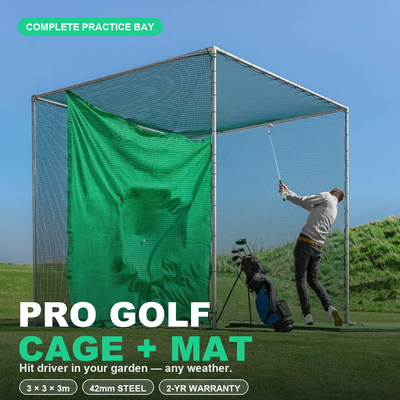
Everything above assumes a cage you can trust with every club at full speed, because random practice with the driver taken out isn’t really random. That’s the practical case for the Pro Golf Cage & Hitting Mat Bundle: 42mm galvanised steel, a driver-rated double net with an archery-grade impact panel, and a tour-density mat, from £1,284.98. And rather than leaving you to design sessions from journal articles, the free 90-day practice programme in our Practice Lab implements exactly this structure — blocked foundations early, progressively randomised sessions and consequence games as the weeks build. It’s the increasing-interference schedule from Porter and Magill (2010), turned into a calendar.
Frequently asked questions
What is the difference between blocked and random practice in golf?
Blocked practice repeats one task in a block — 50 balls with the same club at the same target. Random practice switches club, target or shot type every ball or few balls. Blocked feels better during the session; random tends to produce better retention and transfer to the course.
Why does random practice feel worse?
Because every ball forces you to re-plan the shot from scratch instead of repeating the last solution. That extra cognitive effort hurts in-session performance — and it’s also the mechanism thought to drive better learning (Lee et al., 1994).
Should beginners use random practice?
Sparingly at first. The challenge point framework (Guadagnoli & Lee, 2004) suggests matching difficulty to skill: beginners learn well with more blocked repetition, then benefit from progressively adding variety — the blocked-to-serial-to-random schedule that performed best in Porter and Magill’s 2010 golf study.
How many balls should a cage session be?
Fewer than you think. Around 40–60 balls in 25 minutes with a full routine, club changes and targets on every shot beats a mindless 100. Quality of decision beats volume of repetition.
References
- Czyż, S.; Wójcik, A.; Solarská, P. & Kiper, P. (2024) High Contextual Interference Improves Retention in Motor Learning: Systematic Review and Meta-Analysis, Scientific Reports, 14.
- Franks, I. & Miller, G. (1986) Eyewitness Testimony in Sport, Journal of Sport Behavior, 9 (1), 38–46.
- Guadagnoli, M. & Lee, T. (2004) Challenge Point: A Framework for Conceptualizing the Effects of Various Practice Conditions in Motor Learning, Journal of Motor Behavior, 36 (2), 212–224.
- Guadagnoli, M. & Lindquist, K. (2007) Challenge Point Framework and Efficient Learning of Golf, International Journal of Sports Science & Coaching, 2 (1 Supplement), 185–197.
- Lee, T.; Swinnen, S. & Serrien, D. (1994) Cognitive Effort and Motor Learning, Quest, 46 (3), 328–344.
- Magill, R. & Hall, K. (1990) A Review of the Contextual Interference Effect in Motor Skill Acquisition, Human Movement Science, 9 (3), 241–289.
- Pinder, R.; Davids, K.; Renshaw, I. & Araújo, D. (2011) Representative Learning Design and Functionality of Research and Practice in Sport, Journal of Sport and Exercise Psychology, 33 (1), 146–155.
- Porter, J.; Landin, D.; Hebert, E. & Baum, B. (2007) The Effects of Three Levels of Contextual Interference on Performance Outcomes and Movement Patterns in Golf Skills, International Journal of Sports Science & Coaching, 2 (3), 243–255.
- Porter, J. & Magill, R. (2010) Systematically Increasing Contextual Interference Is Beneficial for Learning Sport Skills, Journal of Sports Sciences, 28 (12), 1277–1285.
Put the science to work in your garden
The Pro Golf Cage & Hitting Mat Bundle handles every club at full speed — from £1,284.98 — and the free 90-day Practice Lab programme structures your sessions exactly as the research suggests.
See the Pro Cage bundle →
Free Home Golf Cage Setup Design Consultation
Not sure on size, base or mat? Chat directly with Tom, OpenGolfer’s founder — he practises from his own garden cage most days and has designed hundreds of home setups.
- Send a photo of your garden with rough measurements — get a tailored layout and spec for your space
- Personal replies from a real golfer, not a call centre
- Honest advice on what to buy — and what not to
Usually replies within the hour, 8am–8pm · prefer to talk? 02033 768500


Leave a comment