
Garmin R50 vs R10: Is the Upgrade Worth £3,878? (UK Guide)

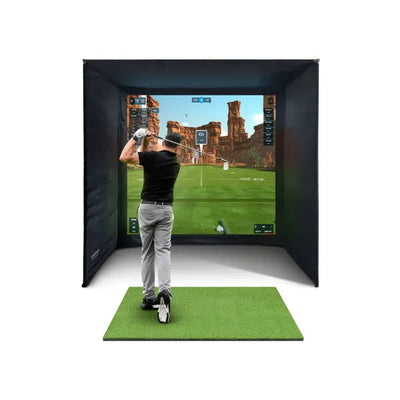
This is one of the most common WhatsApp questions I get, and it usually arrives from someone who already owns the R10: “is the R50 really ten times better?” The honest answer is that it is not ten times better, because that is not how diminishing returns work, but it is a fundamentally different machine rather than a bigger version of the same one. The Garmin Approach R10 at £421 is a radar unit that estimates what your ball did; the Garmin Approach R50 at £4,299 is a triple-camera unit that photographs what your ball did and runs a complete simulator on its own built-in screen. Whether that difference is worth £3,878 to you depends almost entirely on three things: your space, your ambitions, and how often a laptop ritual would stop you practising. Let me walk through all three.

Radar vs camera: why the technology gap matters
The R10 uses Doppler radar. It sits about 2.4m behind the ball, tracks the ball after it leaves the face, and calculates the launch numbers from the flight it observes plus some clever modelling. Indoors, into a net, the ball only flies a few metres before it stops, so the radar sees a short snippet of flight and models the rest. It does this remarkably well for £421, which is why I still recommend the R10 constantly, but modelling is modelling: certain shots, very short flights and less-than-ideal alignment all nudge the numbers.
The R50 photographs the ball at impact with three cameras from in front of the ball. It is not watching flight and working backwards; it is measuring the launch directly, which is the same fundamental approach as the tour-grade photometric units. Indoors into a screen, where radar has the least flight to look at, is exactly where cameras have the biggest advantage. That is the core of what the extra money buys: measurement rather than estimation, precisely in the environment most UK home setups use.
The space question decides it for many UK rooms
Here is the part that catches people out, and it has nothing to do with accuracy. The R10 needs roughly 2.4m of clear space behind the ball for the radar to work, plus your ball-to-screen distance in front. In a typical UK single garage that back-space requirement is frequently the thing that kills the project. The R50 sits in front of the ball, so that 2.4m simply comes off your required room length. I measured this out for a customer in Stockport last month whose garage was too short for the R10 he already owned to work properly into a screen; the camera-based unit fitted with room to spare, and that alone settled his decision before we ever discussed data quality.
If you are not sure which side of the line your room falls on, our simulator room size guide has the measurements to check. It is the first thing to do, because no amount of feature comparison matters if one of the units physically doesn’t fit your space.
One more household detail: the R10 is set up for one handedness at a time, so a left-hander joining a right-hander’s session means repositioning the unit. The R50 handles both without being moved. Mixed-handedness households, take note; it is a small spec-sheet line and a large quality-of-life difference.
Simulation: phone app vs built-in touchscreen
The R10 does offer simulation, and Garmin deserves credit for how much they packed in at the price; our full R10 review covers it in detail. But the R10 experience means a phone or tablet as the brain, or a PC for third-party software, and a certain amount of pairing, propping and fiddling each session.
The R50 has a 10” touchscreen built into the unit running Garmin’s Home Tee Hero course simulation on the device itself. No phone, no laptop, no pairing. Set it down, hit balls, see the course and your numbers behind the ball. For the full projector-plus-GSPro big-screen experience, both units ultimately want a PC, so the R50’s advantage is not that it replaces a top-end sim room; it is that it delivers a genuinely satisfying simulator with zero extra hardware, which the R10 cannot quite do.
Side by side
| Garmin R10 | Garmin R50 | |
|---|---|---|
| Price | £421 | £4,299 |
| Technology | Doppler radar | Triple camera array |
| Position | ~2.4m behind the ball | In front of the ball |
| Suits short rooms | Often not | Yes |
| Sim without extra hardware | No (phone/PC needed) | Yes, built-in 10” touchscreen |
| Left + right handers | Reposition required | No repositioning |
| Best environment | Outdoors/range, longer rooms | Indoors into net or screen |
| Best for | Practice numbers, entry sim | Serious all-in-one home simulator |
The honest case for keeping your £3,878
Now the section a retailer is not supposed to write. A large share of the golfers who ask me this question should buy, or keep, the R10. If your main use is outdoor range sessions and garden net practice with occasional casual sim rounds, the R10 does that job well and the R50’s advantages sit mostly idle. If you have a long garage or a garden setup where the 2.4m behind the ball is no problem, radar’s biggest practical weakness disappears. And if £4,299 means stretching, don’t: an R10 plus a quality net and mat, with money left over, improves your golf more than a launch monitor you resented paying for. We found over the past couple of years of selling both that R10 owners who upgrade happiest are the ones whose usage had already outgrown it, not the ones chasing a spec sheet.
The middle option people forget
There is also a step between these two. The FlightScope Mevo Gen 2 at £1,199 is a radar unit a clear class above the R10 in data quality and simulator credibility, while costing well under a third of the R50. It still carries radar’s space appetite behind the ball, so it does not solve the short-room problem, but for golfers whose room is long enough and whose sticking point is data quality rather than the all-in-one convenience, the Mevo Gen 2 is often the smarter cheque. I recommend it regularly to exactly the people stuck between this article’s two headline units. One thing to know with FlightScope: the simulation software is non-refundable once activated, so decide which software package you want before you switch it on, not after.
Upgrade paths that actually make sense
If you are starting from nothing with under £1,000, buy the R10 and spend the balance on a proper net and mat. If you are starting from nothing with a real simulator budget and a normal UK-sized room, go straight to the R50 rather than buying twice; second-hand R10s lose you money on the round trip. If you own an R10 and love it but want indoor accuracy and one-box convenience, the R50 is the natural upgrade and your R10 keeps its value as the travel-and-range unit, which is genuinely how several of our customers run it. And if you own an R10 and mostly want bigger-screen simulation rather than better numbers, consider spending on the projector, screen and PC first; the R10 might surprise you for another season.
Frequently asked questions
Is the Garmin R50 really worth it over the R10?
If you play indoors into a net or screen, share the setup with players of both handedness, or your room is too short for radar’s 2.4m behind the ball, yes; the R50 is a different class of machine. If you mostly practise outdoors with occasional casual sim use, the R10 remains outstanding value and the honest answer is no.
Can the R10 and R50 both run a golf simulator?
Both can, differently. The R10 simulates via a phone, tablet or PC. The R50 runs Home Tee Hero on its own built-in 10” touchscreen with no other hardware, and can also feed a PC for third-party software such as GSPro or E6 when you want the projector experience.
How much space does each unit need?
The R10 needs about 2.4m behind the ball plus your hitting distance to the net or screen. The R50 sits in front of the ball, so it fits rooms radar cannot. Measure your space first; it eliminates half the decision.
Is there a good option between the R10 and the R50?
The FlightScope Mevo Gen 2 at £1,199 is the natural mid-step: notably stronger data than the R10 for a fraction of R50 money, provided your room has radar’s required depth behind the ball.
The verdict
Match the unit to the golfer, not the badge to the budget. The R10 remains the best few hundred pounds in golf practice for outdoor and long-room use; the R50 is the one to buy when indoor accuracy, a short room, mixed-handedness or one-box simulation genuinely describe your situation. Buy the one your room and habits point at, and you will not think about the other again.
Not sure which option fits your space or budget? Message Tom on WhatsApp for a free consultation — no obligation, real answers from someone who installs this kit weekly.

Free Home Golf Simulator Design Consultation
Not sure on space, screen or launch monitor? Chat directly with Tom, OpenGolfer’s founder — he has designed hundreds of home setups and will tell you exactly what fits your room and budget.
- Send your room size (or a photo) — get a tailored layout and spec for your space, ceiling height included
- Personal replies from a real golfer, not a call centre
- Honest advice on what to buy — and what not to
Usually replies within the hour, 8am–8pm · prefer to talk? 02033 768500


Leave a comment