
Golf Cage Installation UK: DIY, Handyman or Fitted?

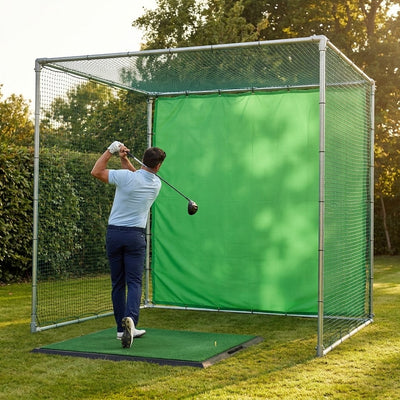
Most garden golf cages are a DIY job for two people: pick a level spot, build the frame from the ground up, hang the net, then anchor it to suit your ground. You don't need a fitter. If you'd rather not build it, book a handyman through Airtasker. We supply the cage and help by message, but we don't install.

"Golf cage installation" sounds like a trade job, and for most garden cages it isn't. A freestanding steel cage is closer to putting up a large gazebo than to building a shed. This guide covers what the job involves, the ground and anchoring decisions that matter more than the build itself, when it's worth paying someone, and exactly what we do and don't do. I'll use our Pro golf cage and mat bundle as the example, because it's the cage I recommend for most gardens.
What you're putting up
The Pro cage is a 3 m × 3 m × 3 m freestanding frame in galvanised 42 mm steel tube, with a 2.3 mm knotless net and an archery-grade impact panel behind the hitting area. It needs no wall fixings and no concrete. With the mat option you also get the FORZA Driving Range mat (1.5 m × 1.5 m) on a jigsaw base. Our other cages follow the same idea at different weights: the Standard cage and mat bundle uses a 34 mm frame, the Socketed cage sets the uprights into ground sockets for a fixed position, and the FORZA ProFlex pop-up cage folds away between sessions. You can compare them all in the golf cage collection.
The parts are long rather than heavy. A 3 m upright is awkward for one person to hold square while someone else connects the top, which is why this is a two-person job even though nothing about it is technical.
Before the build: choose the spot
The spot decides more about how the cage performs than the build does. These are the checks I'd make with a tape measure and a spirit level before anything arrives.
- Footprint plus working room. The cage is 3 m × 3 m. Leave space round it to walk, to reach the net fixings and to get a mower past.
- Level ground. Put a spirit level across the footprint both ways. A slight fall is fine for the frame, but the mat should sit level or your ball position drifts.
- Clear sky. Look up. Branches rub through netting over a season, and washing lines and cables don't mix with a 3 m frame.
- The boundary. The Planning Portal's guidance on outbuildings sets a 2.5 m maximum height for "a building, enclosure or container within two metres of a boundary". A 3 m cage is taller than that, so if yours will stand within 2 m of a fence, or you live in a conservation area or a listed building, ask your council how they treat it before you build.
- Which way you face. Hitting towards the house or a neighbour's garden is fine in a cage, but low morning or evening sun in your eyes is not. Think about when you'll play.
Ground and anchoring: the part that matters
A net is a big surface, and wind loads it like a sail. A cage that isn't held down properly is the one that ends up across the garden after the first storm. The frame stands on its own, but it still needs anchoring to the ground you have. The product page lists what comes in the box and what's an add-on; ground anchors are available as an add-on.
| Ground | How it's usually held down | Who can do it |
|---|---|---|
| Lawn | Ground anchors driven or screwed in at each upright | You, with a helper |
| Artificial turf over stone or sand | Screw anchors through the turf into the sub-base | You, with a helper |
| Patio or paving | Weights on each base point, or fixings drilled into the slabs | You for weights; a handyman for drilled fixings |
| Decking | Screw fixings into the joists, not just the boards | A handyman if you're not confident finding joists |
| Fixed position, any ground | The Socketed cage, with uprights set into ground sockets | A handyman or landscaper for the sockets |
For ground work beyond pegs, our guide on building a base for a garden golf cage covers grass, platforms and sub-bases.
Whatever the ground, a cage should never be left standing on bare concrete as the hitting surface. Put the mat down on turf or a proper base so mis-hits don't bounce back hard.
The build, in order
The instructions in the box are the ones to follow for your cage. In general, a freestanding frame goes up in this order.
- Lay everything out. Sort the tubes and connectors by type on the lawn before you join anything. It saves dismantling a half-built frame because a corner went in the wrong way round.
- Build the base. Assemble the ground-level frame first and check it is square by measuring both diagonals; they should match.
- Stand the uprights. One person holds, one connects. Keep them vertical.
- Join the top. Bridge the uprights with the top rails. This is the step that needs two people most.
- Anchor it. Fix the frame down before the net goes on, while it's light and easy to adjust.
- Hang the net. Fix the top edge first, then bring the sides down evenly. A net with a little slack takes a driver better than a drum-tight one.
- Fit the impact panel and mat. The panel sits behind the hitting area; the mat goes where you'll stand, a short way inside the open front.
- Test gently. Hit a few half-shots with a wedge and watch where the ball goes before you hit a driver.
DIY, handyman or "fitted"
DIY
If you've built flat-pack furniture and have a helper, you can build a garden cage. The skills are measuring, holding things straight and following the order above.
A handyman through Airtasker
Worth it if you're on your own, short of time, unsure about drilling a patio or fixing into decking joists, or putting in ground sockets. Book through Airtasker, send the handyman the product page so they know what's coming, and have the boxes in the garden on the day.
A "fitted" cage
Some sellers offer an installation service; we don't. In my view a garden cage doesn't need a specialist. Where you may want a trade is the ground: a landscaper for a level sub-base, or a builder for a concrete pad with sockets. Get that done before the cage arrives.
What we do and don't do
- We do: help you choose the cage for your garden and ground, answer build questions by WhatsApp from the photos you send, and sort replacement parts. If a net wears out, there is a replacement 3 m cage net.
- We don't: send a fitter, do ground work or fix anything to your property.
Mats for the cage are in the hitting mats collection if you buy the cage on its own.
Frequently asked questions
Do I need someone to install a golf cage?
Usually not. A freestanding garden cage is a two-person DIY job. Book a handyman through Airtasker if you'd rather not build it, or if you need fixings drilled into a patio or decking.
How do I stop a golf cage blowing over?
Anchor it to suit the ground: anchors into lawn or turf, weights or fixings on paving, screws into decking joists. Ground anchors are an add-on on our cages. In storms, check the fixings and consider taking the net down.
Can a golf cage go on a patio?
Yes, with weights or drilled fixings to hold it, and the mat on a proper base rather than bare slabs so mis-hits don't bounce back hard.
Do I need planning permission for a golf cage?
Ask your council if it will stand within 2 m of a boundary, or if you're in a conservation area or a listed building. The Planning Portal's outbuildings guidance sets a 2.5 m height limit near a boundary, and a 3 m cage is taller.
Putting up a garden cage is a weekend job for two people, not a trade. Spend your effort on the spot and the anchoring, follow the instructions in the box, and book a handyman through Airtasker if you'd rather hand it over. For most gardens I recommend the Pro cage with the mat, anchored to suit your ground.
Not sure which option fits your space or budget? Message our sim experts on WhatsApp for a free consultation — no obligation.

Free Home Golf Cage Setup Design Consultation
Not sure on size, base or mat? Chat directly with one of our experts — real golfers who practise from their own garden cage most days and has designed hundreds of home setups.
- Send a photo of your garden with rough measurements — get a tailored layout and spec for your space
- Your design pack: photoreal render, 3D cut-through and overhead plan, plus 2 to 3 build options for your needs
- Honest advice on what to buy — and what not to
Usually replies within the hour, 6am–10pm · prefer to talk? 02033 768500


Leave a comment