
Garden Golf Simulator Cabin UK: Costs, Planning & What to Buy

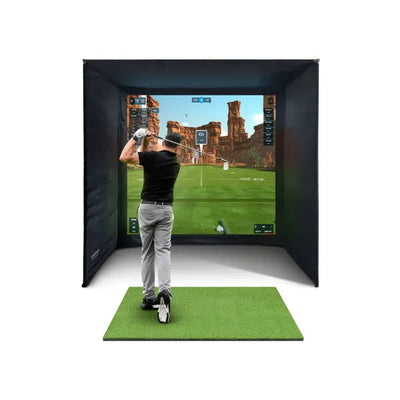
A garden golf simulator cabin is exactly what it sounds like: a purpose-built, insulated garden building designed from day one to house a golf simulator. It has quietly become one of the most-asked-about projects in my inbox, and for good reason — most UK houses simply don't have a spare room with 2.8m of ceiling height, but plenty of them have a garden. I've helped spec and kit out a good number of these cabins now, from budget log-cabin conversions to fully insulated SIP-panel garden rooms, and the difference between the ones that get used every day and the ones that become expensive storage is almost always decided at the planning stage. This guide covers realistic all-in costs, the internal dimensions that actually work, the planning permission basics, heating and ventilation, and which simulator bundles make sense in a cabin.
Why a purpose-built cabin beats converting a shed
I get asked weekly whether a standard garden shed or summer house can take a simulator, and the honest answer is almost always no. The problem isn't floor space — it's height, insulation and floor quality. A typical apex shed gives you 2.2m at the ridge and much less at the eaves, which is nowhere near enough to swing a driver. Standard sheds also have suspended timber floors that bounce, single-skin walls that sweat with condensation, and no realistic way to keep electronics warm and dry through a British winter.
A purpose-built cabin solves all of this because you specify it before it's built. You order the internal height you need, a concrete base or reinforced floor that won't flex under a hitting mat, proper insulation in the walls and roof, and mains power run from the house. One customer in Cheshire tried the shed route first with a £1,200 summer house, gave up after one winter of condensation dripping onto his launch monitor, and ended up spending properly on an insulated cabin — his words to me were that he'd effectively paid for the project twice. Start with the right building and you only pay once.
The internal dimensions that actually work
Cabin suppliers quote external dimensions; simulators care about internal ones. Wall thickness, cladding and insulation can easily eat 20–30cm from each quoted measurement, so always work from the internal figures and check them before you sign anything.
Here's what I recommend as working minimums, based on cabins I've measured and kitted out myself:
- Internal height: 2.8m minimum, 3m ideal. This is the figure that kills most projects. I measured a customer's "3m garden room" last year and found 2.62m internally once the floor build-up and ceiling were in — fine for irons, marginal for driver. If you're over 6ft or have a steep swing, insist on 3m clear internal height.
- Internal length: 5m minimum. You need roughly 3–3.7m from screen to hitting position (launch monitors like the FlightScope Mevo Gen 2 need space behind the ball too), plus 1–1.5m behind you for a comfortable backswing and walking room.
- Internal width: 3.5m minimum, 4m+ ideal. At 3.5m a right-hander can hit from a slightly offset position; at 4m+ both right- and left-handers can play from a centred mat, which matters if the family will use it.
If those numbers feel unfamiliar, my full golf simulator room size guide walks through them in detail, including how to check your swing arc with a club and a broom handle before you commit to a building.
What a garden golf simulator cabin really costs
This is where I'll be more blunt than the garden room brochures. The structure is only half the project — you're buying a building and a simulator, and the two budgets need planning together. Here are the three tiers I see most often, with realistic 2026 all-in figures:
| Tier | Structure | Simulator kit | Realistic all-in |
|---|---|---|---|
| Budget | Insulated log cabin or upgraded timber building, DIY finish — around £8,000–£14,000 | Mevo Gen 2 bundle with enclosure, mat and net — around £3,000–£4,000 | Around £11,000–£18,000 |
| Mid-range | SIP or timber-frame garden room, fitted electrics, plastered — around £15,000–£25,000 | Camera-based bundle, projector and impact screen — around £6,000–£12,000 | Around £21,000–£37,000 |
| Premium | Bespoke garden studio, 3m+ ceilings, heating and AV pre-wired — £25,000–£45,000+ | Foresight GC3S or Golfzon Wave bundle, full enclosure — £10,000–£20,000+ | £35,000–£65,000+ |
Two costs people consistently forget: groundworks and power. A proper concrete base runs £1,500–£3,500 depending on access, and an armoured cable run from the house consumer unit with its own small board is typically £800–£1,500 from a qualified electrician. Neither is optional for a building full of electronics. For a full breakdown of the simulator side of the budget, my UK golf simulator cost guide covers every line item from mat to projector.
Planning permission: the short version
Most garden simulator cabins in England fall under permitted development, meaning no planning application is needed — but the height limits are exactly where simulator buildings get caught. Under permitted development an outbuilding within 2m of a boundary is limited to 2.5m overall height, which after floor and roof build-up leaves you nowhere near enough internal height to swing. Move the building more than 2m from every boundary and you can go to 4m with a dual-pitched roof, which comfortably gives you 3m+ inside.
The other common tripwires: the outbuilding must not cover more than 50% of the land around the original house, rules differ in conservation areas and for listed properties, and permitted development rights don't apply to flats. The Planning Portal's outbuildings guidance is the authoritative reference, and I've written a dedicated golf simulator planning permission guide covering the UK rules, building regulations thresholds and when it's worth applying for a lawful development certificate. Read that before ordering a building — a £150 certificate is cheap insurance against a neighbour dispute.
Heating, ventilation and electrics
An uninsulated building in the UK swings from 2°C to 35°C across the year, and launch monitors, projectors and PCs all dislike both extremes — as does anyone trying to groove a swing in gloves. Here's what I specify for customers:
- Insulation first. 50–100mm PIR in walls, floor and roof transforms the running cost. An insulated cabin needs a fraction of the heating of a bare one, and it stops the condensation that kills electronics.
- Heating: a small panel heater or air-conditioning split unit. A 1.5–2kW panel heater on a smart plug, switched on 30 minutes before you play, is enough for most insulated cabins. If the budget stretches, a small air-con unit gives you heating in January and cooling in July for the same box.
- Ventilation matters more than people think. You'll be exercising in a sealed box. Trickle vents plus a quiet extractor fan keep humidity down; without them, we've seen impact screens develop mildew spots within a single winter.
- Electrics: plan for more sockets than you think. Launch monitor, projector, PC or tablet, screen, heater, lighting, a fan — I wire a minimum of six double sockets, with the projector feed run to the ceiling position before the walls are finished.
One customer in Surrey ran his insulated 5.5m × 4m cabin through two full winters with just a 2kW panel heater and reported it held 16–18°C in evening sessions for pennies a night. The insulation spend paid for itself quickly.
Which simulator bundles suit a cabin
Because you're choosing the building and the simulator together, you can match them properly rather than compromising. My honest recommendations by cabin size:
- Compact cabins (around 5m × 3.5m internal): the FlightScope Mevo Gen 2 bundle is what I fit most often. It's radar-based, tolerant of real-world spaces, and the complete bundle with enclosure and mat lands around the £3k mark — the best value full-simulator experience going into a garden building.
- Mid-size cabins (5.5m+ length, 4m width): a camera-based unit like the Foresight GC3S bundle earns its premium here. Camera systems read the ball at impact, so they're happy with the shorter ball flight a cabin allows, and the accuracy step-up is genuinely noticeable on wedges and putting.
- Premium builds: the Golfzon Wave turns a garden cabin into something close to a commercial sim studio — if the building budget is £30k+, it's the natural partner.
Whichever route you take, buy the enclosure, impact screen and mat as a matched bundle rather than piecing it together — the simulator bundle range exists because mismatched screen and enclosure sizes are the single most common self-build mistake I see. And order the building with the simulator's throw distance and enclosure footprint drawn on the plan; it's far easier to move a wall on paper than in timber.
Garden golf simulator cabin FAQ
How much does a garden golf simulator cabin cost in the UK?
Realistically £11,000–£18,000 all-in at the budget end (insulated timber cabin plus a Mevo Gen 2 bundle), £21,000–£37,000 for a mid-range garden room with a camera-based simulator, and £35,000+ for premium builds. The building is typically 60–70% of the total.
Do I need planning permission for a golf simulator cabin?
Usually not, if it qualifies as permitted development — but height is the catch. Within 2m of a boundary you're capped at 2.5m overall, which is too low for a simulator. Site the cabin more than 2m from boundaries to allow up to 4m with a pitched roof, and check the planning permission guide for conservation areas and other exceptions.
What internal height do I need to swing a driver?
2.8m is the working minimum for most golfers; 3m is comfortable for everyone. Always confirm the internal finished height with the cabin supplier — quoted external heights lose 20–40cm to floor and roof build-up.
Can I use an existing summer house instead?
Rarely. Almost every summer house I've assessed fails on height, floor stiffness or insulation. If yours genuinely has 2.8m+ inside and a solid floor, it can work with insulation added — but for most people a purpose-built cabin is cheaper than upgrading the wrong building.


Free Home Golf Simulator Design Consultation
Not sure on space, screen or launch monitor? Chat directly with Tom, OpenGolfer’s founder — he has designed hundreds of home setups and will tell you exactly what fits your room and budget.
- Send your room size (or a photo) — get a tailored layout and spec for your space, ceiling height included
- Personal replies from a real golfer, not a call centre
- Honest advice on what to buy — and what not to
Usually replies within the hour, 8am–8pm · prefer to talk? 02033 768500


Leave a comment