

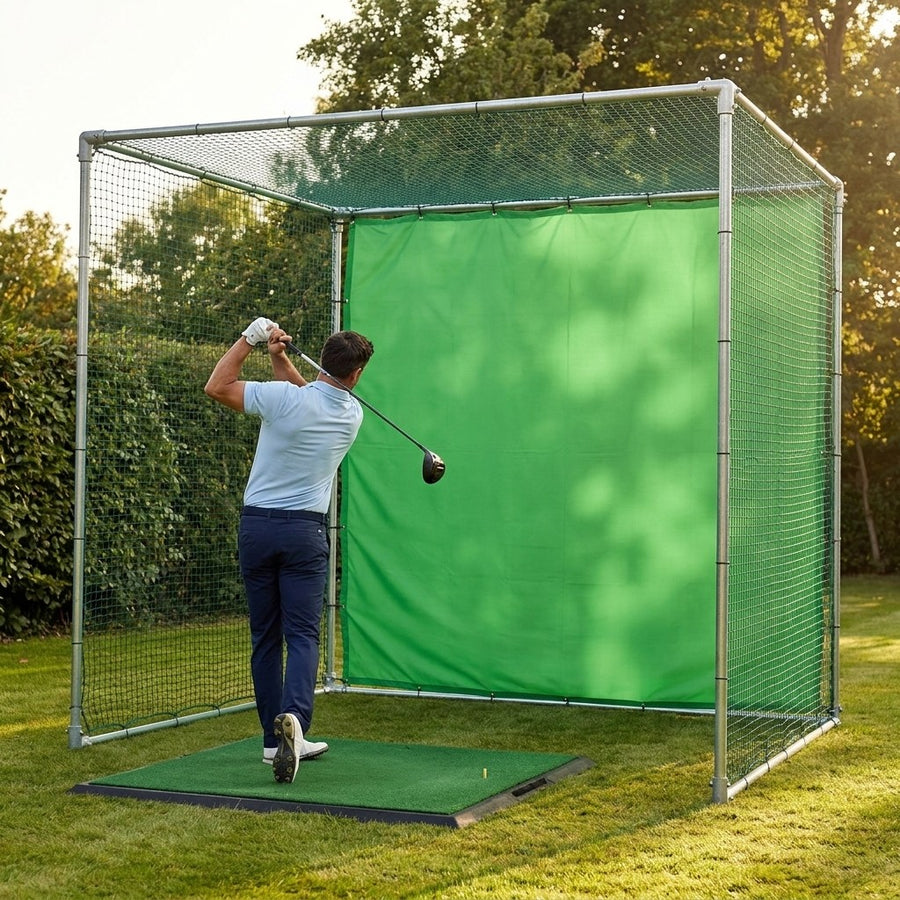
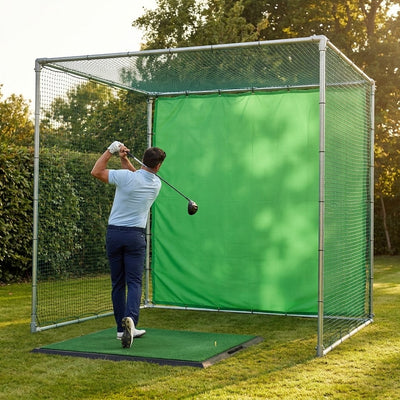
A steel garden golf cage can stay up all winter, but the net is what catches the wind. Treat a Met Office wind warning as your trigger: drop or tie up the net, check every peg or socket, and bring the mat and any launch monitor indoors. After the storm, inspect the frame joints and the net before you hit again.

We have a separate guide on the general question of whether to leave a cage up over winter. This one is narrower: what to do when a storm is actually forecast, what snow does to the roof net, and how to tell when the net has had enough. I'll use our own cages as the examples, because those are the specs I can stand behind.
Why the net, not the frame, is the risk
An empty steel frame lets wind straight through it. Hang a net over it and you've built a sail: three metres high and three metres wide on every side, with a roof on top. The force on the frame comes almost entirely from the net, and it arrives at the joints and the anchoring points. That's why a cage that has stood happily through a summer can shift, rack or lift in a single winter gale.
The frame you have changes how much of a worry that is:
- The Standard Golf Cage is a 34 mm galvanised steel frame that anchors with U-pegs, with no concrete.
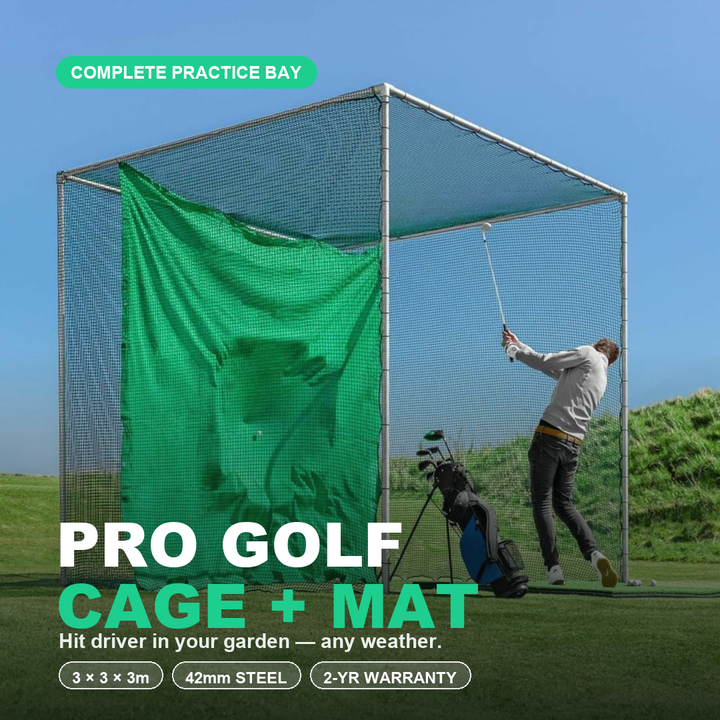
- The Pro Golf Cage uses heavier 42 mm galvanised steel tube and is freestanding on grass, patio or artificial turf.
- The Socketed Pro Golf Cage is the same 42 mm frame with each upright slotted into a ground socket concreted into the ground, so it doesn't rely on pegs or guy ropes.
Our frame-and-net page lists the 34 mm frame at 88 kg and the 42 mm frame at 112 kg. Weight helps, but a freestanding cage is still only as secure as what holds its feet down.
Use the Met Office warning as your trigger
None of our cage pages gives a wind rating in miles per hour, and I'd rather not invent one. So I use the forecast instead of a number. The Met Office issues yellow, amber and red weather warnings for wind, snow and ice by region, usually a few days ahead. Named storms get a warning first.
My rule is simple: a yellow wind warning for your area means the net comes down or gets tied up before the wind arrives. Amber or red means everything loose comes off the garden, not just the net. If you'd like to read wind strength the way sailors do, the Met Office's Beaufort scale guide describes what each force looks like on trees and in gardens. Once small branches are moving constantly, a net on a cage is under real load.
The storm drill, before the wind arrives
Do it with two people, in daylight, before the wind picks up. It's far quicker than rebuilding a bent frame.
- Bring in the loose kit. The hitting mat, the base, balls, any launch monitor, a phone tripod and the ball tray. A mat lifted by wind goes a long way.
- Drop or gather the net. Unclip or untie it from the top bars and roof, lower it, and either take it off completely or gather it at the base and tie it tight in a bundle, so the wind has nothing to push against.
- Leave the impact panel off the frame. If your cage has a separate rear panel, unclip it as well. It's the densest piece of netting and catches the most wind.
- Check the anchoring. Push every U-peg back down to its full depth, and replace any that have bent or loosened in soft ground. On a socketed cage, check each upright is seated in its socket.
- Check the joints. Make sure every connector is fully home and any bolts or pins are tight.
- Stay out of it during the storm. Don't go out to rescue a flapping net in high wind.
Our guide to anchoring a golf cage on every ground type covers pegs, patio weights and guy ropes in detail. If you only read one thing before winter, read that.
What to do by cage type
| Cage | Frame and fixing | Yellow wind warning | Amber or red warning |
|---|---|---|---|
| Standard Golf Cage | 34 mm galvanised steel, U-pegs | Drop or tie up the net, re-seat the pegs | Net off and stored, kit indoors |
| Pro Golf Cage | 42 mm galvanised steel, freestanding | Drop or tie up the net, check the anchoring | Net off and stored, kit indoors |
| Socketed Pro Golf Cage | 42 mm galvanised steel, concreted ground sockets | Tie up the net, check the uprights are seated | Net off and stored, kit indoors |
| FORZA ProFlex pop-up | Steel base, fibreglass poles, guy ropes | Pack it away | Packed away indoors |
The pop-up is the easy one. FORZA's specification for the ProFlex pop-up cage says it's suitable for outdoor use but should be taken down and stored inside when not in use, so in winter it lives in its bag between sessions anyway.
Snow and ice on the roof net
Snow is a different load. Wind pushes sideways; snow sits on top. A roof net with a heavy layer of wet snow sags into the cage and pulls the top bars inwards. Ice on the mesh adds weight and stiffens the net, which makes it more likely to tear if a ball hits it.
When snow is forecast, I'd drop the roof net or the whole net, the same as for wind. If it has already settled, push it off from underneath with a soft broom rather than hitting the net, and wait for ice to melt before you play. A frozen ball hitting a frozen net is hard on both.
The after-storm check
Before you hang the net back up or hit a ball, walk round the cage:
- Frame: look along each top bar and upright for a bend or a kink, and check every joint is still fully seated. A racked frame (leaning out of square) puts uneven tension on the net.
- Anchoring: pegs lifted, ground softened, sockets moved. Re-seat or replace before the next blow.
- Net: spread it out and look for broken strands, especially around the edges and wherever it rubbed on the frame. Small tears can be tied off with twine; long splits at the impact zone can't.
- Galvanising: scratches through the zinc coating can start to rust. Touch them up with a cold galvanising paint.
Only hang the net back when it's dry. Folding a wet net and leaving it in a shed is how mildew starts.
UV, rot and when the net is finished
Winter is actually the easy season for a net. Ultraviolet light from the sun is what slowly weakens netting fibres, and there's much less of it from November to February. What winter does is find the weak spots that summer created. If the net was getting tired by September, a storm is often what finishes it.
Signs it's time for a new net: strands that snap when you pull them by hand, a faded, brittle feel, holes forming where balls land, or the net sagging so far that balls drop through the gaps at the edges. The impact zone at the back wears first, every time.
You don't need a new cage when that happens. Our replacement golf cage net fits any 3 m by 3 m by 3 m frame. It's 2.3 mm knotless nylon twine with a 22 mm mesh, and it comes three ways: the net only, the net with a standard 2.3 mm knotless impact panel, or the net with an archery-grade impact panel made from close-mesh polyester with a reinforced hem. For daily use or a high swing speed, I recommend the archery panel, because that's the piece that takes every strike. Our guide to netting types and grades explains the differences in more depth. See the live price on the product page.
Practising through the winter
None of this means the cage is out of action until spring. In our experience, most winter sessions are lost to short daylight and wet mats, not to storms. Keep the mat and base off the ground when you're not using them so they dry, bring the launch monitor in after every session, and choose a hitting mat with a rubber base that copes with cold, hard ground. Our hitting mats range shows which ones suit outdoor use.
Frequently asked questions
Should I take my golf cage net down in a storm?
Yes. The net is what catches the wind, so drop it or gather it and tie it at the base before a wind warning takes effect. The steel frame on its own lets the wind through and is far less likely to move.
Can a golf cage stay up all winter in the UK?
A galvanised steel cage can, as long as it's properly anchored and you drop the net for storms and heavy snow. A pop-up like the FORZA ProFlex should be packed away and stored inside when you're not using it.
How do I stop my golf cage blowing over?
Anchor every foot properly for your ground type, re-seat pegs after rain, and take the wind load away by dropping the net when a warning is issued. For a cage that will never move, a socketed frame concreted into the ground is the permanent answer.
How do I know if my golf cage net needs replacing?
Look for strands that snap by hand, a brittle faded feel, holes in the impact zone and heavy sagging. If the frame is sound, replace the net only: a replacement net fits any 3 m cube frame.
For most gardens the plan is short: watch the Met Office warnings, drop the net before the wind arrives, check the pegs and joints after, and replace the net when the impact zone wears through. If you're choosing a cage now and know your garden is exposed, the golf cage range includes the socketed frame for exactly that.
Not sure which option fits your space or budget? Message our sim experts on WhatsApp for a free consultation — no obligation.

Free Home Golf Cage Setup Design Consultation
Not sure on size, base or mat? Chat directly with one of our experts — real golfers who practise from their own garden cage most days and has designed hundreds of home setups.
- Send a photo of your garden with rough measurements — get a tailored layout and spec for your space
- Your design pack: photoreal render, 3D cut-through and overhead plan, plus 2 to 3 build options for your needs
- Honest advice on what to buy — and what not to
Usually replies within the hour, 6am–10pm · prefer to talk? 02033 768500




Leave a comment