

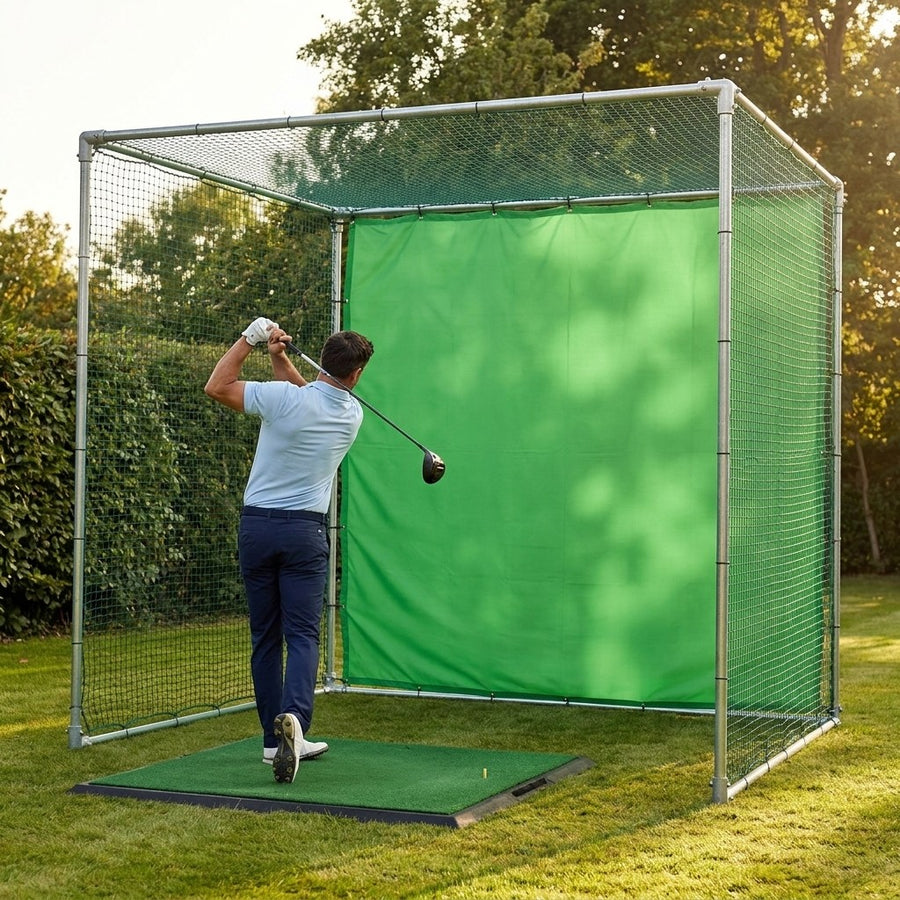
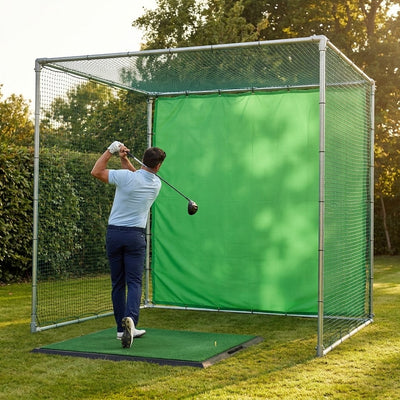
For a garage or spare room, the right indoor golf net is the one that fits under your ceiling with room to swing. A 2.4 m pop-up cage suits most garages you still park in; a SimSpace enclosure suits a room you'll later turn into a simulator. A 3 m garden cage only fits indoors where the ceiling is well above 3 m.

Indoors, the net isn't the hard part. The room is. A garden gives you as much sky as you like; a garage gives you a ceiling, a door mechanism, a concrete floor and a wall a metre behind the net. This guide works through those in order, then compares the net types that work inside a house, and finishes with what changes if you add a launch monitor.
Start with the ceiling
The lowest point above where you swing decides almost everything. Measure to whatever hangs lowest: a beam, a light fitting, garage door runners or the door motor. For a golf simulator we advise a minimum of 2.7 m, with 3 m or more ideal, so a driver clears the ceiling at the top of the swing. The same rule holds for a net. Below 2.7 m, irons and wedges are fine for many golfers; a full driver swing is a gamble that depends on your height and your swing.
The ceiling also limits which frame you can fit at all. A frame can't be taller than the room, and you need a little clearance above it to put it up.
Length: the ball, the net and the wall behind it
Indoors, the ball needs to fly a couple of metres before it hits the net, so the net has time to absorb it rather than spring it straight back at you. Then there's the space behind the net. If a full shot pushes the net back into a wall, the ball comes off the wall, not the net. Leave a gap between the back of the net and the wall, and don't hang anything there you'd mind being hit.
If you'll add a launch monitor, the length grows. I cover that further down.
The floor
Garage floors are concrete, cold and rarely level. A hitting mat on bare concrete jars the wrists and creeps across the floor. A mat with a rubber base underneath fixes both, and the base lifts the mat off a cold, damp slab. Our hitting mats collection shows the bases with each mat. In a spare room, a base also protects the floor underneath.
Four ways to put a net indoors
| Type | Size | Best indoors when | Watch out for |
|---|---|---|---|
| FORZA ProFlex pop-up cage | 2.4 × 2.4 × 2.4 m | A garage you still park in; it packs away | Narrower than a 3 m cage, so wide shots have less net |
| SimSpace enclosure (SIM 2 shown) | 3.0 m wide × 2.5 m high × 1.5 m deep inside | A room that may become a simulator | Needs about 2.6 m of height to stand |
| 3 m golf cage frame | 3 × 3 × 3 m | Barns, workshops and halls with a ceiling well above 3 m | Won't fit under a normal house or garage ceiling |
| Freestanding practice net | Varies by model | Short sessions, smaller spaces | No side or roof protection |
The pop-up cage
The FORZA ProFlex pop-up cage is an 8 ft (2.4 m) cube with an impact panel on the back wall, a 19 kg frame and a wheeled carry bag. It sets up in minutes and packs away, which is what makes it the garage net I'd point most people to. Practise in the empty half, then fold it up when the car comes back.
A 2.4 m frame needs a little more than 2.4 m of clear height to stand. Check that figure under your door runners, not in the middle of the ceiling. The trade-off is width: with about 1.2 m either side of a centred ball, a shot that starts wide has less net to find than in a 3 m cage. Stand so the ball meets the middle of the impact panel.
The simulator enclosure
A simulator enclosure is an indoor net with a screen at the front. The SimSpace SIM 2 enclosure is 3.0 m wide, 2.5 m high and 1.5 m deep inside, with velour side and ceiling panels and an impact screen that stops the ball. Add SimSpace side netting if anything you care about sits beside the bay. Other widths are on the same page.
The reason to start here is the upgrade. Add a projector and a launch monitor later and the same bay becomes a simulator, with nothing thrown away. For a full simulator we advise a room at least 3.0 m wide, 2.7 m high and 4.2 m long; our Sim Buyer Docs page on a golf simulator in a garage covers the measuring.
The 3 m cage, indoors
Our steel garden cages are 3 m cubes, so they only work indoors where the ceiling is comfortably above 3 m, such as a barn, an industrial unit or a sports hall. The 3 m frame and net comes in 34 mm or 42 mm steel. In a house or a standard garage, it won't fit.
A freestanding net
The simplest option is a net on its own frame, with no sides or roof. It's quick to set up and takes the least space, but nothing stops a mishit going sideways or up. Indoors, I'd only use one where there's nothing breakable to either side. The practice nets range has the sizes.
Adding a launch monitor indoors
A net and a launch monitor is the cheapest way to get real numbers at home, and where the unit sits decides how much room you need.
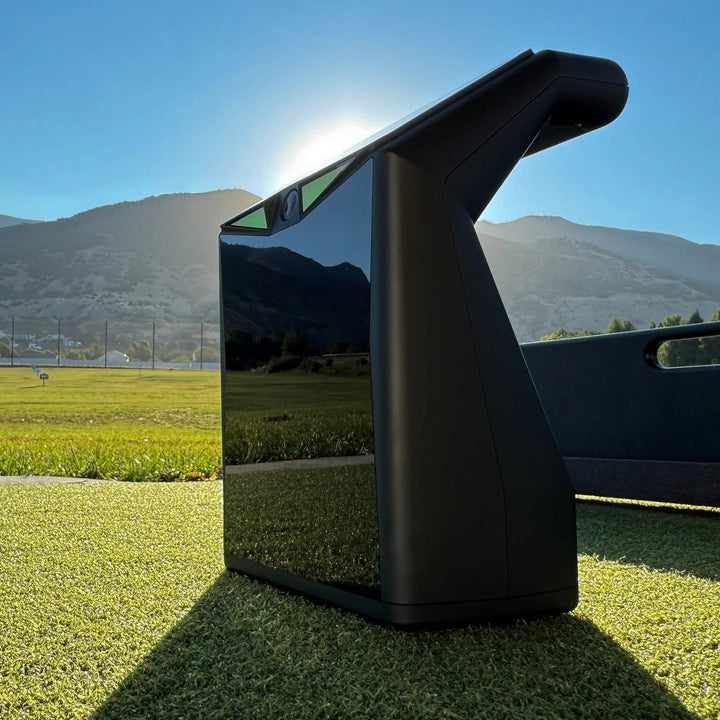
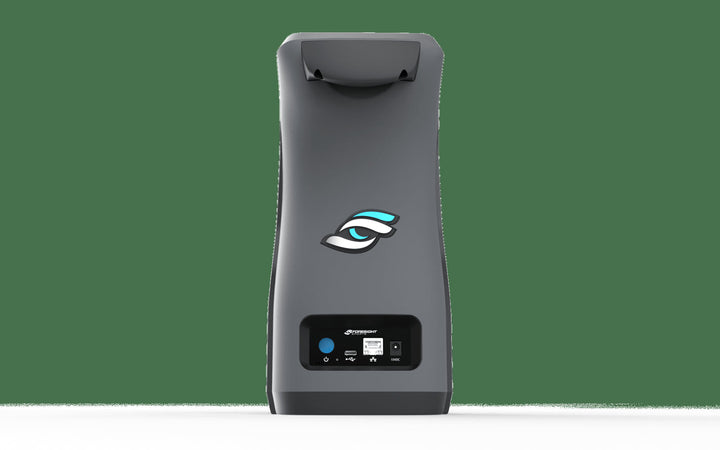
- Camera units sit beside the ball. The Square Golf launch monitor and the Garmin Approach® R50 work this way, so they add nothing to the length. They don't like sunlight on their lenses, so close the garage door or cover the gap round it.
- Radar units sit behind you. Garmin's manual puts the Garmin Approach R10 1.8 m to 2.4 m behind the tee, and FlightScope puts the Mevo Gen2 2.4 m behind the ball. Add that to the space in front of the ball. Garmin's Approach R10 page has the details. Indoors, FlightScope asks for a metallic sticker on the ball for spin readings with the Mevo Gen2.
Radar measures the ball's flight, and indoors the flight is short. Camera units read the ball at impact. In our experience, that's why camera units are the easier fit in a garage.
Noise, light and the neighbours
A ball into a net is quieter than a ball off a wall, but a garage door or a thin party wall still carries the strike. The impact panel takes most of the noise; a rubber base under the mat takes the thump of the club on the floor. Good overhead light helps you see the ball and the strike, and a camera launch monitor needs steady light without sun on it.
Which indoor net I'd buy
- A garage you still park in: the FORZA ProFlex, packed away between sessions.
- A garage or spare room that will become a simulator: a SimSpace enclosure in the widest size your wall takes.
- A tall barn or hall: a 3 m steel cage frame.
- Any of them: a mat with a rubber base, and a camera launch monitor if the room is short.
Frequently asked questions
How high does a ceiling need to be for an indoor golf net?
We advise 2.7 m as a minimum for a full driver swing, with 3 m or more ideal. Below that, many golfers can hit irons and wedges, but check your own swing first. The frame itself must also fit: a 2.4 m pop-up needs a little more than 2.4 m to stand.
Can I use a garden golf cage in my garage?
A 2.4 m pop-up like the FORZA ProFlex, yes, if the height under your door runners allows. A 3 m steel cage needs a ceiling comfortably above 3 m, which rules out most garages.
Can I use a launch monitor with an indoor net?
Yes. Camera units sit beside the ball and need no extra length. Radar units sit behind you: the Garmin R10 1.8 m to 2.4 m behind the tee and the Mevo Gen2 2.4 m behind the ball, per their manuals.
Is a simulator enclosure better than a net?
If you'll ever want a simulator, yes, because the same bay takes a projector and launch monitor later. If you just want to hit balls and keep the garage for the car, a pop-up cage is simpler.
Measure the ceiling under the lowest point, the length from the wall to where you'll stand, and the width you can spare, then pick the net that fits all three. For a garage that keeps the car, I recommend the ProFlex; for a room with a simulator in its future, start with the enclosure.
Not sure which option fits your space or budget? Message our sim experts on WhatsApp for a free consultation — no obligation.

Free Home Golf Cage Setup Design Consultation
Not sure on size, base or mat? Chat directly with one of our experts — real golfers who practise from their own garden cage most days and has designed hundreds of home setups.
- Send a photo of your garden with rough measurements — get a tailored layout and spec for your space
- Your design pack: photoreal render, 3D cut-through and overhead plan, plus 2 to 3 build options for your needs
- Honest advice on what to buy — and what not to
Usually replies within the hour, 6am–10pm · prefer to talk? 02033 768500


Leave a comment