
Can You Use a Golf Simulator Outside? UK Outdoor Setup Guide

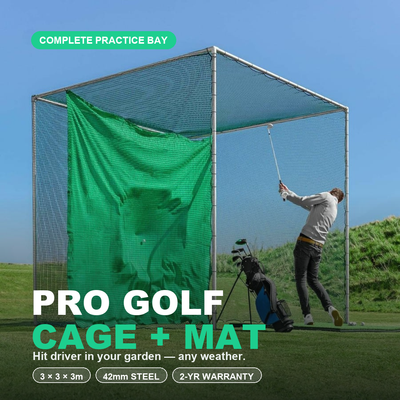
Can you use a golf simulator outside? It's a question I'm asked constantly by people who don't have a garage or spare room but do have a decent garden, and the honest answer is: partly. A full simulator — projector, impact screen, software — is a poor fit for the British outdoors, but a launch monitor paired with a golf cage is a genuinely excellent outdoor setup, and it's what I run in my own garden through the summer. This guide explains which launch monitors cope outside and which don't, what the weather actually does to each piece of kit, how to build an outdoor practice setup that works, and what the UK's seasons realistically allow.
The short answer: launch monitor yes, full simulator mostly no
It helps to separate the two things people mean by "golf simulator". The launch monitor — the device that measures your ball and club — can absolutely work outdoors, and some units are actually better outside because they can track full ball flight. The simulation side — a projector throwing an image onto an impact screen while software renders a course — is where the outdoors fights you. Projectors are dim in daylight, impact screens degrade in UV and damp, and no consumer projector or gaming PC is rated to live outside in British weather.
So the realistic outdoor setups are: a launch monitor with a net or cage, reading your numbers on a phone or tablet; or a semi-outdoor arrangement — a garage, barn or covered structure — where the electronics stay dry and you gain some light control. I'll cover both.
Photometric vs radar: why your launch monitor choice matters outside
This is the single most important technical point in this article. Launch monitors track the ball in one of two ways, and they behave very differently outdoors.
Radar (Doppler) units — like the FlightScope Mevo Gen 2 — sit behind the ball and track the actual flight using microwave radar. Outdoors is their natural habitat: with real ball flight to follow, a radar unit gets more measured (rather than calculated) data than it does indoors. FlightScope builds its professional tracking units on exactly this principle — see flightscope.com for the tech background. The trade-off is that radar wants space: ideally 2m+ behind the ball and a reasonable flight window, which a garden cage provides but a tight patio doesn't.
Photometric (camera) units — the Foresight GC-series and similar — photograph the ball at impact with high-speed cameras. They're superbly accurate, but cameras are light-sensitive: direct low sun into the lens, harsh shadows across the hitting area, or rapidly changing brightness can all disrupt tracking. Camera units do work outdoors — Foresight builds range-use into its GC-series — but they're happiest with consistent light. Outdoors, that means avoiding hitting into a low sun and ideally working under some shade.
Here's how the two approaches compare for outdoor use:
| Radar (e.g. Mevo Gen 2) | Photometric (e.g. GC3S) | |
|---|---|---|
| Outdoor accuracy | Excellent — tracks real flight | Excellent, if light is consistent |
| Light sensitivity | None — radar ignores light | Sensitive to low sun and harsh shadow |
| Space needed | Space behind ball plus flight window | Compact — reads at impact |
| Into a net/cage | Works, with short-flight calculation | Works — flight length irrelevant |
| Weatherproofing | Not waterproof — dry conditions only | Not waterproof — dry conditions only |
Neither type is weatherproof. These are £500–£15,000 electronics; they come out in dry weather and go back inside afterwards, every time. If you want help choosing a specific unit, my launch monitor comparison guide covers the current UK options in detail.
What UK weather does to the rest of the kit
The launch monitor is the fragile part, but the supporting cast has its own weather story, and after years of selling and testing this equipment outdoors I can tell you exactly how each piece fares:
- Cages and nets: genuinely outdoor-rated. A steel-framed cage like the Forza 3m × 3m × 3m practice cage is designed to live outside year-round. One customer in Kent has run his through two winters with nothing worse than a seasonal net brush-down. Pop-up nets like the Forza ProFlex are better treated as fair-weather kit — up in minutes, down and stored when a storm's forecast.
- Hitting mats: outdoor-tolerant, not outdoor-proof. A rubber-backed mat such as the Forza driving range mat handles rain, but leave any mat flat on wet grass permanently and the underside stays sodden. Stand it on slabs or a deck, and tip it on edge or bring it in between sessions.
- Impact screens: keep them inside. UV fades them, damp marks them, and wind turns a 3m screen into a sail. If you're hitting outdoors, hit into netting and watch the ball, not a screen.
- Projectors, PCs and tablets: dry cover only. A tablet running the app clips to the cage frame happily on a dry day; a projector should never be outside at all.
The honest alternative: a cage plus launch monitor
Rather than fighting to recreate an indoor simulator in the garden, the setup I actually recommend — and use — is simpler: a quality cage, a good mat, and a launch monitor on a tablet. You hit real balls, watch the first few metres of genuine flight into the net, and get every number a simulator would give you: carry, ball speed, spin, launch, club data. What you lose is the rendered picture of Pebble Beach; what you gain is real turf-to-ball feel outdoors, zero projector faff and a setup cost from well under £1,000 plus the monitor.
I tested this exact arrangement through last summer — Mevo Gen 2 behind the ball, LinksCube XL cage, mat on slabs — and my session data was noticeably richer than my indoor numbers because the radar had real flight to track for the first 3m. For structure options, the golf net and cage buying guide compares every size and price point, and if you're unsure whether you need a full cage or just a net, start with cage vs net.
Semi-outdoor setups: the best of both
The strongest "outdoor" simulators I've installed are actually semi-outdoor: a garage with the door open, a barn, a deep covered pergola or an open-fronted outbuilding. The electronics stay dry and shaded — which solves the photometric light problem — while you get fresh air and, often, the option to hit out into the garden with real flight. If you have any covered structure at all, build there rather than fully in the open: you'll use it three times as often.
The garage-door-open arrangement deserves a special mention because it's the cheapest genuinely good setup in the country. Mat just inside the door, radar monitor behind the ball, hitting out into a garden cage or net: the monitor and tablet never see a drop of rain, you get real launch conditions and daylight, and when winter arrives you close the door, turn the mat around and hit into a net indoors instead. A budget enclosure like the SimBox can even be rigged under a solid roof to give you a proper screen later, when you decide you want the full simulation experience rather than numbers alone.
The UK seasonal reality
Let me be straight about the calendar, because this is where outdoor-only plans go wrong. From roughly April to September, an outdoor cage setup in the UK is superb — long evenings, dry spells, no light issues for radar. From October to March you're fighting rain, wind, cold hands and 4pm darkness (radar doesn't care about darkness, but you won't fancy it). Most of my outdoor-setup customers get 7–8 good months and then either pause for winter or migrate the launch monitor indoors to a mat and net in the garage. That's not a failure — a monitor that serves garden duty in summer and garage duty in winter is arguably the best-value practice setup in golf. If year-round, whatever-the-weather practice is the goal, that's the point at which a garage build or garden room becomes the answer, and the garage simulator guide is the place to start.
Outdoor golf simulator FAQ
Can you use a golf simulator outside in the rain?
No. Cages, nets and rubber-backed mats are fine in rain, but launch monitors, tablets and projectors are not weatherproof and must only be used in dry conditions and stored indoors. Treat the electronics like a camera, not like garden furniture.
Do launch monitors work in direct sunlight?
Radar units are unaffected by light — sun, shade or darkness make no difference to tracking. Photometric (camera) units work outdoors but can struggle with low direct sun into the lens or hard shadows across the ball; position them so the sun is behind or above the cameras, or work under shade.
Can I get full course simulation outdoors?
Technically yes on a tablet screen — the software runs happily and shows your shot on a rendered course. What doesn't work outdoors is the projector-and-impact-screen experience; daylight washes out the image and screens don't tolerate weather. Outdoors, think numbers and net; indoors, think screen and simulation.
What's the best outdoor golf practice setup for a UK garden?
A steel-framed cage sited on level ground, a quality rubber-based mat on slabs, and a radar launch monitor like the Mevo Gen 2 with the app on a tablet. It's weather-tolerant where it needs to be, the expensive part comes indoors after each session, and the whole thing upgrades later into a full indoor simulator bundle.


Free Home Golf Cage Setup Design Consultation
Not sure on size, base or mat? Chat directly with Tom, OpenGolfer’s founder — he practises from his own garden cage most days and has designed hundreds of home setups.
- Send a photo of your garden with rough measurements — get a tailored layout and spec for your space
- Personal replies from a real golfer, not a call centre
- Honest advice on what to buy — and what not to
Usually replies within the hour, 8am–8pm · prefer to talk? 02033 768500


Leave a comment