
Do You Need Planning Permission for a Garden Golf Cage or Net? (UK Guide)

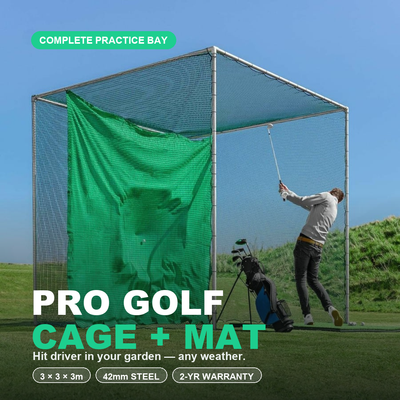
Short answer: almost certainly not. A garden golf cage is not a building — it is a freestanding, non-permanent structure, more like a large gazebo or fruit cage than a garden room. I did not need planning permission for mine, none of our customers has ever reported needing it, and there is no planning class that captures a pegged-down net frame. But “almost certainly” deserves a proper explanation, because buyers often ask exactly this when their spot is within 2m of the boundary, and it is a sensible thing to check before spending £1,000+.

The usual caveat: I sell golf cages, I do not grant planning permission. This is general guidance, not legal advice — when in doubt, one email to your local planning office settles it for free.
OUR #1 GARDEN CAGE, READY TO PLAY
The Pro Golf Cage & Hitting Mat Bundle pairs a galvanised 42mm steel cage with a driver-rated double net and a tour-density mat — a buy-once, all-weather practice station for the UK garden. Best seller, includes the free 90-day practice programme.
See the Heavy-Duty Garden Golf Cage →Why cages almost never need permission
Planning permission regulates development — buildings and permanent structures. A golf cage fails the “building” test on every practical count: no walls or roof in the building sense (it is netting on poles), no foundations (U-pegs into grass, no concrete), and it is not permanent — two people can take ours down in an hour and move it. That is the same reason trampolines, fruit cages and marquees do not need permission.
The 2-metre boundary question
The “2m from a boundary” rule that worries people comes from permitted development rights for outbuildings — sheds and garden rooms — where structures within 2m of a boundary are limited to 2.5m height. If a cage were an outbuilding, a 3m cage within 2m of the fence would be a problem. But a netted frame is not an outbuilding, and planning officers do not treat it as one. If your spot is tight against a boundary and you want certainty, ask your council — and think about the neighbour relationship either way, because a happy neighbour matters more than a technicality.
When you SHOULD check first
Four situations where a quick email to the council is worth it: you live in a conservation area or an Area of Outstanding Natural Beauty; the property is listed; you rent or are in a leasehold with garden covenants; or you are planning something genuinely permanent — concreted ground sockets, floodlights, or a full outdoor simulator building. Lighting in particular can attract attention where netting never would.
The neighbour test beats the planning test
In practice the only complaints that matter come over the fence, not from the council. Three things fix that before it starts: choose a ground-level or sunken base rather than a raised platform (keeps the cage below most hedge lines — see our setup guide), use the dark green net option which visually disappears against a hedge, and mention it to the neighbour before it goes up. A 3m cage sounds tall; against a mature hedge it is barely visible.
⛳ Free resource: the 90-Day Golf Cage Practice Programme
A cage stops your golf balls — a plan lowers your scores. The free interactive golf cage practice programme gives you 39 structured 25-minute sessions, a 24-drill library, and progress scorecards you can track online — built around the Pro Golf Cage & Hitting Mat Bundle and open to every garden golfer.
📏 Free tool: the Garden Golf Cage Planner
Planning a garden golf cage? The free Garden Golf Cage Planner answers the space, base, netting and cost questions in one place — including the Will-It-Fit calculator: enter your garden size and see which cages fit. No sign-up.
Not sure what fits your garden?
Send me a photo of your garden with rough measurements on WhatsApp and I’ll design your setup with you — free, no obligation. Chat with Tom on WhatsApp →
What the Planning Portal actually covers
The official guidance worth reading is the Planning Portal’s outbuildings page — it is the source of the 2.5m-within-2m-of-boundary rule people half-remember. Read it and you will notice everything it lists is enclosed structures: sheds, garages, garden rooms, greenhouses. A netted frame with no walls, no roof membrane and no foundation simply is not the thing the rules describe. That is not a loophole; it is the same distinction that keeps trampolines, washing lines and fruit cages outside planning control.
The simple way to be certain
If your cage will sit within 2m of a boundary, or you are in a conservation area or near a listed building, email your council’s planning department before ordering and describe it as a freestanding, non-permanent netted frame. The email costs nothing and the reply settles it. I recommend that route to anyone unsure: councils answer “do I need permission for X” questions for free, and a saved reply is better protection than any blog post — including this one.
If a neighbour objects anyway
Planning is rarely the real issue; visibility is. After two seasons with mine I noticed the thing nobody predicts: a dark green cage against a hedge disappears within a fortnight — visitors literally stop seeing it. If a neighbour raises it, the productive conversation is about siting and screening, not law: drop the base to ground level or sunken, keep it off the shared fence line, and offer the kids a go.
Frequently asked questions
Do I need planning permission for a golf net in my garden (UK)?
No — garden golf nets and cages are freestanding, non-permanent structures, not buildings, so planning permission is not normally required. Check first only in conservation areas, for listed properties, or if adding permanent features like concrete bases or floodlights.
Can a golf cage be within 2 metres of my boundary?
Usually yes. The 2m/2.5m height rule applies to outbuildings under permitted development; a netted cage frame is not an outbuilding. If in doubt, one email to your local planning office gives certainty.
Is a golf cage a permanent structure?
No — a freestanding cage anchors with U-pegs, needs no concrete, and can be dismantled and moved in about an hour.
Do I need permission for a golf simulator building?
A dedicated simulator garden room IS an outbuilding and permitted-development rules apply — height limits near boundaries, floor area, and use restrictions. That is a different project from a net cage.
Does a golf net count as an outbuilding?
No. Outbuildings are enclosed structures — sheds, garages, garden rooms. A netted frame with no walls, roof membrane or foundations does not meet that description, which is why permitted-development height limits do not apply to it.
Do I need to tell my home insurer about a garden golf cage?
It is rarely required for a freestanding net structure, but if you add anything permanent — concreted sockets, lighting — a quick note to your insurer costs nothing and avoids surprises.
Ready to build your garden practice space?
Configure the cage, mat and base in 60 seconds — from £734.99 with a £50 bundle saving and the free 90-day practice programme included.
Shop the Pro Golf Cage Bundle →
Free Home Golf Cage Setup Design Consultation
Not sure on size, base or mat? Chat directly with Tom, OpenGolfer’s founder — he practises from his own garden cage most days and has designed hundreds of home setups.
- Send a photo of your garden with rough measurements — get a tailored layout and spec for your space
- Personal replies from a real golfer, not a call centre
- Honest advice on what to buy — and what not to
Usually replies within the hour, 8am–8pm · prefer to talk? 02033 768500


Leave a comment