
Golf Cage or Golf Simulator: Which Should You Buy First? (UK Guide)

Of all the questions that land in my WhatsApp, this is the most common by a distance: “I’ve got a couple of grand or so to spend on practising at home — should it go on a garden cage or a golf simulator?” It is a genuinely good question, because the two products solve different problems, most budgets only fund one of them properly, and buying the wrong one first is an expensive way to find out. I have installed both in my own garden and in a lot of customers’ homes, so here is the honest decision guide: what each actually does, what the money buys at every level, and the upgrade path that means whichever you buy first, nothing is wasted.

The real difference: what each one is for
Strip the marketing away and the split is simple. A golf cage is about hitting. Full swings, real balls, real contact, outdoors, whenever you have ten spare minutes. You learn strike, tempo and the feeling of flushing one, and you groove it through sheer volume. What you do not get is information: the ball flies three metres into a net and tells you nothing about where it would have finished.
A simulator is about information and immersion. A launch monitor measures every shot — carry, ball speed, launch, spin — and simulation software turns that into rounds at famous courses and structured range sessions, indoors, in January, in the dry. What you trade away is some of the raw convenience: a sim needs a dedicated indoor space, more budget, and a little more setting up per session.
Neither is the “serious” option and neither is the toy. I have single-figure golfers who swear the cage rebuilt their ball-striking, and I have customers whose sim gave them their first winter of actually improving rather than hibernating.
Side by side: cage vs simulator
| Garden golf cage | Home golf simulator | |
|---|---|---|
| Realistic starting budget | From £279.99 (pop-up); £1,284.98 for the premium bundle | From roughly £4,099 for a proper full package |
| Where it lives | Garden — the standard footprint is 3m × 3m × 3m | Garage, spare room or garden building |
| Weather | Outdoors; a good cage stands all year, you supply the waterproofs | Indoors; completely weatherproof practice |
| What it teaches | Strike, contact, tempo, swing volume | Numbers, distances, dispersion, course play |
| Time per session | Zero setup once built — walk out and hit | A few minutes to power up |
| Family appeal | Good — kids love hitting balls | Excellent — sim golf is a genuine games night |
| Upgrade path | Add a launch monitor later and it becomes a data range | Already the end state |
One row of that table deserves underlining: time per session. In years of talking to customers about what they actually use versus what they bought, friction is the single best predictor. The cage wins on friction outdoors — no screens to power, no software to load, just a club and ten minutes — while the sim wins from November to March, when the cage session that needs waterproofs quietly stops happening for a lot of golfers. Be honest with yourself about which kind of lazy you are, because that answers the question faster than any spec sheet.
What the money buys at each level
Budget usually makes this decision before philosophy does, so here are the real numbers from our shelves.
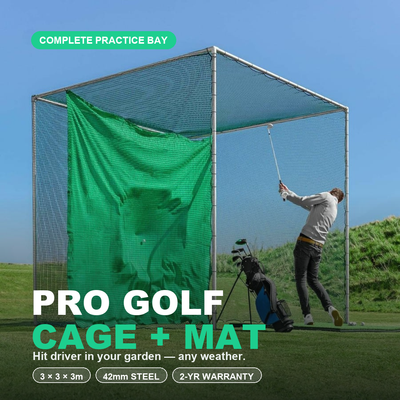
Around £1,300: the cage route done properly. The Pro Golf Cage & Hitting Mat Bundle (from £1,284.98) is the complete outdoor answer: 42mm galvanised steel frame, driver-rated double net, tour-density mat included, 2-year warranty, and it goes up in 60–90 minutes. It stands through British winters, which is precisely what cheap cages do not do. You can spread the cost at checkout from around £110 a month.
Around £421: the data route on a budget. The Garmin Approach R10 is a small radar launch monitor that gives you genuinely useful numbers for the price of a wedge-and-putter fitting. It is not a full simulator on its own — you still need somewhere to hit — but it is the single cheapest way to add measurement to your practice. Garmin’s own Approach R10 page covers the software side of what it can do.
Around £4,099: the full simulator. The FlightScope Mevo Gen 2 full package (from £4,099) is a complete sim in one order: launch monitor, enclosure, impact screen and mat. This is the sensible floor for “a proper simulator” — below it you are assembling compromises, above it you are buying accuracy and polish.
Let the building decide: gardens vs garages
Here is the shortcut I use on WhatsApp every week: your property usually answers the question for you.
Garden but no spare indoor room? Cage. Do not fight it. A simulator squeezed into a space that never quite worked gets used for a month; a cage twenty steps from the back door gets used constantly because the friction is zero. Check your garden genuinely fits a 3m cage plus swing room with our Will-It-Fit cage planner before you commit.
Garage or spare room with honest dimensions? Simulator becomes realistic — but measure properly, because ceiling height and room depth kill more sim plans than budget does. One detail that catches people: radar launch monitors like the Mevo and R10 sit behind you and need about 2.4m behind the ball to read the shot, which adds depth many rooms do not have. Our golf simulator room size guide walks through the measurements that actually matter before you spend a penny.
Both available? Then it comes down to what your golf is missing. If your striking is inconsistent, buy volume: cage. If your striking is fine but you have no idea how far anything goes or you stop playing entirely from November to March, buy information and weatherproofing: sim.
The upgrade path: cage now, launch monitor later
This is the option most people have not considered, and for many golfers it is the best answer of all. Buy the cage first. Practise all summer. Then, when winter arrives or the budget refills, add a launch monitor inside the cage — and your net suddenly produces numbers.
I tested exactly this in my own setup. I am 6'1" and hit from about 3m off the back baffle in my cage, and a radar unit needs roughly 2.4m behind the ball, so plan your cage position with that in mind if the upgrade path appeals — it is much easier to leave the space at the start than to rearrange a garden later. An R10 at £421 dropped behind the hitting mat turns a £1,284.98 cage into a data-driven practice station for well under half the price of a full indoor sim, and unlike the indoor route it never needed a spare room at all.
The reverse path is weaker. Buying a launch monitor first with nowhere consistent to hit means it lives in a drawer between range trips; a customer in Kent told me his previous monitor, bought elsewhere, had logged more miles in the car boot than shots at home. The cage creates the habit; the monitor upgrades it.
Frequently asked questions
Is a golf cage or a simulator better for actually improving?
For most club golfers, contact and strike are the biggest gap, and volume fixes them — which argues for the cage. If your striking is already solid, the sim’s feedback on distances and dispersion becomes the more valuable tool. The honest answer is that frequency beats equipment: whichever one you will genuinely use four times a week is the better one for your game.
Can I turn a golf cage into a simulator later?
Effectively, yes. A launch monitor in a cage gives you measured practice outdoors, and that is the upgrade path I recommend most. What a cage cannot become is a projection simulator — there is no screen and no dark room — so if playing simulated courses on a big screen is the dream, plan for an indoor space eventually.
How much does a home golf simulator cost in the UK?
A complete package with launch monitor, enclosure, impact screen and mat starts at about £4,099 with the Mevo Gen 2 bundle, and rises with launch monitor accuracy from there. Budgeting much below that for a full projection setup usually means a corner has been cut somewhere you will notice.
Do I need planning permission for a garden golf cage?
In almost all ordinary cases, no — a golf cage is a temporary garden structure rather than a building. There are edge cases (listed properties, conservation areas, very tall installations), and we have covered the detail in our cage planning permission guide.
If I had to give one blanket recommendation: golfers with gardens should buy the cage first and pencil in a launch monitor for the season after. It is the cheapest path to daily practice, it wastes nothing, and it leaves every upgrade open. The simulator-first route is right for golfers with a genuinely suitable indoor room and the budget to do it properly in one go — done that way, it is glorious.
Not sure which option fits your space or budget? Message Tom on WhatsApp for a free consultation — no obligation, real answers from someone who installs this kit weekly.

Free Home Golf Cage Setup Design Consultation
Not sure on size, base or mat? Chat directly with Tom, OpenGolfer’s founder — he practises from his own garden cage most days and has designed hundreds of home setups.
- Send a photo of your garden with rough measurements — get a tailored layout and spec for your space
- Personal replies from a real golfer, not a call centre
- Honest advice on what to buy — and what not to
Usually replies within the hour, 8am–8pm · prefer to talk? 02033 768500


Leave a comment